
Stainless Steel – Grades, Products & Specifications
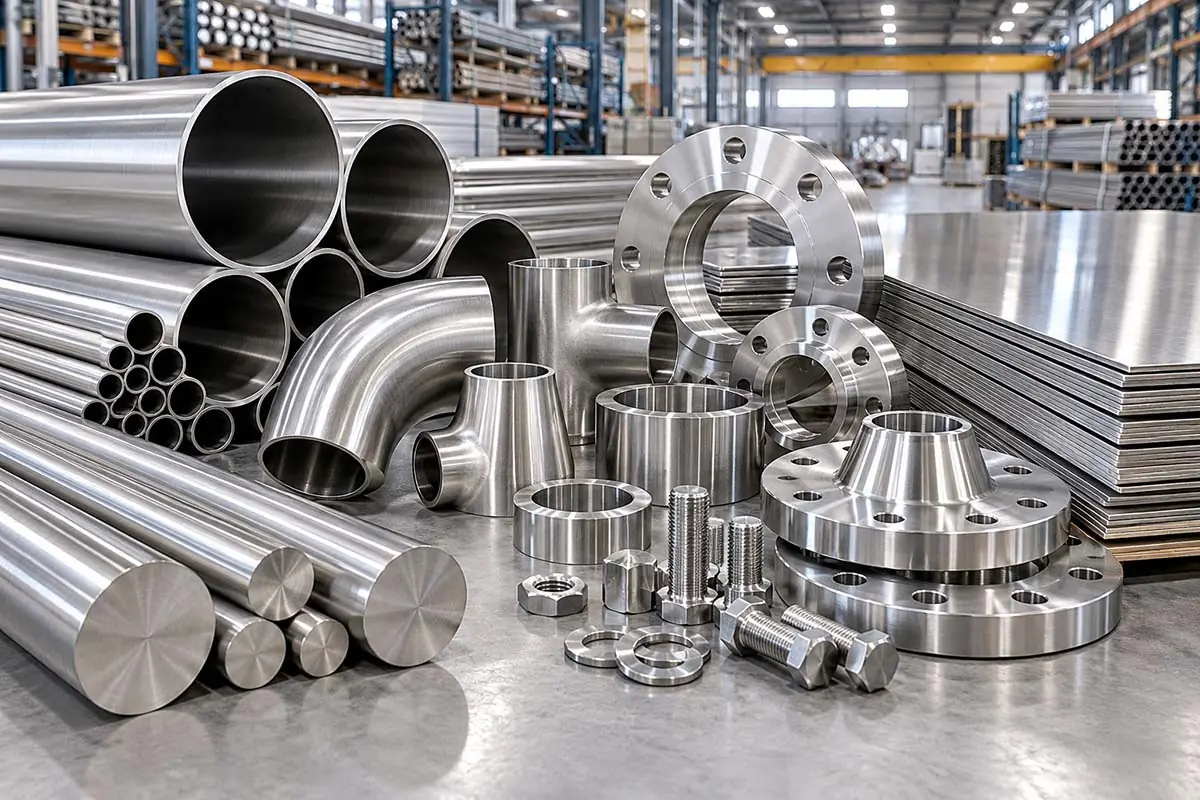
Stainless steel is iron alloyed with at least about 10.5% chromium, which forms a thin, self-healing oxide film on the surface and gives the metal its resistance to corrosion. Giriraj Impex supplies stainless steel in more than 20 grades – the 300 series austenitic grades such as 304 and 316, the 200 series, heat-resistant 310S, stabilised 321 and 347, super austenitic 904L, and the 400 series ferritic and martensitic grades – as pipes, tubes, plates, sheets, coils, bars, flanges, fittings and fasteners.
We manufacture stainless steel flanges, fittings, bars and fasteners, and stock and supply stainless steel pipes, tubes, plates, sheets and coils from approved mills.
Families of stainless steel
- Austenitic (300 and 200 series) – chromium-nickel grades, non-magnetic when annealed, easy to form and weld, with good toughness down to cryogenic temperatures. The 200 series replaces part of the nickel with manganese and nitrogen.
- Ferritic (400 series, e.g. 409, 430) – chromium grades with little or no nickel; magnetic, lower cost, used for exhausts, appliances and trims.
- Martensitic (e.g. 410, 420, 431) – can be hardened by heat treatment for strength and wear resistance; used for shafts, valve parts and pump components.
- Super austenitic (904L, 254 SMO) – higher nickel and molybdenum for strong acids and seawater; see SMO 254.
- Duplex – mixed austenite and ferrite structure with higher strength; covered on our duplex and super duplex steel page.
Stainless steel grades
| Grade | UNS | WNR / EN | Key feature |
|---|---|---|---|
| 304 / 304L | S30400 / S30403 | 1.4301 / 1.4307 | General-purpose 18Cr-8Ni grade; L for welding |
| 304H | S30409 | 1.4948 | Controlled higher carbon for high-temperature strength |
| 316 / 316L | S31600 / S31603 | 1.4401 / 1.4404 | Molybdenum for chloride pitting resistance |
| 316Ti | S31635 | 1.4571 | Titanium stabilised 316 |
| 317L | S31703 | 1.4438 | Higher molybdenum than 316L |
| 321 | S32100 | 1.4541 | Titanium stabilised for 425–815 °C service |
| 347 | S34700 | 1.4550 | Niobium (columbium) stabilised |
| 310S | S31008 | 1.4845 | 25Cr-20Ni for oxidation resistance at high temperature |
| 904L | N08904 | 1.4539 | Super austenitic for sulphuric and phosphoric acid |
| 202 | S20200 | 1.4373 | Chromium-manganese-nickel grade for light-duty uses |
| 410 | S41000 | 1.4006 | Hardenable martensitic grade |
| 430 | S43000 | 1.4016 | Ferritic grade for appliances and trim |
More designations are listed in the grade equivalent chart.
Stainless steel products we supply
| Product | Main standards |
|---|---|
| Seamless pipes and welded pipes | ASTM A312, A358, A778; ASME B36.19M |
| Tubes | ASTM A213, A269, A249, A270 |
| Plates, sheets and coils | ASTM A240, A480 |
| Round bars and wires | ASTM A276, A479, A580 |
| Flanges | ASTM A182; ASME B16.5, B16.47 |
| Pipe fittings | ASTM A403 (butt-weld), A182 (forged); ASME B16.9, B16.11 |
| Fasteners | ASTM A193 B8/B8M, A194 8/8M |
| Circles and rings | ASTM A240 (from plate), A182 (forged) |
| Angles, channels and flats | ASTM A276, A479 |
Popular grade pages: SS 304 pipes, SS 316 pipes, SS 304 sheets and plates, SS 316 sheets and plates, SS 310S plates, SS 304 round bars, SS 316 round bars, SS 316 flanges and SS 316 pipe fittings.
Corrosion and temperature guidance
For fresh water, atmospheric exposure, food and most mild chemicals, 304L is usually enough. Where chlorides are present – seawater, brine, coastal air, many process streams and cleaning chemicals – the molybdenum in 316L gives better resistance to pitting and crevice corrosion. For stronger chloride conditions, duplex steels, 904L or 254 SMO are considered. Austenitic grades can suffer chloride stress corrosion cracking above roughly 60 °C under tensile stress, which is one reason duplex grades are used in hot chloride service.
At high temperatures, the low-carbon grades can lose strength, so 304H, 321 or 347 are used in heaters and boiler parts, while 310S is chosen for oxidation resistance in furnace and heat-treatment equipment. The "L" grades (304L, 316L) have a carbon limit low enough to avoid sensitisation during welding, so they are the usual choice for welded construction. Your corrosion engineer and the design code set the final grade.
Handling and fabrication care
Stainless steel keeps its corrosion resistance only if its surface stays clean. Carbon steel particles from grinding discs, wire brushes, slings or storage racks can embed in the surface and rust, so stainless material should be stored and fabricated away from carbon steel and worked with dedicated tools. Heat tint from welding should be removed by pickling, and the surface passivated, before the equipment goes into service. Following these steps matters as much as choosing the right grade.
Documents and inspection
All stainless steel material is supplied with mill test certificates (MTC) showing heat number, chemical composition and mechanical properties. Material is often dual certified, for example 304/304L or 316/316L. Third-party inspection can be arranged on request, and items can be supplied to NACE MR0175 / ISO 15156 on request for sour service. See the other material families on our materials page.
Frequently Asked Questions
Its chromium content, at least about 10.5%, forms a thin chromium oxide film on the surface. If the surface is scratched, the film re-forms in the presence of oxygen. Nickel, molybdenum and nitrogen improve the resistance further in different environments.
316 contains about 2–3% molybdenum, which improves resistance to pitting and crevice corrosion in chloride environments such as seawater and many chemicals. 304 has no molybdenum and is used for general corrosion resistance.
L stands for low carbon. The lower carbon limit reduces chromium carbide formation in the heat-affected zone during welding, which protects the weld area from intergranular corrosion.
Austenitic grades such as 304 and 316 are essentially non-magnetic when annealed. Ferritic grades such as 430 and martensitic grades such as 410 are magnetic.
304H, 321 and 347 keep their strength at elevated temperatures and are used in heaters and boiler components, while 310S is chosen for its oxidation resistance in furnace parts and heat-treatment equipment.
Yes. We supply stainless steel pipes, tubes, plates, sheets, coils, round bars, wires, flanges, pipe fittings, fasteners, circles, rings and structural sections, with mill test certificates.
Standard 316L can pit and corrode at crevices in warm seawater. For seawater systems, duplex 2205, super duplex 2507, 254 SMO or nickel alloys are normally specified, depending on temperature, flow and design life.
Request a Quote
Tell us the product, grade, size, standard, quantity and delivery location, and our sales team will reply with a quotation.
254 SMO® is a trademark of Outokumpu.