
Titanium – Grades, Products & Specifications
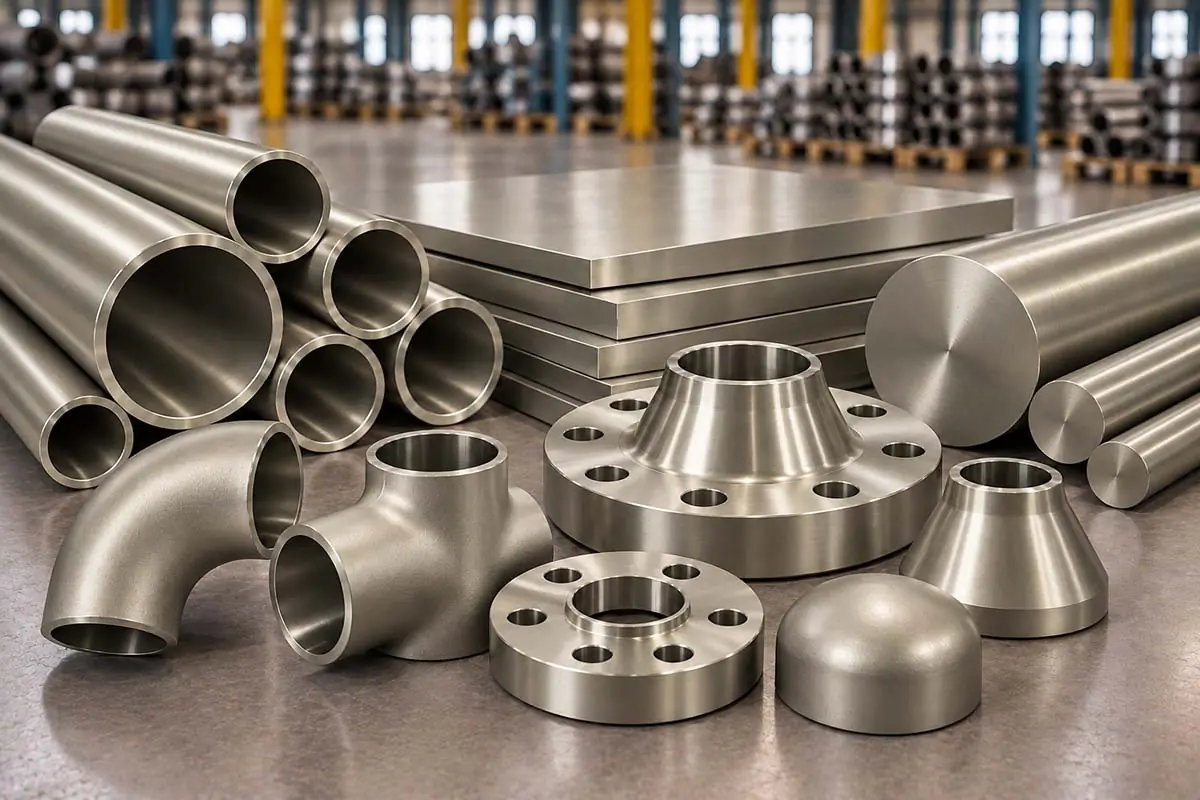
Titanium combines a density only about 60% that of steel with high strength and outstanding resistance to seawater, chlorides, oxidising acids and chlorine. Giriraj Impex supplies titanium Grades 1, 2, 5, 7 and 12 as pipes, tubes, plates, sheets, round bars, flanges, pipe fittings and fasteners, to the ASTM B specifications for each product form.
We manufacture titanium flanges, fittings, bars and fasteners, and stock and supply titanium pipes, tubes, plates and sheets from approved mills. The commercially pure Grade 2 is the most widely used for process equipment, and Grade 5 (Ti-6Al-4V) for high-strength parts.
Titanium grades
| Grade | UNS | WNR | Type and key feature |
|---|---|---|---|
| Grade 1 | R50250 | 3.7025 | Commercially pure, lowest strength and highest formability |
| Grade 2 | R50400 | 3.7035 | Commercially pure; the standard grade for corrosion-resistant equipment |
| Grade 5 (Ti-6Al-4V) | R56400 | 3.7165 | Alloy with 6% aluminium and 4% vanadium; high strength, heat treatable |
| Grade 7 | R52400 | 3.7235 | Grade 2 with palladium for resistance to reducing acids and crevice corrosion |
| Grade 12 | R53400 | 3.7105 | Alloy with molybdenum and nickel; better crevice corrosion resistance and strength than Grade 2 |
Chemical composition and mechanical properties
| Grade | UNS | N | C | H | Fe | O | Al | V | Other |
|---|---|---|---|---|---|---|---|---|---|
| Grade 1 | R50250 | 0.03 | 0.08 | 0.015 | 0.20 | 0.18 | – | – | – |
| Grade 2 | R50400 | 0.03 | 0.08 | 0.015 | 0.30 | 0.25 | – | – | – |
| Grade 5 | R56400 | 0.05 | 0.08 | 0.015 | 0.40 | 0.20 | 5.5–6.75 | 3.5–4.5 | – |
| Grade 7 | R52400 | 0.03 | 0.08 | 0.015 | 0.30 | 0.25 | – | – | Pd 0.12–0.25 |
| Grade 12 | R53400 | 0.03 | 0.08 | 0.015 | 0.30 | 0.25 | – | – | Mo 0.2–0.4, Ni 0.6–0.9 |
Hydrogen limits differ slightly between product forms; residual element limits as given in each ASTM specification.
| Grade | Tensile strength, MPa (ksi) | Yield strength 0.2%, MPa (ksi) | Elongation, % |
|---|---|---|---|
| Grade 1 | 240 (35) | 138 (20) | 24 |
| Grade 2 | 345 (50) | 275 (40) | 20 |
| Grade 5 | 895 (130) | 828 (120) | 10 |
| Grade 7 | 345 (50) | 275 (40) | 20 |
| Grade 12 | 483 (70) | 345 (50) | 18 |
Grades 1, 2 and 7 also have maximum yield strength limits. Values are typical of ASTM B265 and B348; check the specification for the product form.
In the commercially pure grades, strength rises with oxygen and iron content: Grade 1 is the softest and most formable, and Grade 2 offers a good balance of strength, formability and weldability. Grade 5 is about two and a half times as strong as Grade 2.
Titanium products and specifications
| Product | Specification |
|---|---|
| Seamless pipes | ASTM B861 |
| Welded pipes | ASTM B862 |
| Condenser and heat-exchanger tubes, seamless and welded | ASTM B338 |
| Plates, sheets and strip | ASTM B265 |
| Round bars and billets | ASTM B348 |
| Flanges and forgings | ASTM B381 |
| Pipe fittings | ASTM B363 |
| Fasteners | From bar to ASTM B348 |
Flanges are made to ASME B16.5 dimensions and butt-weld fittings to ASME B16.9. Grade 5 bars are also listed on our titanium Grade 5 round bars page.
Where titanium is used
Titanium forms a thin, tenacious oxide film that makes it practically immune to corrosion in seawater and in most chloride solutions at normal temperatures. This is why Grade 2 titanium tubes are used in seawater-cooled condensers and heat exchangers in power stations and refineries, in desalination plants, and in offshore platform cooling and firewater systems. In the chemical industry, titanium is used for chlorine and chlorine dioxide equipment, bleach plants in pulp and paper, chlor-alkali cells, nitric acid service and plate heat exchangers.
Grade 7 and Grade 12 are used where the commercially pure grades could suffer crevice corrosion – in hot brines and chloride solutions above about 70 °C, or in mildly reducing acids. Grade 5 is used for high-strength parts: fasteners, pump and valve components, shafts, offshore riser components, aerospace and motorsport parts, and medical implants in its extra-low-interstitial form.
Because titanium tubes resist erosion and corrosion in flowing seawater, they can be specified with thinner walls than copper-alloy tubes, which offsets part of the higher material cost and gives long service lives in condensers. Titanium's low density also reduces weight in offshore topsides and rotating equipment.
Limits of titanium
Titanium is not resistant to every medium. It is attacked by hydrofluoric acid and fluoride-containing solutions, by hot concentrated reducing acids such as hydrochloric and sulphuric acid, and by dry chlorine gas. In service with hydrogen, absorption of hydrogen can make it brittle, particularly when it is coupled to less noble metals. Its maximum service temperature in air is limited by oxidation and loss of ductility. These points should be reviewed for each application.
Working with titanium
Titanium is welded by TIG or plasma processes with full inert-gas shielding on both the weld pool and the hot surrounding metal, as contamination by air causes embrittlement – the weld colour, from bright silver to straw, is used as an acceptance check. Workshops must keep titanium separate from carbon steel and use dedicated tools. Titanium machines well with sharp tools, low speeds, heavy feeds and plenty of coolant, and Grades 1 and 2 form readily cold, with allowance for spring-back.
Documents and inspection
Titanium material is supplied with mill test certificates (MTC) showing heat number, chemical composition and mechanical properties. Third-party inspection is available on request. Other non-ferrous and nickel alloys are covered on our materials page.
Frequently Asked Questions
Grade 2 is commercially pure titanium with good corrosion resistance, formability and weldability. Grade 5 (Ti-6Al-4V) is an alloy with about 6% aluminium and 4% vanadium, with roughly two and a half times the strength of Grade 2.
ASTM B338 covers seamless and welded titanium tubes for condensers and heat exchangers. Seamless pipe is covered by ASTM B861 and welded pipe by ASTM B862.
Titanium forms a stable oxide film that makes it practically immune to corrosion in seawater at normal temperatures, including pitting, crevice corrosion and erosion.
Grade 7 is commercially pure titanium with 0.12–0.25% palladium, which greatly improves resistance to reducing acids and crevice corrosion in hot chloride solutions.
No. Titanium has a density of about 4.5 g/cm³, around 60% of steel's 7.85 g/cm³, so titanium parts weigh much less for the same volume.
ASTM B265 covers titanium and titanium alloy strip, sheet and plate in all the common grades.
Request a Quote
Tell us the product, grade, size, standard, quantity and delivery location, and our sales team will reply with a quotation.