
Angles – Stockist, Supplier & Exporter
Giriraj Impex is a stockist, supplier and exporter of angles – L-shaped structural sections – in stainless steel and mild steel. We stock and supply equal and unequal angles from approved mills: stainless steel angles hot rolled and annealed to ASTM A276 and A484 or laser fused to ASTM A1069, and mild steel angles to IS 2062 with dimensions to IS 808, as well as ASTM A36 and EN 10025 grades, with mill test certificates.
Angles are the most versatile structural section, used for frames, supports, brackets, bracing, platforms, cable trays, towers and general fabrication in industrial plants, buildings and infrastructure.
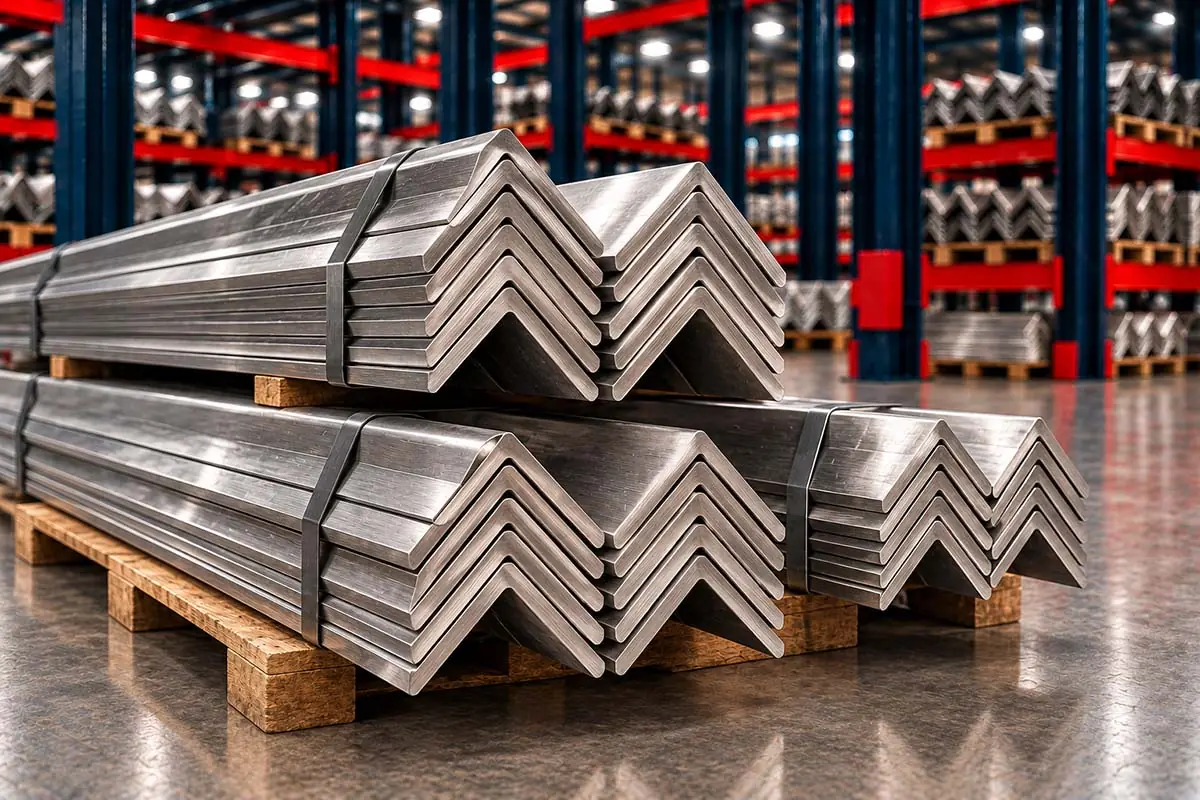
Angle materials
- Stainless steel angles – 304/304L, 316/316L and other grades, hot rolled, laser fused or bent from sheet, for corrosive, hygienic and architectural use.
- MS angles – mild steel to IS 2062 E250 and E350, ASTM A36 and EN 10025, for general structures and fabrication.
| Grade | Use |
|---|---|
| 304 / 304L | General structures, food plants, architecture, inland environments |
| 316 / 316L | Coastal, marine, chemical and pharmaceutical environments |
| 321, 310S | High-temperature supports and furnace structures |
| Duplex 2205 | High-strength, chloride-resistant structures on request |
Types of angles
Equal angles have two legs of the same length; unequal angles have one longer leg, which gives more stiffness in one direction. Angles are described by leg lengths and thickness – for example 50 × 50 × 6 mm or 2" × 2" × ¼". Stainless angles are made in three ways: hot rolled and annealed, with slightly rounded root and toes; laser fused from strip or plate, with sharp corners and close tolerances; and bent (cold formed) from sheet or plate, with an inside radius at the corner, used for lighter sections and special sizes.
Standards and sizes
| Item | Stainless steel | Mild steel |
|---|---|---|
| Material | ASTM A276, A484 (hot rolled); ASTM A1069 (laser fused); ASTM A240 (bent from sheet) | IS 2062; ASTM A36, A572; EN 10025-2 |
| Dimensions | ASTM A484 tolerances; mill standard sizes | IS 808 (equal and unequal angles); ASTM A6; EN 10056 |
| Sizes | Standard mill sizes in metric and imperial leg lengths and thicknesses; other sizes on enquiry | |
| Length | Standard mill lengths, typically 6 m, or cut to length | |
| Finish | Annealed and pickled; polished on request | Black; galvanised or painted on request |
Mild steel grades
| Standard | Grades | Minimum yield strength (typical, thinner sections) |
|---|---|---|
| IS 2062 | E250 (A, BR, B0, C), E350, E410 | 250, 350, 410 MPa |
| ASTM A36 | – | 250 MPa |
| ASTM A572 | Grade 50 | 345 MPa |
| EN 10025-2 | S275JR, S355JR, S355J2 | 275, 355 MPa |
Yield strength reduces for thicker sections as given in each standard. The sub-grade letter in IS 2062 and EN 10025 indicates impact testing (for example BR or J2), which matters for structures in cold climates or under dynamic loads.
Choosing stainless or mild steel angles
Mild steel angles are the economical choice for most structures and are painted or galvanised for corrosion protection. Stainless steel angles cost more but need no coating and resist corrosion for the life of the structure, so they are chosen for food and pharmaceutical plants, chemical plants, coastal and offshore structures, water treatment, and architectural work where appearance matters. When stainless and mild steel parts are joined, insulating washers or coatings help prevent galvanic corrosion of the mild steel.
Fabrication
Angles are cut by saw or shear, drilled or punched for bolted connections, and welded. Mild steel angles weld easily with standard consumables. Stainless angles are welded with matching filler – 308L for 304, 316L for 316 – and welds are pickled and passivated to restore corrosion resistance. Fabricators should keep stainless and carbon steel work separate and use dedicated tools to prevent iron contamination and rust spots.
Applications
Angles are used for structural frames, equipment supports and skids, pipe supports and brackets, platforms, walkways and handrails, cable trays and ladders, transmission and telecom towers, storage racks, conveyor frames, door and window frames, and general fabrication. Related sections are on our channels, beams and flats pages, and all products on the products page.
Weight, handling and storage
Angles are sold by weight or by length. Theoretical weight per metre is calculated from the cross-section and the density – 7.85 g/cm³ for mild steel and about 7.9–8.0 g/cm³ for stainless steel – and can be checked with our weight calculator. Actual weights vary with rolling tolerances, so invoiced weights are based on the weighed or calculated figures agreed with the order. Bundles are sized for safe handling by crane or forklift.
Store structural sections off the ground on timber bearers, under cover where possible, and keep stainless steel apart from mild steel to avoid contamination and rust staining. Galvanised sections should be stacked with spacers so that rainwater can drain, preventing white rust.
Galvanising and coatings
Mild steel angles for outdoor structures, towers and cable supports are often hot-dip galvanised to IS 4759 or ASTM A123, giving a zinc coating that protects the steel for many years in most atmospheres. Where galvanising is not practical, angles are shot blasted and painted with a primer and finish coats suited to the environment. Stainless steel angles need no coating; a pickled and passivated surface, or a brushed or polished finish for architectural work, keeps its appearance for longest.
Quality checks
Before dispatch, angles are checked against the order for grade, size, length and quantity, and the heat numbers on the material are matched to the mill test certificates. Straightness and surface condition are inspected visually, and dimensions are checked against the tolerances of the product standard. For project orders, material can be marked with item or tag numbers, colour coded by grade, and packed by delivery area to make site receiving easier. Third-party inspection by the buyer's nominated agency can be arranged at our premises.
Documents and ordering
All structural sections are supplied with mill test certificates (MTC) showing heat number, chemistry and mechanical properties, and third-party inspection is available on request. Sections are bundled and tagged with grade, size and heat number; stainless sections are packed with protection to keep them separate from carbon steel and free of surface contamination.
Please give the material and grade, equal or unequal, leg sizes and thickness, length, finish, quantity and any inspection requirement.
Why Giriraj Impex
- Wide range of materials, grades, sizes and international specifications, supplied since 2008
- Mill test certificates (MTC) supplied with material; third-party inspection on request
- Inspection and quality verification before dispatch
- ISO 9001:2015, ISO 14001:2015 and ISO 45001:2018 certified
- Competitive pricing and timely delivery
- Supply across India and for export, from our Mumbai headquarters
Frequently Asked Questions
Equal angles have two legs of the same length; unequal angles have one longer leg for more stiffness in one direction.
IS 808 gives the dimensions of hot-rolled equal and unequal angles, and IS 2062 covers the steel grade.
A laser-fused angle is made by welding strips together with a laser, giving sharp corners and close tolerances, to ASTM A1069.
In food, pharmaceutical, chemical, coastal and architectural applications where corrosion resistance and appearance matter.
Yes. Mild steel angles can be supplied hot-dip galvanised or painted on request.
Yes. Angles are supplied in standard mill lengths or cut to the lengths required.
Request a Quote for Angles – Stockist, Supplier & Exporter
Tell us the product, grade, size, standard, quantity and delivery location, and our sales team will reply with a quotation.