
Duplex & Super Duplex Steel – Grades, Products & Specifications
Duplex steel is a stainless steel with a two-phase microstructure of roughly equal parts austenite and ferrite. The combination gives about twice the yield strength of standard austenitic grades such as 316L, and much better resistance to chloride stress corrosion cracking, pitting and crevice corrosion. Super duplex grades raise the chromium, molybdenum and nitrogen further for seawater and other aggressive chloride service.
Giriraj Impex supplies duplex 2205 (UNS S31803 / S32205), super duplex 2507 (UNS S32750) and Zeron 100 (UNS S32760). We manufacture duplex flanges, fittings, bars and fasteners, and stock and supply duplex pipes, tubes and plates from approved mills.
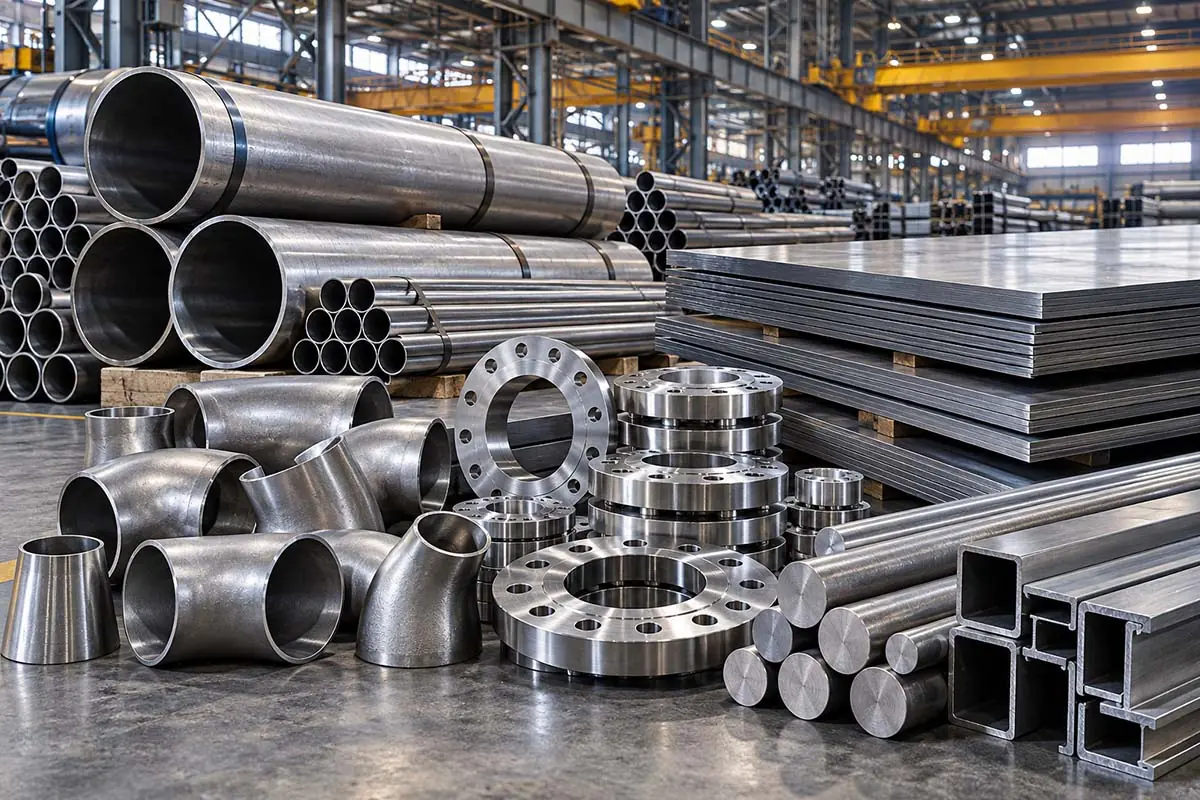
Duplex and super duplex grades
| Grade | UNS | WNR / EN | Typical use |
|---|---|---|---|
| Duplex 2205 | S31803 / S32205 | 1.4462 | The most widely used duplex grade; process, offshore and desalination |
| Super duplex 2507 | S32750 | 1.4410 | Seawater systems, offshore and high-chloride process lines |
| Zeron 100 | S32760 | 1.4501 | Super duplex with copper and tungsten additions |
| Lean duplex 2304 | S32304 | 1.4362 | Lower-alloy duplex for less severe duties |
UNS S32205 is a tighter-composition version of S31803 with higher minimum nitrogen; material is commonly dual certified to both.
PREN – comparing pitting resistance
The pitting resistance equivalent number (PREN) is a quick way to rank stainless steels for chloride pitting. It is calculated from the composition as PREN = %Cr + 3.3 × %Mo + 16 × %N (some specifications add a tungsten term for grades such as S32760). Higher numbers indicate better resistance. Super duplex grades are normally specified with a minimum PREN of 40, which is why they are chosen for seawater. Many oil and gas specifications state a minimum PREN for duplex and super duplex material, and it can be calculated from the actual composition on the mill test certificate.
Duplex products we supply
| Product | Duplex 2205 | Super duplex |
|---|---|---|
| Pipes and tubes | Duplex pipes and tubes – ASTM A790, A789, A928 | Super duplex pipes and tubes – ASTM A790, A789 |
| Plates and sheets | Duplex sheets and plates – ASTM A240 | Super duplex sheets and plates – ASTM A240 |
| Round bars | Duplex round bars – ASTM A276, A479 | Super duplex round bars – ASTM A276, A479 |
| Flanges | Duplex flanges – ASTM A182 F51, F60 | Super duplex flanges – ASTM A182 F53, F55 |
| Pipe fittings | Duplex pipe fittings – ASTM A815, A182 | Super duplex pipe fittings – ASTM A815, A182 |
| Fasteners | Duplex and super duplex fasteners | |
When to choose duplex
Duplex steels are chosen where 316L is at risk of chloride stress corrosion cracking or pitting – hot chloride process streams, seawater cooling, desalination, offshore topsides, pulp and paper bleach plants and chemical tankers – and where the higher strength allows thinner walls and lighter structures. Super duplex is the usual choice for seawater piping, firewater systems and subsea components.
Duplex steels need care in fabrication. Welding procedures control heat input and cooling rate to keep the ferrite–austenite balance, and long exposure in roughly the 300–1000 °C range can form brittle phases. For this reason duplex grades are normally limited to service below about 250–300 °C, and material is often tested for ferrite content and impact toughness, and to ASTM A923 for detrimental intermetallic phases, when specified. Your design code sets the limits that apply.
Fittings, flanges and pipes in duplex should be ordered with the same requirements for ferrite content and testing, so the whole system meets one specification.
Duplex compared with 316L
The main reasons buyers move from 316L to duplex are strength and chloride resistance. Duplex 2205 plate to ASTM A240 (UNS S32205) has a minimum yield strength of 450 MPa, compared with 170 MPa for 316L, so pressure-containing walls and structural members can be thinner and lighter. Its higher chromium, molybdenum and nitrogen give a PREN in the mid-30s against roughly 24–26 for 316L, and its ferrite content makes it far less prone to chloride stress corrosion cracking. Super duplex pushes the PREN above 40 for seawater. The trade-offs are a temperature ceiling, more demanding welding and the need to verify phase balance, which is why duplex is selected and fabricated to a written specification.
Documents and inspection
Duplex and super duplex material is supplied with mill test certificates (MTC) giving the composition, from which the PREN can be calculated, and mechanical properties. Additional tests such as ferrite count, impact tests or ASTM G48 corrosion tests can be specified with the order, third-party inspection is available on request, and material can be supplied to NACE MR0175 / ISO 15156 on request. Compare other families on our materials page.
Frequently Asked Questions
Duplex stainless steel has a microstructure of roughly half austenite and half ferrite. This gives about twice the yield strength of 316L and better resistance to chloride stress corrosion cracking, pitting and crevice corrosion.
Both are duplex 2205. UNS S32205 has a tighter composition range, with higher minimum chromium, molybdenum and nitrogen, giving more consistent corrosion resistance. Material is often dual certified to S31803 and S32205.
Super duplex grades such as UNS S32750 (2507) and S32760 contain more chromium, molybdenum and nitrogen than 2205, giving a PREN of 40 or more. They are used for seawater and other severe chloride service.
The common formula is PREN = %Cr + 3.3 × %Mo + 16 × %N, using the actual composition. Some specifications include tungsten for grades such as S32760. A higher PREN indicates better resistance to chloride pitting.
Duplex steels are normally limited to service below about 250–300 °C, because long exposure at higher temperatures can form brittle phases. The design code gives the exact limit. Austenitic or nickel alloys are used for higher temperatures.
Yes. Because about half of its structure is ferrite, duplex stainless steel is magnetic, unlike annealed 304 or 316. This is normal and does not indicate a material defect.
Request a Quote
Tell us the product, grade, size, standard, quantity and delivery location, and our sales team will reply with a quotation.
Zeron® 100 is a trademark of Rolled Alloys.