
Circles – Manufacturer, Stockist, Supplier & Exporter
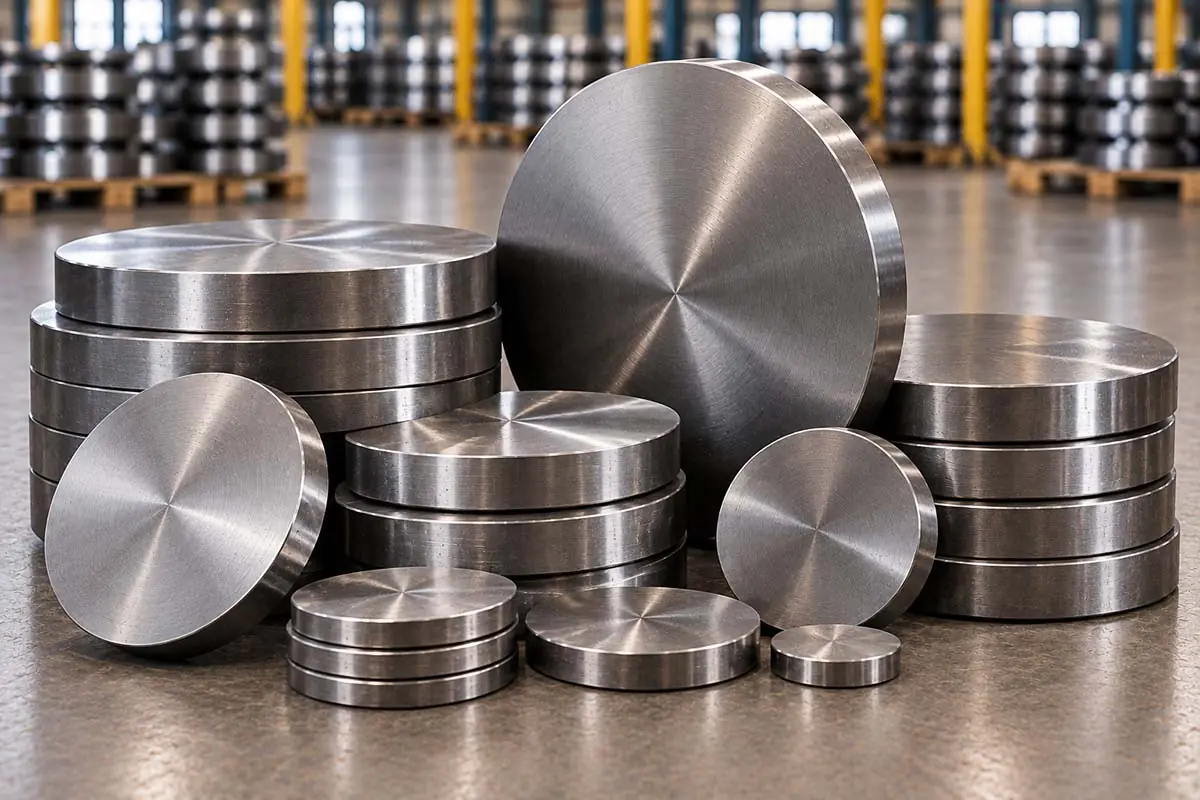
Giriraj Impex is a manufacturer, stockist, supplier and exporter of circles – flat round discs cut from sheet and plate – in stainless steel, carbon steel, alloy steel, duplex and super duplex steel and nickel alloys. We manufacture circles to the diameter and thickness each customer needs, cut from mill-certified sheet and plate to ASTM A240, ASTM A516, ASTM A387 and the ASTM B specifications for nickel alloys, and supply them with mill test certificates.
Circles are the starting blank for a wide range of products: flange and blind flange blanks, tube sheets and baffles for heat exchangers, dished ends, pressed and spun parts, utensils and cookware, valve discs, gaskets and spacers, and machined components.
Circle materials and grades
| Material | Typical grades | Source standard |
|---|---|---|
| Stainless steel | 304, 304L, 316, 316L, 321, 310S, 410, 430 | ASTM A240 sheet and plate |
| Duplex and super duplex steel | UNS S31803, S32205, S32750, S32760 | ASTM A240 |
| Carbon steel | A516 Grade 60 and 70, A36, IS 2062 | ASTM A516, A36, IS 2062 plate |
| Alloy steel | A387 Grade 11 and 22 | ASTM A387 plate |
| Nickel alloys | Inconel 600 and 625, Incoloy 800 and 825, Monel 400, Hastelloy C276 | ASTM B168, B443, B409, B424, B127, B575 |
| Titanium | Grades 1 and 2 | ASTM B265 |
Stainless steel circles are the most widely used. Circles in other materials are cut to order from plate of the required specification, so please give the material, grade and specification with the enquiry.
How circles are made
Circles are cut from sheet or plate by one of several methods, chosen according to the thickness, diameter, tolerance and quantity:
- Press blanking – for thin sheet in large quantities, such as utensil circles. A die punches the circle in one stroke, giving a clean edge and consistent diameter.
- Circle shearing – for thin and medium sheet, where a rotary shear cuts the circle from a square blank.
- Plasma cutting – for medium and thick plate in carbon, stainless and alloy steel, giving a fast cut with a narrow heat-affected zone.
- Oxy-fuel (gas) cutting – for thick carbon steel plate.
- Water-jet and laser cutting – where a close tolerance or no heat-affected zone is required, and for nickel alloys and titanium.
After cutting, circles can be supplied as cut, with edges ground or deburred, or machined on the diameter and faces to drawing. Each circle is marked with the grade and heat number so it can be traced to the mill test certificate of the parent plate or sheet.
Sizes and tolerances
| Item | Details |
|---|---|
| Diameter | Cut to the diameter required, within the width of the available sheet or plate |
| Thickness | From thin sheet gauges to heavy plate, as the source sheet or plate allows |
| Diameter tolerance | Depends on the cutting method; closer tolerances by machining |
| Surface | Mill finish of the parent material – 2B, BA, No. 4 for stainless sheet; hot rolled for plate |
| Edge | As cut, ground, deburred or machined |
| Centre hole | On request, for rings and flange blanks |
| Documents | Mill test certificate (MTC) of the parent material; third-party inspection on request |
Please give the outside diameter, thickness and tolerance on each, and any inside diameter or centre hole, edge finish and surface finish required.
Circles for flange blanks and heat exchangers
Plate circles are widely used as blanks for blind flanges, slip-on and plate flanges, spectacle blinds and spacers, which are then machined to ASME B16.5, B16.48 or the customer's drawing. For pressure-retaining parts, the plate must be of a grade and specification permitted by the design code – for example ASTM A516 Grade 70 or A240 316L – and the circle keeps the heat number of the plate so that the mill test certificate follows the part.
For heat exchangers, circles become tube sheets and baffles. Tube sheets are usually cut from thick plate with a machining allowance and ordered with ultrasonic testing of the parent plate, while baffles are cut from thinner plate or sheet. In both cases the grade is matched to the shell and tube materials.
Circles for utensils, spinning and pressing
Thin stainless steel circles in 304, 410 and 430 are blanked in large numbers for cookware, pressure cookers, plates, bowls and sinks, and for spun and pressed parts such as lids, covers and reflectors. For deep-drawn products, the grade and temper must suit the depth of draw: annealed 304 with a deep-drawing quality is used for deep shapes, while ferritic 430 and 410 are used for shallower parts and where magnetic properties are needed, such as induction-compatible cookware bases. The surface finish – usually 2B or BA – should be specified, and polished circles are supplied with PVC film on request.
Choosing the material
304 and 304L are the general choice for stainless circles; 316 and 316L where chlorides, acids or marine exposure are expected; and 321 and 310S for elevated-temperature parts. Carbon steel A516 circles are used for pressure parts, and IS 2062 or A36 for structural and general use. Alloy steel A387 is selected for high-temperature pressure parts in refineries and power plants. Duplex, super duplex and nickel alloy circles are used for tube sheets, flange blanks and components in corrosive and seawater service. For guidance on each material, see our plates and sheets pages, which list the full grade range from which circles are cut.
Quality, inspection and packing
Circles are checked for diameter, thickness, flatness and edge condition before dispatch, and each is marked with the grade and heat number of the parent material. Mill test certificates are supplied with every order, and third-party inspection by the customer's nominated agency can be arranged on request. Thin circles are packed in stacks with interleaving and plastic wrapping on pallets, and plate circles are strapped on skids or packed in wooden crates for export.
Related products
Circles with a centre hole are the starting point for flat rings and washers; forged and rolled rings for flanges and bearing races are on our rings page. Circles are cut from the products on our plates and sheets pages, and every product form is listed on the products page.
Why Giriraj Impex
- Wide range of materials, grades, sizes and international specifications, supplied since 2008
- Mill test certificates (MTC) supplied with material; third-party inspection on request
- Inspection and quality verification before dispatch
- ISO 9001:2015, ISO 14001:2015 and ISO 45001:2018 certified
- Competitive pricing and timely delivery
- Supply across India and for export, from our Mumbai headquarters
Frequently Asked Questions
A metal circle is a flat round disc cut from sheet or plate. It is used as a blank for flanges, tube sheets, dished ends, pressed and spun parts, utensils and machined components.
Thin circles are press blanked or circle sheared; thicker circles are plasma, oxy-fuel, water-jet or laser cut. The method depends on thickness, diameter, tolerance and quantity.
Stainless steel 304 is used for most cookware and deep-drawn utensils, with ferritic 430 and martensitic 410 for shallower parts and induction-compatible bases.
Yes. Circles can be supplied with a centre hole or inside diameter cut to order, for rings, washers and flange blanks.
Yes. Each circle is marked with the heat number of the parent sheet or plate, and the mill test certificate is supplied with the order.
Yes. Circles are cut from heavy plate by plasma or oxy-fuel cutting and can be machined to the final diameter and thickness.
Request a Quote for Circles – Manufacturer, Stockist, Supplier & Exporter
Tell us the product, grade, size, standard, quantity and delivery location, and our sales team will reply with a quotation.
Incoloy® and Monel® are trademarks of Special Metals Corporation; Hastelloy® of Haynes International.