
Stainless Steel Circles
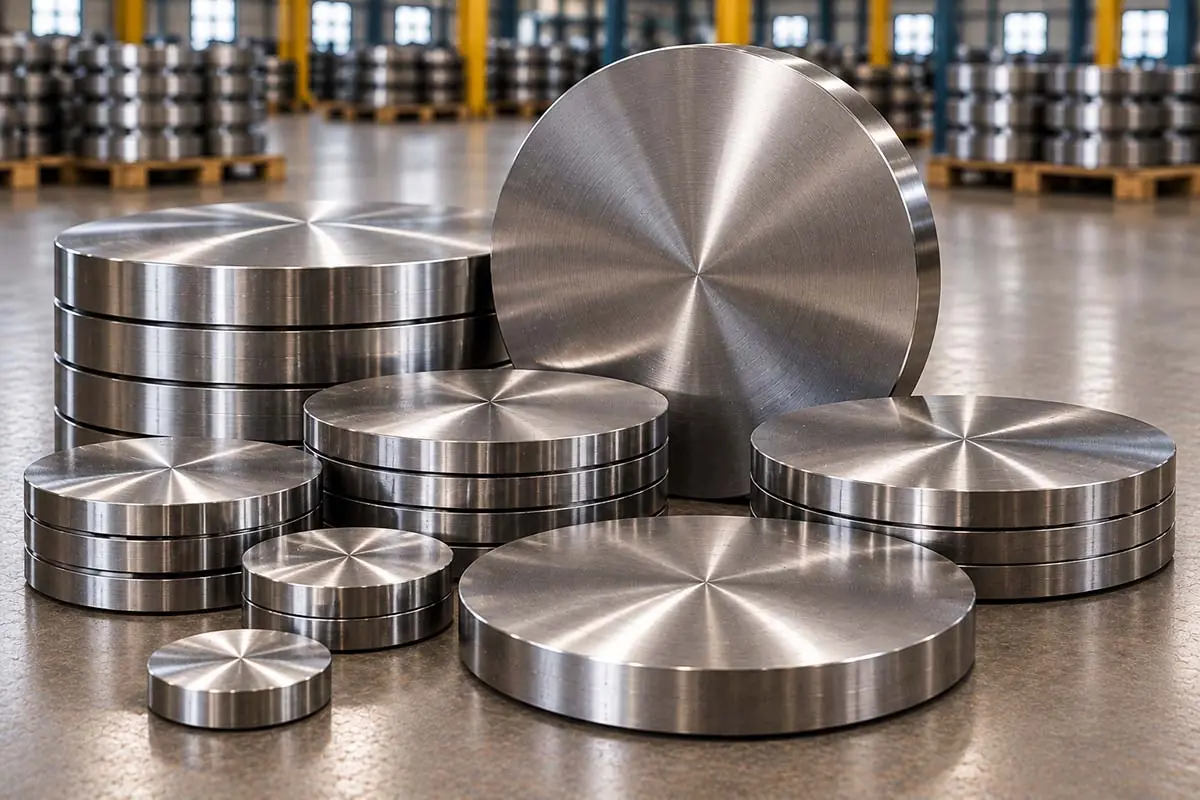
Giriraj Impex is a manufacturer, stockist, supplier and exporter of stainless steel circles in 304, 304L, 316, 316L, 321, 310S, 410 and 430. We manufacture stainless steel circles by press blanking, circle shearing, plasma and water-jet cutting from ASTM A240 / ASME SA240 sheet and plate, to the diameter and thickness each customer needs, with mill test certificates.
Stainless steel circles are used as blanks for cookware and utensils, pressure cooker bodies and lids, sinks and bowls, spun and pressed parts, blind flanges and flange blanks, heat-exchanger tube sheets and baffles, valve discs, spacers and machined components.
Specifications
| Item | Details |
|---|---|
| Source material | ASTM A240 / ASME SA240 sheet and plate; ASTM A480 general requirements |
| Grades | 304, 304L, 316, 316L, 321, 310S, 410, 430; duplex and other grades on request |
| Diameter | Cut to the diameter required, within the width of the available sheet or plate |
| Thickness | Thin sheet gauges for utensils up to heavy plate for flange blanks and tube sheets |
| Cutting method | Press blanking, circle shearing, plasma, water-jet or laser, depending on thickness and tolerance |
| Finish | 2B, BA, No. 4 (sheet); hot rolled, annealed and pickled (plate) |
| Edge | As cut, deburred, ground or machined |
| Protection | PVC film on request for BA and polished circles |
| Documents | Mill test certificate (MTC) of the parent material; third-party inspection on request |
Chemical composition and mechanical properties – 304 and 316
| Grade | UNS | C | Mn | P | S | Si | Cr | Ni | Mo | N |
|---|---|---|---|---|---|---|---|---|---|---|
| 304 | S30400 | 0.07 | 2.00 | 0.045 | 0.030 | 0.75 | 17.5–19.5 | 8.0–10.5 | – | 0.10 |
| 304L | S30403 | 0.030 | 2.00 | 0.045 | 0.030 | 0.75 | 17.5–19.5 | 8.0–12.0 | – | 0.10 |
| 316 | S31600 | 0.08 | 2.00 | 0.045 | 0.030 | 0.75 | 16.0–18.0 | 10.0–14.0 | 2.00–3.00 | 0.10 |
| 316L | S31603 | 0.030 | 2.00 | 0.045 | 0.030 | 0.75 | 16.0–18.0 | 10.0–14.0 | 2.00–3.00 | 0.10 |
Other elements and footnotes as given in the standard.
| Grade | Tensile strength min, MPa (ksi) | Yield strength min, MPa (ksi) | Elongation in 50 mm min, % | Hardness max, HBW / HRB |
|---|---|---|---|---|
| 304 | 515 (75) | 205 (30) | 40 | 201 / 92 |
| 304L | 485 (70) | 170 (25) | 40 | 201 / 92 |
| 316 | 515 (75) | 205 (30) | 40 | 217 / 95 |
| 316L | 485 (70) | 170 (25) | 40 | 217 / 95 |
Values for annealed material.
Circles keep the properties of the parent sheet or plate, which are reported on the mill test certificate. Background and equivalents are on the stainless steel page.
Utensil circles
Thin stainless steel circles for utensils are press blanked from cold-rolled sheet in large quantities, then deep drawn, spun or pressed into cookware, pressure cookers, plates, bowls, tiffin boxes, lids and sinks. The grade and temper must suit the depth of draw. Annealed 304 with deep-drawing quality is used for deep and complex shapes; 430 is used for shallower utensils and for the magnetic bases needed for induction cooking; and 410 for parts that need hardness. 2B is the usual finish for utensils that will be polished after forming, and BA where a bright surface is wanted without further polishing.
For deep drawing, please tell us the depth and shape of the product so that the grade, thickness and finish can be matched to the process and the risk of splitting or earing is kept low.
Flange blanks and heat-exchanger circles
Plate circles in 304L, 316L, 321 and other grades are cut as blanks for blind flanges, plate flanges, spectacle blinds and spacers, which are then machined to ASME B16.5, B16.48 or the customer's drawing. For heat exchangers, plate circles become tube sheets and baffles; tube-sheet circles are usually ordered with a machining allowance and ultrasonic testing of the parent plate. Each circle carries the heat number of the plate so that its mill test certificate follows the finished part.
Where a pressure part must be forged rather than cut from plate, see our stainless steel rings and stainless steel flanges.
Cutting methods and tolerances
The cutting method sets the edge quality and diameter tolerance. Press-blanked circles have a clean sheared edge and consistent diameter, suited to high volumes of thin sheet. Circle-sheared circles are cut from square blanks on a rotary shear for thin and medium sheet. Plasma cutting is used for medium and thick plate, leaving a small heat-affected edge that can be ground or machined away. Water-jet and laser cutting are used where a close tolerance or no heat-affected zone is required. For the closest tolerances, circles are machined on the diameter and faces after cutting.
Ordering stainless steel circles
Please give the grade, outside diameter, thickness, tolerance on each, any inside diameter or centre hole, finish, edge condition, PVC film, quantity and the end use. Thin circles are packed in stacks with interleaving and plastic wrapping on pallets, and plate circles are strapped on skids or packed in wooden crates for export.
Applications and related products
Stainless steel circles are used for cookware and kitchen utensils, pressure cookers, sinks, lighting reflectors, spun covers and lids, flange blanks, heat-exchanger tube sheets and baffles, valve discs, pump parts and machined components. All circle materials are on the circles page. Circles are cut from stainless steel sheets and stainless steel plates, and coil is on stainless steel coils. In stainless steel we also supply seamless pipes, welded pipes, tubes, pipe fittings, round bars, wires, fasteners, angles, channels and flats.
Frequently Asked Questions
304 is used for most deep-drawn cookware and utensils. 430 is used for shallower utensils and induction-compatible bases, and 410 for parts that need hardness.
Thin circles are press blanked or circle sheared from sheet; thicker circles are plasma, water-jet or laser cut from plate, and can be machined to final size.
Circles are cut from sheet and plate to ASTM A240 (ASME SA240), and keep the composition and properties of the parent material shown on its mill test certificate.
Yes. BA and polished circles can be supplied with PVC protective film to protect the surface during handling and forming.
Yes. Plate circles are cut as blanks for blind flanges, spectacle blinds and spacers, with the heat number of the parent plate for traceability.
304 is austenitic, non-magnetic when annealed, with better corrosion resistance and formability. 430 is ferritic, magnetic and lower in cost, and is used for shallower parts and induction bases.
Request a Quote for Stainless Steel Circles
Tell us the product, grade, size, standard, quantity and delivery location, and our sales team will reply with a quotation.