
Alloy Steel – Grades, Products & Specifications
Alloy steel in piping usually means chromium-molybdenum (chrome-moly) steel. Adding chromium and molybdenum to carbon steel raises its strength at high temperature, its creep resistance and its resistance to oxidation, hydrogen attack and sulphidation, which is why alloy steel is used for high-temperature steam, superheater, reheater and refinery furnace lines. Giriraj Impex supplies alloy steel in grades P5, P9, P11, P22 and P91 and their equivalents for every product form.
We manufacture alloy steel flanges, fittings, bars and fasteners, and stock and supply alloy steel pipes, tubes and plates from approved mills.
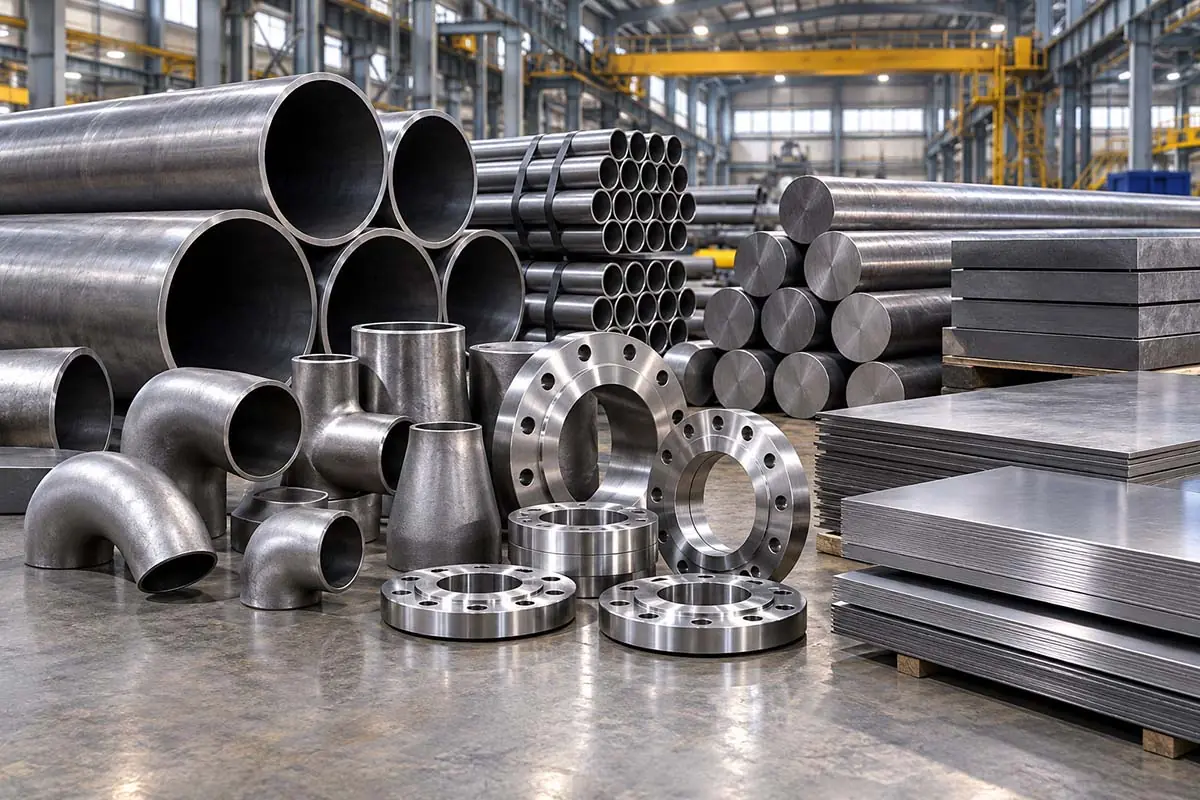
Alloy steel grades
| Nominal composition | Pipe (A335) | Tube (A213) | Forging (A182) | Fitting (A234) | Plate (A387) |
|---|---|---|---|---|---|
| 1¼Cr-½Mo | P11 | T11 | F11 | WP11 | Gr 11 |
| 2¼Cr-1Mo | P22 | T22 | F22 | WP22 | Gr 22 |
| 5Cr-½Mo | P5 | T5 | F5 | WP5 | Gr 5 |
| 9Cr-1Mo | P9 | T9 | F9 | WP9 | Gr 9 |
| 9Cr-1Mo-V (modified) | P91 | T91 | F91 | WP91 | Gr 91 |
Grade pages: ASTM A335 P91 pipes and ASTM A335 P11 and P22 pipes.
Alloy steel products we supply
- Alloy steel pipes and tubes – seamless pipe to ASTM A335 and boiler, superheater and heat-exchanger tubes to ASTM A213.
- Alloy steel flanges – ASTM A182 F5, F9, F11, F22 and F91 to ASME B16.5 and B16.47.
- Alloy steel pipe fittings – butt-weld fittings to ASTM A234 WP grades and forged fittings to ASTM A182.
- Alloy steel plates – ASTM A387 in Class 1 and Class 2 strength levels.
- Alloy steel round bars – 4130, 4140, EN19, EN24 and A182 F-grades.
- Alloy steel fasteners – ASTM A193 B7, B7M and B16 studs with A194 2H and 2HM nuts.
Choosing a chrome-moly grade
As the chromium and molybdenum content rises, so do the allowable stresses at temperature and the resistance to oxidation and hydrogen attack. P11 and P22 are used widely for main steam and hot reheat lines and for refinery piping. P5 and P9 suit higher temperatures and sulphur-bearing hydrocarbons in refinery heaters. P91, a modified 9Cr-1Mo steel with vanadium and niobium, has much higher creep strength, so it allows thinner walls in high-temperature, high-pressure steam lines of modern power plants. The design code – for example ASME B31.1 for power piping or B31.3 for process piping – gives the allowable stresses and temperature limits for each grade.
When an older plant is upgraded, P91 is sometimes welded to existing P22 or P11 lines; these dissimilar joints need a qualified procedure and filler metal chosen for the combination.
Welding and heat treatment
Chrome-moly steels need controlled welding: preheat, interpass temperature control and post-weld heat treatment (PWHT) are normally required, and the requirements become stricter from P11 to P91. P91 in particular depends on correct normalising and tempering at the mill and on correct PWHT after welding to keep its creep strength, so material is checked for hardness and, where specified, by positive material identification. Pipes, fittings and flanges in the same grade should be ordered together so that their heat treatment and certification match.
Hardness testing of welds and base metal after PWHT is a common acceptance check for chrome-moly piping, because both under-tempered and over-tempered material can fall outside the specified hardness range.
Alloy steel in refineries and power plants
In refineries, chrome-moly piping and tubes are used where hot hydrocarbons, hydrogen and sulphur compounds would attack carbon steel – heater and furnace tubes, hydrotreater and reformer lines, and hot transfer lines. The grade rises with temperature and sulphur content, from P11 and P22 to P5 and P9. In power plants, P11 and P22 have long been used for steam lines and headers, and P91 has become the standard for main steam and hot reheat lines in high-efficiency units.
Ordering alloy steel
Please give the specification and grade (for example A335 P91, A182 F22, A234 WP11), size and schedule or class, length, quantity, any hardness limit, and whether IBR certification or third-party inspection is required.
Documents and inspection
Alloy steel material is supplied with mill test certificates (MTC) showing heat number, chemical composition, heat treatment and mechanical properties, and hardness where required. Third-party inspection is available on request, and boiler tubes can be supplied with IBR certification where the order requires it. See all materials.
Frequently Asked Questions
Chrome-moly steel is low-alloy steel containing chromium and molybdenum, such as 1¼Cr-½Mo (P11) or 2¼Cr-1Mo (P22). The alloying improves strength at high temperature, creep resistance and oxidation resistance compared with carbon steel.
P11 contains about 1.25% chromium and 0.5% molybdenum, while P22 contains about 2.25% chromium and 1% molybdenum. P22 has higher allowable stresses at elevated temperature and is used for hotter or higher-pressure lines.
P91 (modified 9Cr-1Mo) has much higher creep strength than P22, so high-temperature, high-pressure steam lines can be made with thinner walls. It needs careful heat treatment and welding to keep these properties.
ASTM A182 F11 is the forged equivalent of P11, and ASTM A234 WP11 is the butt-weld fitting grade. Pipes, flanges and fittings of the same nominal composition are used together.
Usually yes. Chrome-moly steels normally need preheat and post-weld heat treatment, with the requirements set by the design code and the grade. P91 has the strictest requirements.
Yes. Alloy steel boiler and steam pipes and tubes can be supplied with IBR certification where the order requires it. Please mention IBR in your enquiry so the documents are arranged.
Request a Quote
Tell us the product, grade, size, standard, quantity and delivery location, and our sales team will reply with a quotation.