
Alloy 20 – Grades, Products & Specifications
Alloy 20 (UNS N08020, WNR 2.4660), often called Carpenter 20 or 20Cb-3 type, is a nickel-iron-chromium alloy with molybdenum and copper, stabilised with niobium. It was developed for sulphuric acid service and resists sulphuric acid across a wide range of concentrations and temperatures, as well as chloride stress corrosion cracking, pitting and intergranular corrosion.
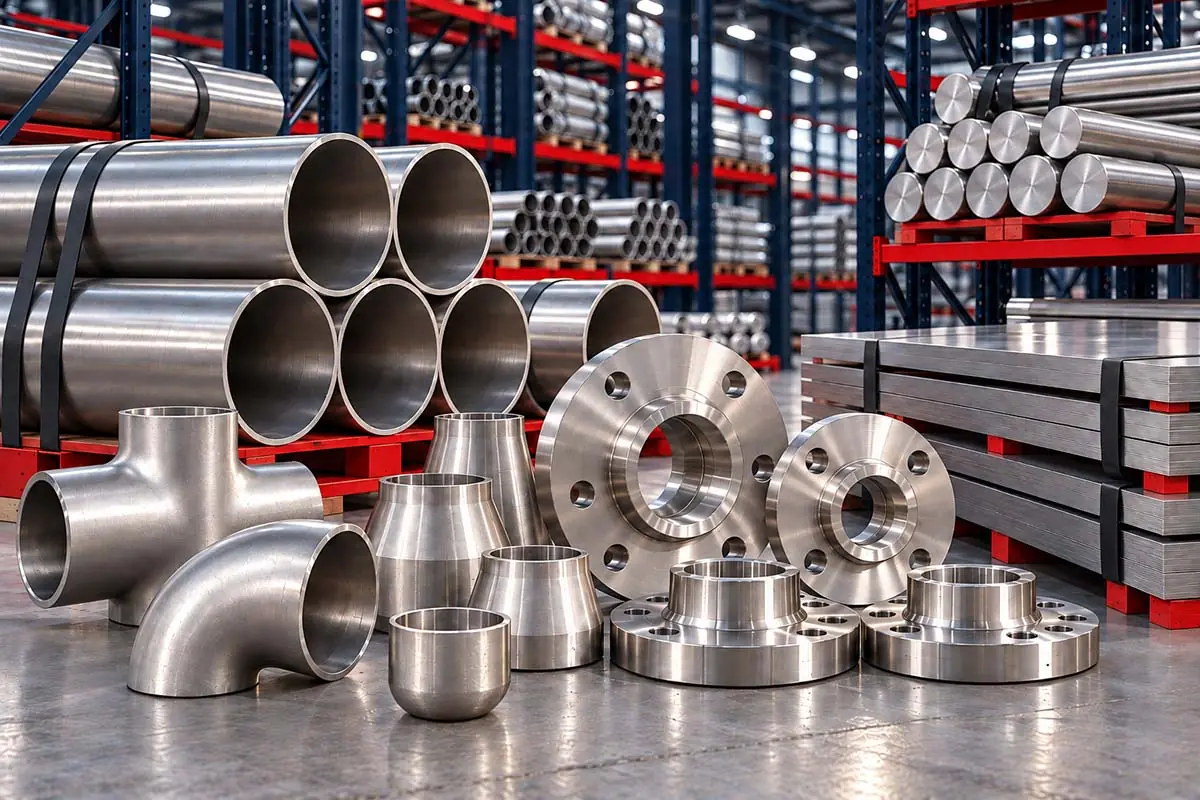
Giriraj Impex supplies Alloy 20 in every product form – we manufacture flanges, fittings, bars and fasteners, and stock and supply pipes, tubes, plates and sheets, to the ASTM B specifications for each form.
Chemical composition
| C | Mn | Si | P | S | Cr | Ni | Mo | Cu | Nb + Ta |
|---|---|---|---|---|---|---|---|---|---|
| 0.07 | 2.00 | 1.00 | 0.045 | 0.035 | 19.0–21.0 | 32.0–38.0 | 2.00–3.00 | 3.0–4.0 | 8 × C min, 1.00 max |
Limits as given in the ASTM B specifications for N08020.
About 34% nickel gives resistance to chloride stress corrosion cracking; copper and molybdenum give resistance to sulphuric acid; and niobium ties up carbon so that welds do not become sensitised.
Mechanical properties and equivalents
| Product | Tensile strength, MPa (ksi) | Yield strength 0.2%, MPa (ksi) | Elongation, % |
|---|---|---|---|
| Plate, sheet and strip – ASTM B463 | 551 (80) | 241 (35) | 30 |
Pipe, bar and forging requirements are given in ASTM B464, B729, B473 and B462.
| Grade | UNS | WNR | DIN name |
|---|---|---|---|
| Alloy 20 (20Cb-3 type) | N08020 | 2.4660 | NiCr20CuMo |
Equivalent designations are similar but not identical; order to the standard you need.
Alloy 20 products and specifications
| Product | Specification |
|---|---|
| Seamless pipe and tube | ASTM B729 |
| Welded pipe and tube | ASTM B464, B468 |
| Plates, sheets and strip | ASTM B463 |
| Round bars | ASTM B473 |
| Flanges and forgings | ASTM B462 |
| Pipe fittings | ASTM B366 (WP20CB) |
Flanges are made to ASME B16.5, butt-weld fittings to ASME B16.9 and forged fittings to ASME B16.11.
Sulphuric acid service
Sulphuric acid is one of the most widely used industrial chemicals, and one of the hardest to handle: dilute and intermediate concentrations attack carbon steel and most stainless steels rapidly, especially when hot or contaminated. Alloy 20 resists boiling sulphuric acid up to moderate concentrations and cooler acid across most of the concentration range, and tolerates contamination by chlorides better than stainless steels. It is used for acid piping, pumps, valves, mixing tanks, pickling equipment, heat exchangers and dilution systems.
Other applications
Beyond sulphuric acid, Alloy 20 is used for phosphoric and nitric acid service, chemical and pharmaceutical process equipment, synthetic rubber, plastics and solvent production, food and dye processing, pickling tanks and racks, and heat exchangers handling chloride-bearing water where 316L would suffer stress corrosion cracking.
Alloy 20 compared with other alloys
SS 904L is a lower-nickel alternative with similar sulphuric acid resistance in many conditions. Incoloy 825 has higher nickel and titanium stabilisation and is used in similar services, especially where oil and gas or higher chloride levels are involved. For hot concentrated or contaminated acids beyond the limits of these alloys, Hastelloy C276 is used. More materials are on the materials page.
Fabrication
Alloy 20 forms readily hot and cold and is welded with matching ER320LR filler or with nickel-based fillers, using low heat input and clean joints, as fully austenitic welds can be sensitive to hot cracking. Niobium stabilisation means post-weld heat treatment is not normally needed. Machining requires rigid set-ups and sharp tools.
Corrosion behaviour in detail
The corrosion rate of any alloy in sulphuric acid depends on concentration, temperature, aeration and impurities. Dilute acid, below about 10%, and intermediate concentrations around 40–80% are the most aggressive to stainless steels. Alloy 20 keeps low corrosion rates across this range at moderate temperatures, and in boiling acid at lower concentrations. Oxidising impurities such as ferric or cupric ions and dissolved air generally help passivity, while chlorides and reducing conditions make attack more likely. Alloy 20 also has good resistance to chloride stress corrosion cracking because of its high nickel, which is a common failure of 304 and 316 in warm chloride-bearing water.
Niobium stabilisation means that the heat-affected zones of welds keep their resistance to intergranular corrosion without post-weld heat treatment, which matters in pickling and acid service where sensitised zones would be attacked quickly.
Typical equipment
Typical Alloy 20 equipment includes acid transfer lines, valves and pump casings, dilution coolers and heat exchangers, mixing and storage tanks, steel pickling tanks, racks and heating coils, agitators and reactor internals, and spray nozzles. Flanges, fittings and fasteners in the same alloy are used so that every wetted part of the system has the same resistance. Material can be supplied with intergranular corrosion testing to ASTM A262 when the end user specifies it.
Documents and inspection
Material is supplied with mill test certificates (MTC) showing heat number, chemical composition and mechanical properties. Third-party inspection is available on request.
Frequently Asked Questions
Alloy 20 (UNS N08020) is a nickel-iron-chromium alloy with molybdenum and copper, developed for sulphuric acid service.
The Werkstoff number of Alloy 20 is 2.4660.
It is often grouped with stainless steels, but with about 34% nickel it is classed as a nickel alloy with a UNS N-series number.
ASTM B729 covers seamless Alloy 20 pipe and tube; ASTM B464 covers welded pipe.
Its copper, molybdenum and high nickel give resistance to sulphuric acid across a wide range of concentrations and temperatures.
ER320LR matching filler or suitable nickel-based fillers are used.
Request a Quote
Tell us the product, grade, size, standard, quantity and delivery location, and our sales team will reply with a quotation.
Incoloy® are trademarks of Special Metals Corporation; Hastelloy® of Haynes International.