
SMO 254 – Grades, Products & Specifications
SMO 254 is a 6% molybdenum super-austenitic stainless steel – UNS S31254, WNR 1.4547 – with about 20% chromium, 18% nickel, 6% molybdenum, 0.2% nitrogen and a little copper. Its pitting resistance equivalent number (PREN) of at least 42 gives it resistance to pitting and crevice corrosion in seawater, brines and chloride-bearing process streams far beyond 316L and 904L, while remaining a formable, weldable austenitic steel.
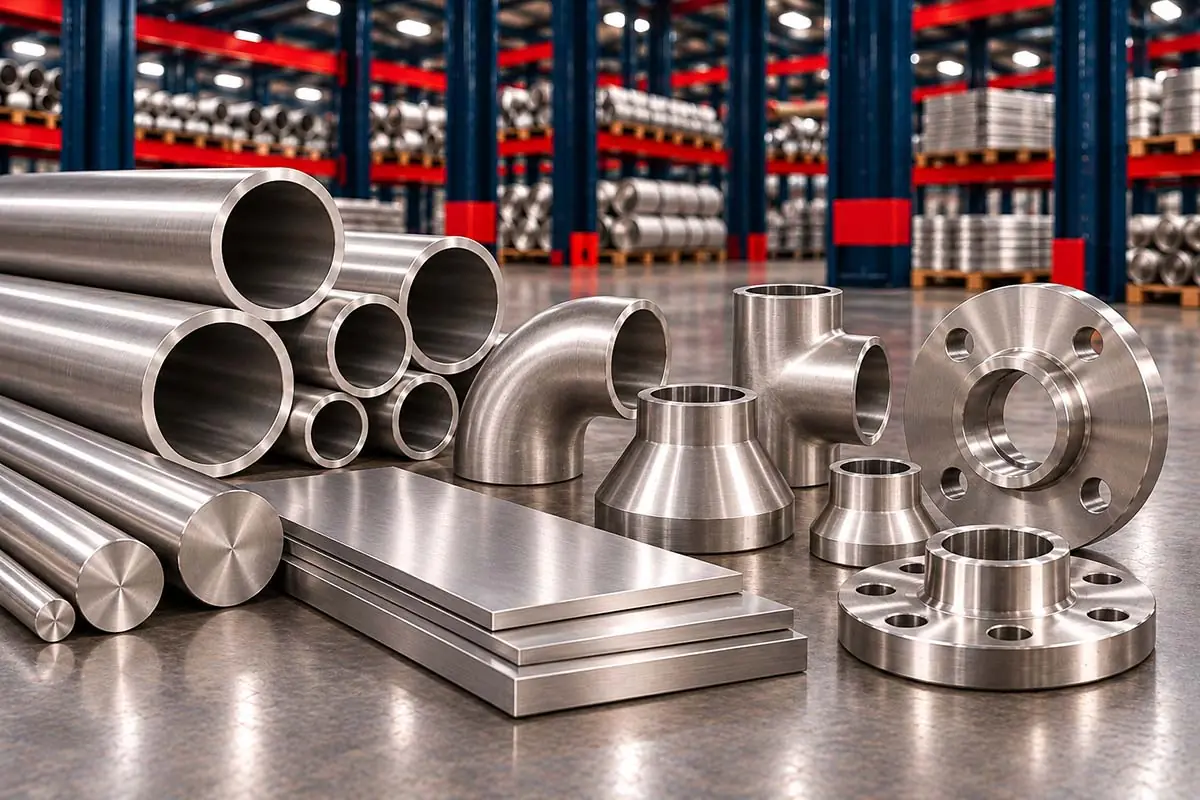
Giriraj Impex supplies SMO 254 – generic UNS S31254 material – in every product form: we manufacture flanges, fittings, bars and fasteners, and stock and supply pipes, tubes, plates and sheets, to the ASTM specifications for each form.
Chemical composition
| C | Mn | Si | P | S | Cr | Ni | Mo | N | Cu |
|---|---|---|---|---|---|---|---|---|---|
| 0.020 | 1.00 | 0.80 | 0.030 | 0.010 | 19.5–20.5 | 17.5–18.5 | 6.0–6.5 | 0.18–0.25 | 0.50–1.00 |
Limits for plate, sheet and strip to ASTM A240. Pipe (A312), tube (A249, A269) and bar (A276, A479) limits are similar.
With the minimum composition, PREN (%Cr + 3.3 × %Mo + 16 × %N) is about 42; typical material is 43 or more. The high nitrogen strengthens the austenite and improves pitting resistance, and the low carbon keeps welds resistant to intergranular corrosion.
Mechanical properties and equivalents
| Tensile strength, MPa (ksi) | Yield strength 0.2%, MPa (ksi) | Elongation, % | Hardness max |
|---|---|---|---|
| 655 (95) | 310 (45) | 35 | 223 HB |
Values for plate, sheet and strip; check the standard for other product forms and thicknesses.
| Grade | UNS | EN number | EN name |
|---|---|---|---|
| 254 SMO® type (6Mo) | S31254 | 1.4547 | X1CrNiMoCuN20-18-7 |
Equivalent designations are similar but not identical; order to the standard you need.
SMO 254 is about 50% stronger than 316L, with good ductility and impact toughness down to cryogenic temperatures.
SMO 254 products and specifications
| Product | Specification |
|---|---|
| Pipes and tubes | ASTM A312 (pipe), A269 and A249 (tube), A358 (EFW pipe) |
| Plates and sheets | ASTM A240 |
| Round bars | ASTM A276, A479 |
| Flanges and forgings | ASTM A182 F44 |
| Pipe fittings | ASTM A403 WPS31254 |
Flanges are made to ASME B16.5 and B16.47, butt-weld fittings to ASME B16.9 and forged fittings to ASME B16.11.
Corrosion resistance
SMO 254 was developed for seawater and other high-chloride environments. It resists pitting and crevice corrosion in natural seawater at moderate temperatures, in brackish and polluted water, and in chloride-bearing process streams such as bleach plant filtrates. Its high nickel and molybdenum give good resistance to chloride stress corrosion cracking, much better than 316L. It also performs well in sulphuric and phosphoric acids, including those contaminated with chlorides and fluorides. In warm seawater with tight crevices, super duplex or nickel alloys may be preferred, and design should limit crevices and use suitable gaskets.
Where SMO 254 is used
SMO 254 is used for seawater cooling systems and heat exchangers on offshore platforms and in coastal plants, firewater and ballast systems, desalination plant evaporators and brine heaters, pulp and paper bleach plants, flue-gas desulphurisation scrubbers, chemical process equipment for chloride-bearing acids, food processing with salty brines, and tall-oil distillation. It is also used for instrument and hydraulic tubing in offshore service.
SMO 254 compared with other alloys
Compared with 316L (PREN about 25) and 904L (PREN about 35), SMO 254 offers a large step up in pitting and crevice resistance. Super duplex 2507 has a similar PREN with higher strength and lower nickel cost, but is ferritic-austenitic and has stricter limits on heat input and thick sections. SMO 254, as a fully austenitic steel, is easier to form and weld in thin sections and keeps toughness at low temperatures. Nickel alloys such as Inconel 625 and Hastelloy C276 are used where conditions exceed the limits of 6Mo steels. More materials are on the materials page.
Fabrication
SMO 254 forms well cold, though it needs more force than 316L because of its higher strength. It is welded with over-alloyed nickel-based filler metals such as ERNiCrMo-3 or ERNiCrMo-4, because matching-composition welds lose molybdenum to segregation and would be less corrosion resistant than the base metal. Heat tint must be removed and welds pickled. Machining needs rigid set-ups and sharp tools, as the alloy work-hardens.
Testing SMO 254
Because the value of SMO 254 lies in its corrosion resistance, purchasers often add a pitting test to ASTM G48 at a stated temperature to confirm that the material and any welds perform as expected. Positive material identification is used at receiving inspection, since SMO 254 looks identical to 316L. For welded fabrications, the weld procedure qualification usually includes a corrosion test of the weld as well as mechanical tests.
Documents and inspection
Material is supplied with mill test certificates (MTC) showing heat number, chemical composition and mechanical properties. Third-party inspection is available on request, and positive material identification can be carried out to confirm the grade.
Frequently Asked Questions
SMO 254 is a 6% molybdenum super-austenitic stainless steel, UNS S31254 (WNR 1.4547), with high resistance to pitting and crevice corrosion in chlorides.
SMO 254 has a PREN of at least about 42, and typical material is 43 or higher, compared with about 25 for 316L.
Over-alloyed nickel-based fillers such as ERNiCrMo-3 or ERNiCrMo-4 are used, so the weld is as corrosion resistant as the base metal.
Both have similar pitting resistance. Super duplex is stronger; SMO 254 is fully austenitic, easier to form and weld in thin sections and tougher at low temperatures.
SMO 254 flanges and forgings are made to ASTM A182 grade F44.
In seawater systems, desalination, bleach plants, flue-gas scrubbers and chloride-bearing chemical processes.
Request a Quote
Tell us the product, grade, size, standard, quantity and delivery location, and our sales team will reply with a quotation.
Inconel® are trademarks of Special Metals Corporation; Hastelloy® of Haynes International; 254 SMO® of Outokumpu.