
Rings – Manufacturer, Stockist, Supplier & Exporter
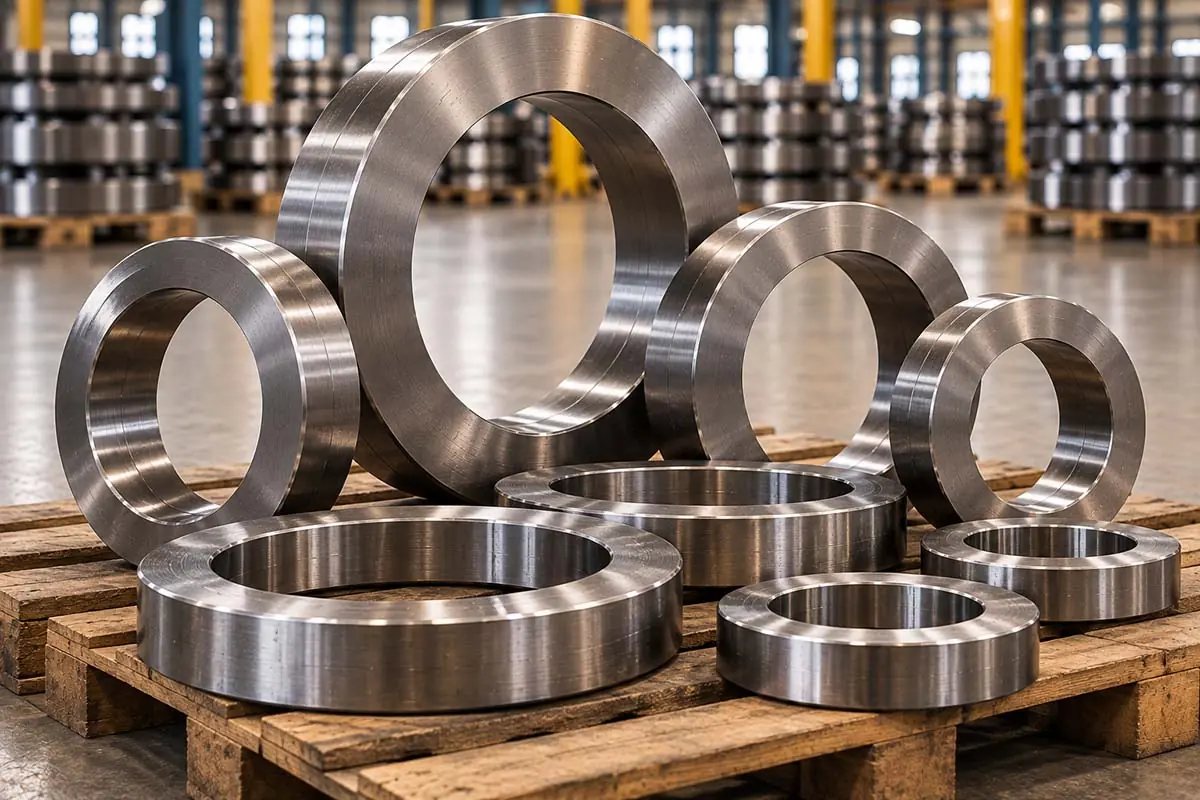
Giriraj Impex is a manufacturer, stockist, supplier and exporter of forged rings, rolled rings and plate-cut rings in stainless steel, carbon steel, alloy steel, duplex and super duplex steel and nickel alloys. We manufacture forged rings to ASTM A182, ASTM A105, ASTM A350 and the ASTM B forging specifications for nickel alloys, and to customer drawings, supplied rough machined or finish machined with mill test certificates.
Forged rings are used where a round part must carry pressure, load or rotation – as blanks for large flanges and girth flanges, body flanges for pressure vessels and heat exchangers, bearing and gear rings, valve seats, slewing rings and machined components for pumps, compressors and turbines.
Ring materials and specifications
| Material | Typical grades | Forging standards |
|---|---|---|
| Stainless steel | F304, F304L, F316, F316L, F321, F347, F310 | ASTM A182 / ASME SA182 |
| Carbon steel | A105, A350 LF2, A694 F42–F70 | ASTM A105, A350, A694 |
| Alloy steel | F11, F22, F5, F9, F91 | ASTM A182 |
| Duplex and super duplex steel | F51, F53, F55 | ASTM A182 |
| Nickel alloys | Inconel 600 and 625, Incoloy 800 and 825, Monel 400, Hastelloy C276 | ASTM B564 |
Rings can also be supplied to EN and DIN forging grades and to the customer's own material specification, on enquiry.
Types of rings
- Seamless rolled rings – a forged and pierced blank is rolled between a driven roll and an idler roll to increase its diameter and reduce its wall. Rolling gives a continuous circumferential grain flow, which improves strength and fatigue resistance. Rolled rings are used for large flanges, bearing races, gear blanks and slewing rings.
- Open-die forged rings – forged over a mandrel from a pierced billet, for thick-walled and smaller-diameter rings and for alloys or sizes not suited to ring rolling.
- Plate-cut rings – cut from plate by plasma, oxy-fuel or water-jet, for flat rings, spacers, stiffening rings and low-stress parts. They do not have the grain flow of forged rings and are not used where forging is specified.
How we manufacture forged rings
The process starts with a billet of certified material, cut to the weight needed for the finished ring plus machining allowance. The billet is heated, upset and pierced to form a doughnut-shaped preform, which is then forged over a mandrel or rolled to the required outside diameter, inside diameter and height. After forging, the ring is heat treated to the condition the specification requires – solution annealing for stainless and duplex steel, normalising or normalising and tempering for carbon steel, and normalising and tempering or quenching and tempering for alloy steel.
Rings are then rough machined or finish machined to drawing. Test pieces for chemical and mechanical testing are taken from the ring or from a prolongation forged with it, as the specification and order require.
Sizes, condition and testing
| Item | Details |
|---|---|
| Dimensions | Outside diameter, inside diameter and height to customer drawing |
| Condition | As forged, rough machined, or finish machined to drawing |
| Heat treatment | As required by the material specification and order |
| Testing | Chemical analysis, tensile and hardness tests; impact tests where specified |
| Non-destructive testing | Ultrasonic testing, dye penetrant or magnetic particle testing on request |
| Documents | Mill test certificate (MTC); third-party inspection on request |
Please send a drawing or the finished and as-supplied dimensions, with the material specification, heat-treatment condition, testing and quantity.
Rough-machined rings are supplied with an allowance on every surface for the customer's final machining, which also removes the forging skin and any surface decarburisation. Finish-machined rings are supplied ready for use or for final assembly, with surface finish and tolerances to the drawing.
Choosing the material
Carbon steel A105 rings are used for flange blanks and vessel parts in ambient and higher-temperature service, and A350 LF2 where impact testing at low temperature is required. A694 high-yield forgings are used for pipeline flanges and fittings. Alloy steels F11 and F22 are chosen for high-temperature steam and refinery service, and F91 for the most demanding power plant conditions. Stainless steel F304L and F316L rings are used for chemical, pharmaceutical and food equipment, and duplex F51 and super duplex F53 and F55 for seawater and chloride service. Nickel alloy rings to ASTM B564 are used for highly corrosive chemical service and for high-temperature components. Sour-service rings can be supplied to NACE MR0175 / ISO 15156 on request.
Applications
- Blanks for large-diameter and special flanges, girth flanges and body flanges of pressure vessels and heat exchangers
- Bearing races, gear rings and slewing rings for heavy machinery, wind turbines and cranes
- Valve seats, bonnets and body rings
- Pump and compressor casings, wear rings and seal rings
- Turbine and generator components in power plants
- Stiffening rings, spacers and support rings in fabrication
Quality and traceability
Each ring is marked with the material grade, heat number and a unique identification, so it can be traced to its billet, heat-treatment batch and test results. Dimensional inspection is carried out against the drawing, and the mill test certificate reports chemical composition, mechanical properties and heat treatment. Third-party inspection by the customer's nominated agency can be arranged on request. Our company is certified to ISO 9001:2015, ISO 14001:2015 and ISO 45001:2018.
Related products
Rings are closely related to our flanges, which are often machined from forged rings, and to our round bars, from which smaller rings are made. Flat rings and washers can also be cut from circles. Every product form is listed on the products page.
Why Giriraj Impex
- Wide range of materials, grades, sizes and international specifications, supplied since 2008
- Mill test certificates (MTC) supplied with material; third-party inspection on request
- Inspection and quality verification before dispatch
- ISO 9001:2015, ISO 14001:2015 and ISO 45001:2018 certified
- Competitive pricing and timely delivery
- Supply across India and for export, from our Mumbai headquarters
Frequently Asked Questions
A forged ring is a circular part made by piercing a heated billet and forging or rolling it to the required diameter and height. Forging gives a continuous grain flow and better strength than a ring cut from plate.
A rolled ring is forged and rolled from a pierced billet, giving circumferential grain flow and higher strength. A plate-cut ring is cut from plate and is used for flat, low-stress parts such as spacers and stiffening rings.
Stainless, alloy and duplex rings are usually made to ASTM A182, carbon steel rings to ASTM A105 or A350, and nickel alloy rings to ASTM B564, with dimensions to the customer's drawing.
Yes. Ultrasonic testing and surface tests such as dye penetrant or magnetic particle testing can be carried out on request.
Yes. Rings can be supplied as forged, rough machined or finish machined to the customer's drawing.
Yes. Rings can be supplied to NACE MR0175 / ISO 15156 on request, with the hardness controls and testing the standard requires.
Request a Quote for Rings – Manufacturer, Stockist, Supplier & Exporter
Tell us the product, grade, size, standard, quantity and delivery location, and our sales team will reply with a quotation.
Incoloy® and Monel® are trademarks of Special Metals Corporation; Hastelloy® of Haynes International.