
Hastelloy – Grades, Products & Specifications
Hastelloy is the trade name for a group of nickel-molybdenum and nickel-chromium-molybdenum alloys designed for the most aggressive chemical environments – hot acids, wet chlorine, chlorides and mixed oxidising and reducing media. Giriraj Impex supplies Hastelloy C276, C22, B2, B3 and X as pipes, tubes, plates, sheets, round bars, flanges, pipe fittings and fasteners, to the ASTM B specifications for each alloy and under the alloys' UNS numbers.
We manufacture Hastelloy flanges, fittings, bars and fasteners, and stock and supply Hastelloy pipes, tubes, plates and sheets from approved mills.
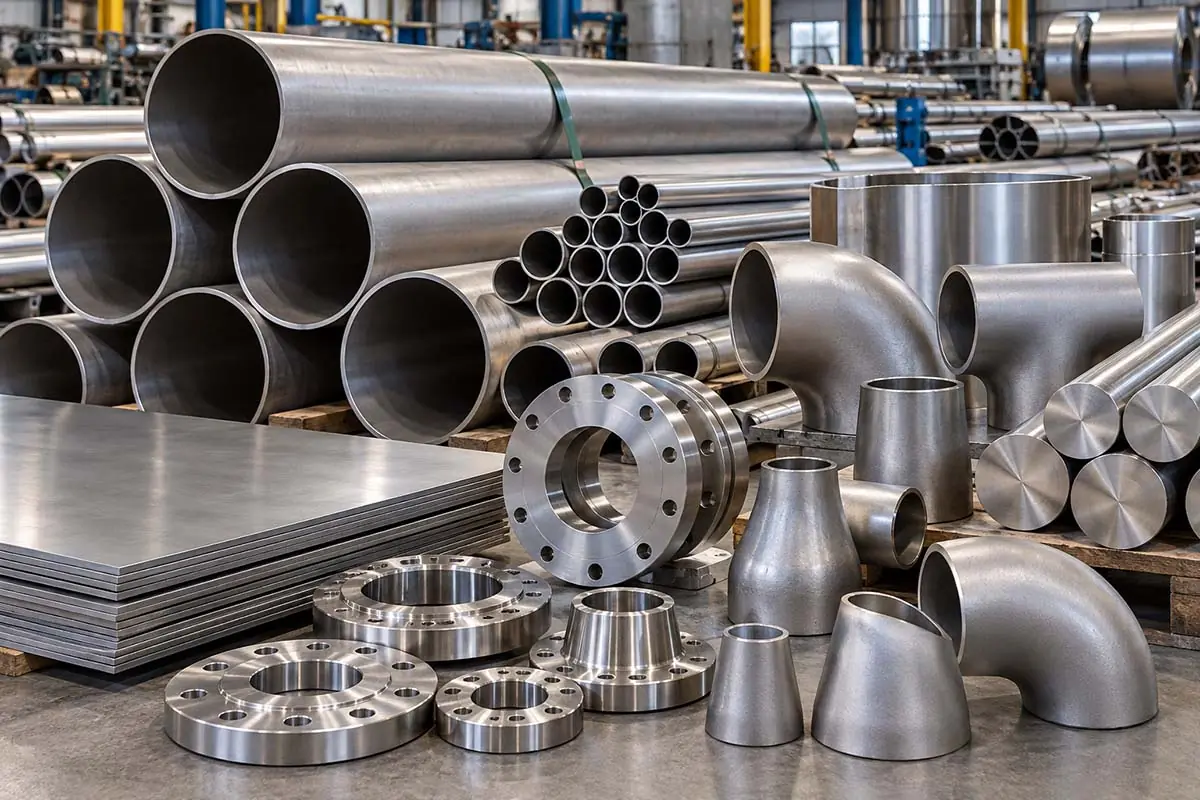
Hastelloy grades
| Alloy | UNS | WNR | Key feature |
|---|---|---|---|
| Hastelloy C276 | N10276 | 2.4819 | Ni-Cr-Mo-W alloy for a very wide range of chemical environments |
| Hastelloy C22 | N06022 | 2.4602 | Higher chromium for better resistance in oxidising media |
| Hastelloy B2 | N10665 | 2.4617 | Nickel-molybdenum alloy for reducing acids such as hydrochloric acid |
| Hastelloy B3 | N10675 | 2.4600 | Improved thermal stability over B2 during fabrication |
| Hastelloy X | N06002 | 2.4665 | High-temperature strength and oxidation resistance for furnace and turbine parts |
Hastelloy products and specifications
| Product | Specification |
|---|---|
| Seamless pipes and tubes | ASTM B622 |
| Welded pipes / welded tubes | ASTM B619 / B626 |
| Plates and sheets | ASTM B575 |
| Round bars | ASTM B574 |
| Flanges and forgings | ASTM B564 |
| Pipe fittings | ASTM B366 |
| Fasteners | Machined from ASTM B574 bar |
Hastelloy B2 and B3 plate is supplied to ASTM B333 and bar to B335; Hastelloy X plate to B435 and bar to B572. See also Hastelloy C276 sheets and plates.
Choosing a Hastelloy grade
Hastelloy C276 is the general-purpose choice for chemical plants: it resists hot contaminated mineral acids, organic acids, wet chlorine gas, hypochlorite and chlorine dioxide solutions, and seawater and brine, and is widely used in flue gas desulphurisation, pulp bleaching, pharmaceutical reactors and pickling equipment. Hastelloy C22 has more chromium and performs better in oxidising conditions and mixed acid streams. Hastelloy B2 and B3 are nickel-molybdenum alloys for reducing environments such as hydrochloric acid, but they are not suited to oxidising conditions or ferric and cupric salts. Hastelloy X is a high-temperature alloy for furnace hardware and gas turbine parts rather than a corrosion alloy.
Because the right alloy depends on the exact chemistry, temperature and impurities, your corrosion engineer should confirm the selection, ideally with corrosion data for the actual process stream.
Small changes in a process – a higher temperature, a trace of oxidising salts, chlorides carried over from another unit – can change which alloy performs well, so plants often trial coupons of two or three alloys in the actual stream before ordering equipment.
Fabrication notes
The low carbon and silicon content of C276 and C22 lets them be welded without losing corrosion resistance in the heat-affected zone, so they are normally used in the as-welded condition. Like other nickel alloys they work-harden during machining and forming, and weld joints must be clean of sulphur, lead and other low-melting contaminants. Material is supplied solution annealed.
Hastelloy is more expensive than stainless steel, so it is often used selectively – as liners, cladding or weld overlay on carbon steel, or only in the parts of a system that see the most aggressive conditions. We can supply plate, pipe and forgings in matching heats for such mixed designs.
Where Hastelloy is installed
Typical Hastelloy C276 and C22 installations include flue gas desulphurisation scrubbers, ducts and dampers in power stations; chlorination and bleaching equipment in pulp mills; reactors, heat exchangers and transfer lines in pharmaceutical and fine-chemical plants; acid pickling lines in steel works; and sour gas and seawater components in oil and gas. B-type alloys are found in hydrochloric acid processes such as acid recovery and some organic syntheses.
When ordering, state the alloy and UNS number, the ASTM product specification, dimensions, quantity, and any intergranular corrosion test, NACE MR0175 / ISO 15156 or third-party inspection requirement. For pipe, include the schedule and whether seamless (B622) or welded (B619) pipe is acceptable.
Documents and inspection
Hastelloy material is supplied with mill test certificates (MTC) showing heat number, composition and mechanical properties. Intergranular corrosion tests, third-party inspection and NACE MR0175 / ISO 15156 compliance can be arranged on request. See also Inconel and the full materials list.
Frequently Asked Questions
Hastelloy C276 (UNS N10276) is used in chemical processing, flue gas desulphurisation, pulp bleaching, pharmaceutical reactors and acid-handling equipment, where it resists hot acids, wet chlorine, hypochlorite and chlorides.
C22 contains more chromium than C276, which improves its resistance in oxidising environments and mixed acids. C276 has more molybdenum and is strong in reducing acids. The choice depends on the process chemistry.
ASTM B622 covers seamless Hastelloy C276 pipe and tube. Welded pipe is covered by ASTM B619 and welded tube by ASTM B626. Plates are supplied to ASTM B575 and bars to ASTM B574.
No. Hastelloy B2 and B3 are designed for reducing environments such as hydrochloric acid. Oxidising conditions, including ferric or cupric ions, can cause rapid corrosion, so a C-type alloy is used instead.
Yes. Every item is supplied with a mill test certificate. Intergranular corrosion testing and third-party inspection can be arranged on request.
No. Hastelloy C276, C22 and B-type alloys are nickel-based austenitic alloys and are essentially non-magnetic in the annealed condition.
Request a Quote
Tell us the product, grade, size, standard, quantity and delivery location, and our sales team will reply with a quotation.
Inconel® are trademarks of Special Metals Corporation; Hastelloy® of Haynes International.