
Nickel Alloy – Grades, Products & Specifications
Commercially pure nickel – Nickel 200 (UNS N02200, WNR 2.4066) and the low-carbon Nickel 201 (UNS N02201, WNR 2.4068) – contains at least 99% nickel. It has outstanding resistance to caustic soda and other alkalis, good resistance to many reducing chemicals and to fresh and distilled water, high thermal and electrical conductivity, and magnetic and magnetostrictive properties used in electronics. Other nickel alloys – Inconel, Incoloy, Monel and Hastelloy – are covered on their own pages.
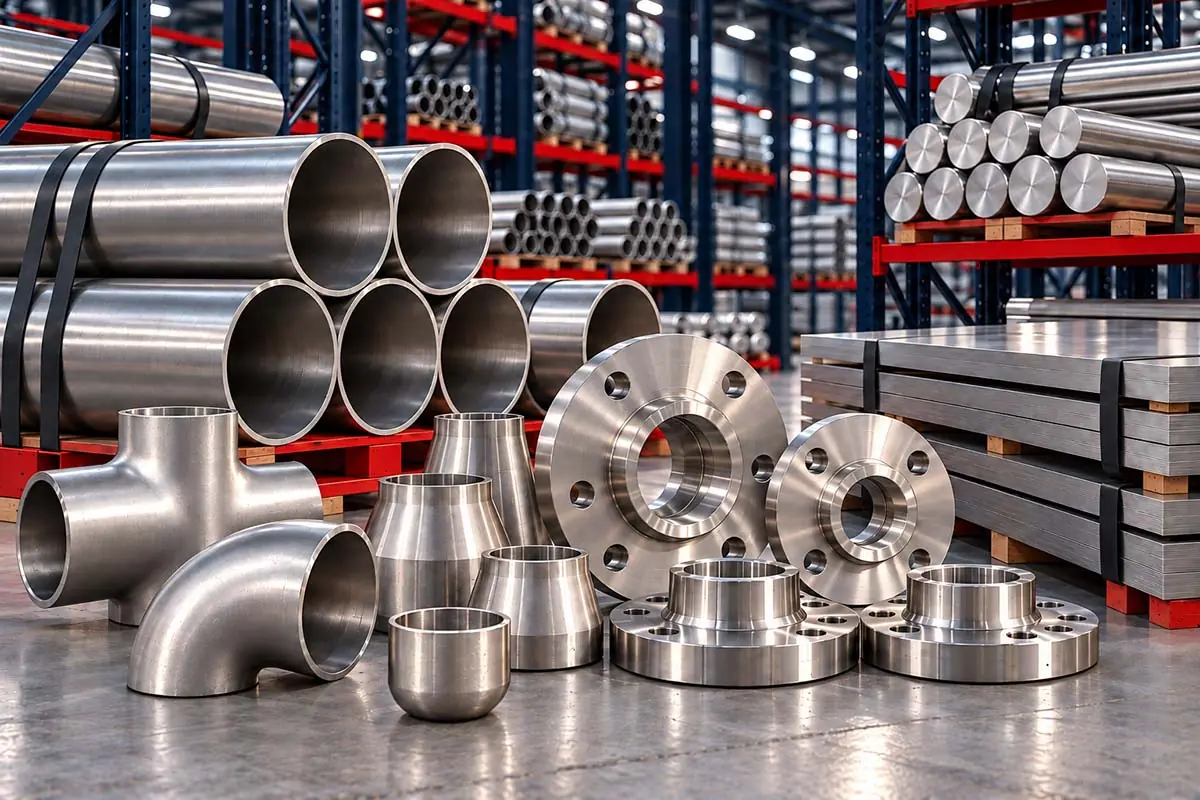
Giriraj Impex supplies Nickel 200 and 201 as pipes and tubes, plates and sheets, round bars and other forms – we manufacture flanges, fittings, bars and fasteners, and stock and supply pipes, tubes, plates and sheets – to the ASTM B specifications for each form.
Chemical composition
| Alloy | Ni | Cu | Fe | Mn | C | Si | S |
|---|---|---|---|---|---|---|---|
| Nickel 200 (N02200) | 99.0 min | 0.25 | 0.40 | 0.35 | 0.15 | 0.35 | 0.01 |
| Nickel 201 (N02201) | 99.0 min | 0.25 | 0.40 | 0.35 | 0.02 | 0.35 | 0.01 |
Nickel includes cobalt. Limits as given in ASTM B160, B161 and B162.
The only significant difference between the two grades is carbon: Nickel 201 has a carbon maximum of 0.02%, against 0.15% for Nickel 200.
Mechanical properties and equivalents
| Alloy | Tensile strength, MPa (ksi) | Yield strength 0.2%, MPa (ksi) | Elongation, % |
|---|---|---|---|
| Nickel 200 | 380 (55) | 105 (15) | 40 |
| Nickel 201 | 345 (50) | 80 (12) | 40 |
Values for hot-rolled annealed plate; other forms and conditions as given in each standard.
| Alloy | UNS | WNR | DIN name |
|---|---|---|---|
| Nickel 200 | N02200 | 2.4066 | Ni 99.2 |
| Nickel 201 | N02201 | 2.4068 | LC-Ni 99 |
Equivalent designations are similar but not identical; order to the standard you need.
Nickel 200 or 201?
Nickel 200 is used up to about 315 °C. Above that temperature, carbon in Nickel 200 can precipitate as graphite at the grain boundaries over long periods, making the metal brittle. Nickel 201, with its very low carbon, does not suffer this graphitisation and is used for service above about 315 °C – for example in caustic evaporators and fused caustic handling. Nickel 201 is also slightly softer, which helps in deep drawing and spinning.
Nickel products and specifications
| Product | Specification |
|---|---|
| Seamless pipe and tube | ASTM B161; B163 (condenser and heat-exchanger tube) |
| Welded pipe and tube | ASTM B725, B730 |
| Plates, sheets and strip | ASTM B162 |
| Round bars and rods | ASTM B160 |
| Forgings and flanges | ASTM B564 |
| Butt-weld fittings | ASTM B366 (WPN, WPNL) |
Caustic soda and alkali service
Nickel is the standard material for handling caustic soda (sodium hydroxide) and caustic potash at high concentrations and temperatures, including molten caustic. In caustic evaporators, concentrators and storage at elevated temperature, stainless steels suffer stress corrosion cracking and general attack, while nickel corrodes at very low rates. Chlor-alkali plants use nickel tubes, plates and piping in the evaporation and concentration sections, and nickel is also used in caustic fusion pots and in the production of synthetic fibres and soaps.
Other applications
Nickel 200 and 201 are also used for food processing equipment where product purity matters, handling of dry chlorine and hydrogen chloride at moderate temperatures, fluorine and hydrofluoric acid service in some conditions, battery components and electronics, electroplating anodes, aerospace and missile components, and laboratory crucibles. They are not suitable for oxidising acids such as nitric acid or for oxidising salts.
Fabrication
Nickel 200 and 201 are very ductile and form readily by bending, spinning and deep drawing. They are welded with ERNi-1 filler by TIG or MIG on clean joints, as sulphur and lead contamination cause cracking. Hot working must be done in a sulphur-free atmosphere. Machining requires sharp tools and generous coolant because nickel is soft and gummy in the annealed condition; cold-drawn material machines better.
Physical properties
Commercially pure nickel has a density of about 8.89 g/cm³, a melting point of about 1435–1446 °C, and high thermal and electrical conductivity compared with nickel alloys and stainless steels – about 70 W/m·K for Nickel 200 at room temperature – which makes it useful for heat-transfer equipment and electrical parts. It is ferromagnetic, with a Curie temperature of about 360 °C, and has magnetostrictive properties used in transducers. Its strength at room temperature is modest, similar to mild steel, but it keeps excellent ductility and toughness down to cryogenic temperatures.
Product forms and supply
Nickel 200 and 201 are supplied as seamless and welded pipe and tube, plate, sheet and strip, round bar and wire, and forgings for flanges and fittings. Pipe is supplied annealed or stress relieved; plate hot rolled and annealed; sheet cold rolled and annealed for forming. Because nickel is costly and specialised, availability of each size is confirmed at the enquiry stage. Please give the grade, specification, size, condition and quantity.
Documents and inspection
Material is supplied with mill test certificates (MTC) showing heat number, chemical composition and mechanical properties. Third-party inspection is available on request.
More nickel alloys are on the materials page.
Frequently Asked Questions
Nickel 200 (UNS N02200) is commercially pure wrought nickel with at least 99% nickel, used for caustic, food and electronic applications.
Nickel 201 has a maximum of 0.02% carbon, against 0.15% for Nickel 200, so it can be used above about 315 °C without graphitisation.
Nickel corrodes at very low rates in caustic soda at high concentrations and temperatures, where stainless steels crack or corrode.
ASTM B161 covers seamless Nickel 200 and 201 pipe and tube; ASTM B162 covers plate and ASTM B160 covers bar.
Nickel 200 is WNR 2.4066 and Nickel 201 is WNR 2.4068.
Yes. Commercially pure nickel is ferromagnetic at room temperature.
Request a Quote
Tell us the product, grade, size, standard, quantity and delivery location, and our sales team will reply with a quotation.
Inconel®, Incoloy® and Monel® are trademarks of Special Metals Corporation; Hastelloy® of Haynes International.