
Nickel Alloy Round Bars
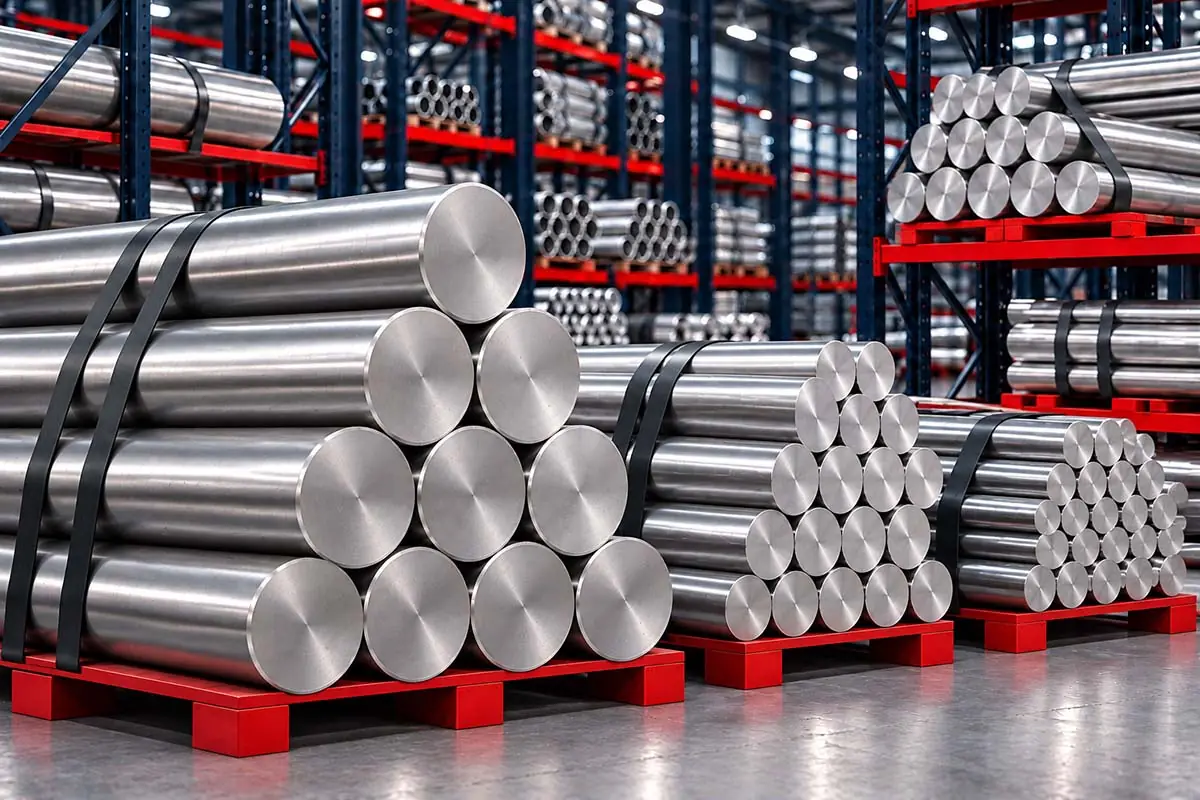
Giriraj Impex is a manufacturer, stockist, supplier and exporter of nickel alloy round bars in commercially pure Nickel 200 (UNS N02200) and Nickel 201 (UNS N02201) to ASTM B160 / ASME SB160. We manufacture nickel round bars hot finished, annealed or cold drawn, black or bright, together with hexagonal and square bars, in random lengths or cut to length, with mill test certificates.
Nickel bars are machined into valve and pump parts, fittings and flanges for caustic service, electrical and electronic components, and parts for food and chemical equipment. Bars in other nickel alloys – Inconel, Incoloy, Monel and Hastelloy – are on their own pages.
Specifications
| Item | Details |
|---|---|
| Standard | ASTM B160 / ASME SB160 |
| Grades | Nickel 200 (N02200, WNR 2.4066), Nickel 201 (N02201, WNR 2.4068) |
| Condition | Hot finished, annealed, cold drawn |
| Surface | Black, peeled, turned, ground |
| Shapes | Round, hexagonal, square; forged bars on request |
| Length | Random lengths or cut to length |
| Documents | Mill test certificate (MTC); third-party inspection on request |
Chemical composition and mechanical properties
| Alloy | Ni | Cu | Fe | Mn | C | Si | S |
|---|---|---|---|---|---|---|---|
| Nickel 200 (N02200) | 99.0 min | 0.25 | 0.40 | 0.35 | 0.15 | 0.35 | 0.01 |
| Nickel 201 (N02201) | 99.0 min | 0.25 | 0.40 | 0.35 | 0.02 | 0.35 | 0.01 |
Nickel includes cobalt. Limits as given in ASTM B160, B161 and B162.
| Alloy | Tensile strength, MPa (ksi) | Yield strength 0.2%, MPa (ksi) | Elongation, % |
|---|---|---|---|
| Nickel 200 | 380 (55) | 105 (15) | 40 |
| Nickel 201 | 345 (50) | 80 (12) | 40 |
Values for hot-rolled annealed plate; other forms and conditions as given in each standard.
The mechanical values shown are for B162 plate; bar requirements in B160 depend on condition and size and are reported on the mill test certificate.
Why nickel bar
Commercially pure nickel resists caustic soda and caustic potash at high concentrations and temperatures, where stainless steels suffer stress corrosion cracking. It also resists many reducing chemicals, food products and distilled water, and has high thermal and electrical conductivity and magnetic properties used in electronics. Nickel 201, with low carbon, is used above about 315 °C, where Nickel 200 could become brittle through graphitisation.
How we manufacture nickel bars
We manufacture nickel round bars from certified billets by hot rolling or forging, followed by annealing, or by cold drawing for closer tolerance and higher strength. Bright bars are peeled, turned or ground. Every bar is marked with grade and heat number, and ultrasonic testing is carried out on request.
Machining nickel
Annealed nickel is soft and gummy, so it tends to form long, stringy chips and build up on tools. Cold-drawn bar machines better. Use sharp tools with positive rake and generous chip clearance, moderate speeds and plenty of coolant. Nickel is welded with ERNi-1 filler on clean joints free of sulphur and lead.
Certification and traceability
Nickel 200 and 201 differ only in carbon content, which a portable analyser cannot measure, so traceability to the mill test certificate is essential. Every bar carries its grade and heat number, and the certificate reports the chemistry and mechanical properties. Please state whether Nickel 200 or 201 is required with the enquiry.
Sizes, supply and ordering
Bars are supplied in random lengths or cut to length, in metric and imperial diameters. Please give the grade, size, condition, surface, length, quantity and any testing or inspection requirement. Bars are packed in wooden boxes or bundles and each piece is traceable to its mill test certificate.
Nickel bars for caustic equipment
In caustic soda and chlor-alkali plants, nickel bars are machined into valve stems, plugs and seats, pump shafts and impellers, agitator parts and fittings for evaporators and concentrators, where stainless steel parts would crack. Nickel 201 bars are specified for parts that run above about 315 °C. Matching nickel pipes, tubes and plates are used for the rest of the equipment, so that all wetted parts have the same corrosion resistance.
Electrical and electronic uses
Because of its high electrical conductivity, magnetic properties and resistance to corrosion, nickel rod is used for lead wires, terminals and connectors, battery components, heating-element terminals and electroplating anodes. For these uses, the purity and surface condition of the rod matter, and Nickel 201 or higher-purity grades may be specified.
Comparing nickel with other alloys
For caustic service at moderate temperatures, Monel 400 and Inconel 600 are alternatives with higher strength; Inconel 600 is preferred at very high temperatures. For oxidising acids, nickel is not suitable and stainless steels or nickel-chromium-molybdenum alloys are used. Commercially pure nickel is chosen where its outstanding caustic resistance, conductivity or purity is the priority.
Applications and related products
Nickel round bars are used for valve and pump components and fittings in caustic service, electrical and electronic parts, battery and electroplating components, and food and chemical equipment parts. Matching products include nickel alloy pipes and tubes and nickel alloy sheets and plates. Background is on the nickel alloy page, and other bar materials on the round bars, rods and wires page.
Frequently Asked Questions
ASTM B160 (ASME SB160) covers Nickel 200 and 201 rod and bar.
For valve and pump parts in caustic service, electrical and electronic components, and food and chemical equipment.
Nickel 201 has lower carbon and is used above about 315 °C.
Annealed nickel is soft and gummy; cold-drawn bar machines better, with sharp tools and plenty of coolant.
Yes. Commercially pure nickel is ferromagnetic at room temperature.
Yes. Bars are supplied peeled, turned or ground, as well as black.
Request a Quote for Nickel Alloy Round Bars
Tell us the product, grade, size, standard, quantity and delivery location, and our sales team will reply with a quotation.
Inconel®, Incoloy® and Monel® are trademarks of Special Metals Corporation; Hastelloy® of Haynes International.