
Piping Materials for Refinery & Petrochemical Plants
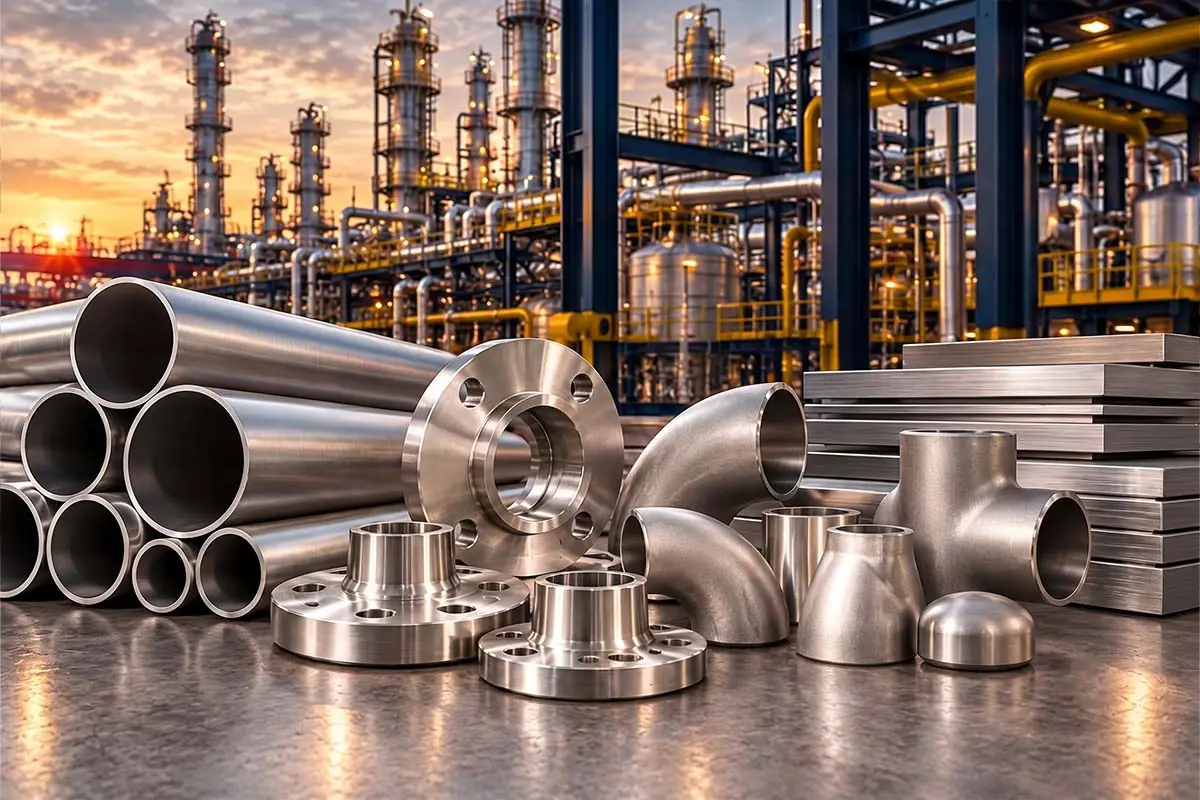
Refinery piping materials range from carbon steel for most hydrocarbon and utility lines to chrome-moly steels, stainless steels and nickel alloys for high temperatures, hydrogen and corrosive streams. Giriraj Impex supplies refineries and petrochemical plants with pipes, flanges, fittings, plates, bars and fasteners in all these materials – we manufacture flanges, fittings, fasteners and bars, and stock and supply pipes, tubes and plates – for new units, revamps and turnarounds.
Carbon steel
Carbon steel is used wherever temperature and corrosion allow: crude and product lines, steam and condensate, cooling water, flare and utility systems. Typical materials are ASTM A106 Grade B pipes and other carbon steel seamless pipes, A105 flanges, A234 WPB fittings and A516 Grade 70 plate. Killed carbon steel with controlled hardness, and NACE MR0175 / ISO 15156 material on request, are used in wet H₂S service such as sour water and amine units.
Chrome-moly steels – P11, P22, P91
For high-temperature service and hydrogen, alloy steel pipes and tubes to ASTM A335 are used: P11 (1¼Cr-½Mo) and P22 (2¼Cr-1Mo) for hydrotreater, reformer and FCC lines and heater transfer lines; P5 and P9 for high-sulphur crude service and heater tubes; and P91 for the highest creep strength. Matching alloy steel flanges (A182 F11, F22, F5, F9, F91) and fittings (A234 WP11, WP22) complete the system. Chrome-moly piping needs controlled welding, preheat and post-weld heat treatment.
Stainless steels – 304L, 316L, 321, 347
Stainless steel seamless pipes are used for corrosive and high-temperature lines. 304L and 316L serve in amine, sour water and chemical injection systems. Stabilised 321 and 347 are used in hydroprocessing reactor effluent systems, heater outlets and other lines between about 425 °C and 850 °C, where polythionic acid stress corrosion cracking during shutdowns is a risk for unstabilised grades.
Incoloy 800H and 825
Incoloy pipes and tubes are used where other materials reach their limits. Incoloy 800H and 800HT serve in hydrogen plant and reformer outlet systems, pigtails and transfer lines at very high temperature. Incoloy 825 is used in crude overhead condensers, reactor effluent air coolers and other chloride- and acid-bearing services, where it resists stress corrosion cracking and pitting better than stainless steel.
Products for refineries
- Seamless pipes and tubes, welded pipes and tubes and heat exchanger tubes
- Flanges – including RTJ, orifice and spectacle blinds
- Pipe fittings – butt-weld, forged and olets
- Plates and sheets – A516, A387 and stainless
- Round bars and fasteners – B7, B16 and stainless bolting
All industries we serve are on the industries page.
Petrochemical plants
Petrochemical plants – ethylene crackers, aromatics, polymer and fertiliser units – use many of the same materials as refineries, with some particular needs. Cracking furnaces use Incoloy 800H, HK and HP cast alloys for radiant coils and outlet systems, and alloy steel for transfer lines. Cold sections of ethylene plants run down to around −100 °C and use impact-tested low-temperature carbon steel, 3½% nickel steel and austenitic stainless steel. Aromatics and polymer plants use 304L and 316L widely for product purity. Fertiliser plants use stainless 316L urea grade and duplex steels in carbamate service.
Turnarounds and documentation
Refinery shutdowns need the right material, correctly certified, on time. We help prepare material lists against the piping specifications and supply mill test certificates with every item, with positive material identification, hardness testing and third-party inspection on request – especially important for alloy steels, where mixed grades are a known cause of failures.
For units in hydrogen or high-temperature service, alloy grades and heat-treatment records are checked against the original design data before replacement material is released, so that like-for-like replacement is guaranteed.
Frequently Asked Questions
Carbon steel for most lines, chrome-moly steels (P11, P22, P91) for high temperature and hydrogen, stainless 321/347 and 304L/316L for corrosive and hot lines, and Incoloy 800H and 825 for the most demanding services.
Chromium and molybdenum give strength at high temperature and resistance to high-temperature hydrogen attack, which carbon steel lacks.
Stabilised grades resist sensitisation and polythionic acid stress corrosion cracking that can occur in unstabilised stainless steel during shutdowns.
Yes. Positive material identification can be carried out on request to confirm alloy grades before dispatch.
Request a Quote
Tell us the product, grade, size, standard, quantity and delivery location, and our sales team will reply with a quotation.
Incoloy® is a trademark of Special Metals Corporation.