
Carbon Steel – Grades, Products & Specifications
Carbon steel is the workhorse of pressure piping. Its strength, toughness and weldability, together with its low cost, make it the default material for oil and gas, refinery, power and utility lines wherever the fluid is not corrosive enough to need stainless steel or an alloy. Giriraj Impex supplies carbon steel for pressure service to ASTM and API standards – A106, A53, API 5L and A333 pipes, A105 and A350 LF2 flanges, A234 WPB and A420 WPL6 fittings, A516 plates, bars and bolting.
We manufacture carbon steel flanges, fittings, bars and fasteners, and stock and supply carbon steel pipes and plates from approved mills. Structural sections and sheets to IS 2062 are covered under mild steel.
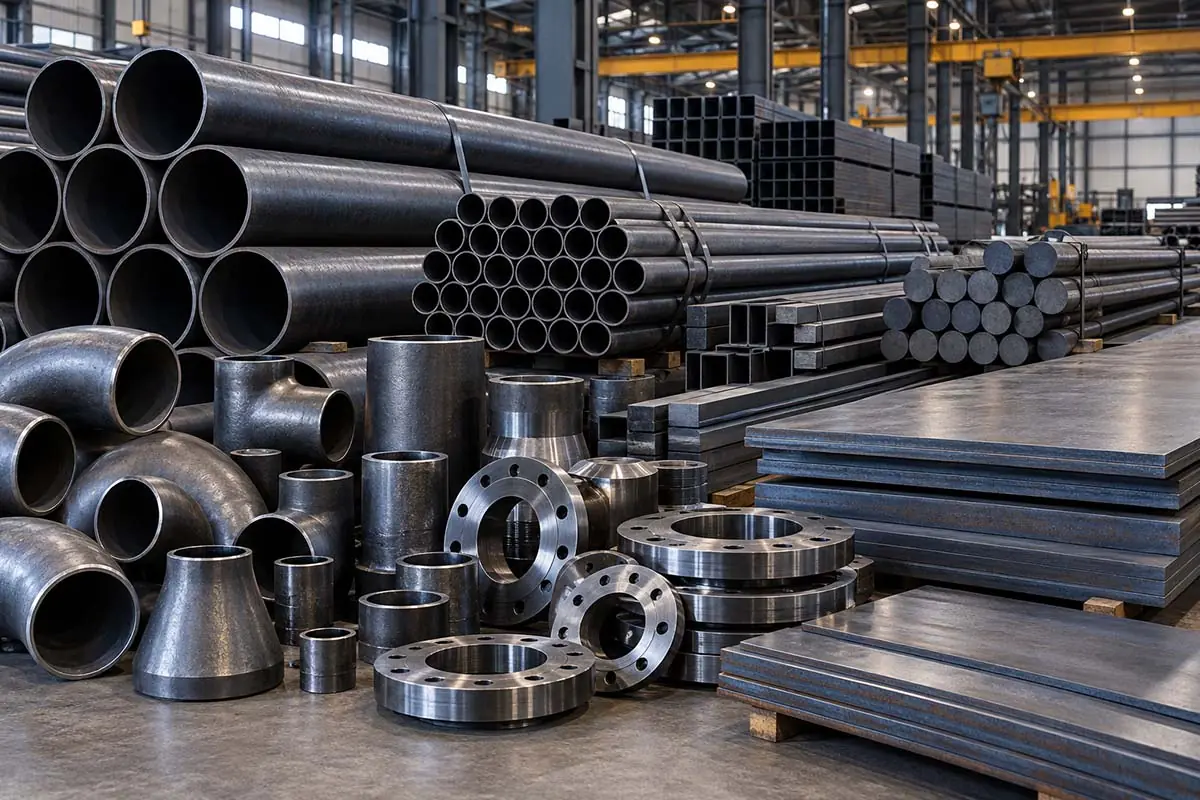
Carbon steel grades by product
| Product | Grades | Standard and use |
|---|---|---|
| Seamless pipes | A106 Gr A, B, C; A53 Gr B (Type S) | ASTM A106 for high-temperature service; A53 for general pressure use |
| Line pipe | API 5L Gr B, X42 to X70 (PSL1, PSL2) | Oil and gas transmission – see API 5L pipes |
| Low-temperature pipe | A333 Gr 6 | ASTM A333, impact tested |
| ERW pipes | A53 Type E Gr A, B; API 5L ERW | Welded pressure and line pipe |
| Boiler and heat-exchanger tubes | A179, A192, A210 Gr A1 and C | Seamless tubes for boilers, condensers and heat exchangers |
| Flanges | A105; A350 LF2; A694 F42 to F70 | Forgings for ambient/high temperature, low temperature and pipelines |
| Pipe fittings | A234 WPB, WPC; A420 WPL6; MSS SP-75 WPHY | Butt-weld fittings; A105 for forged fittings |
| Plates | A516 Gr 60, 65, 70; A515 Gr 70 | Pressure vessel plates |
| Round bars | A105, A350 LF2, EN8 | Forged and machined parts |
| Fasteners | A307, ISO 898-1 classes | General and structural bolting |
Popular grade pages: ASTM A106 Grade B pipes, ASTM A105 flanges, ASTM A234 WPB fittings and ASTM A516 Grade 70 plates.
A matched carbon steel piping system
A typical carbon steel process line combines A106 Grade B seamless pipe, A234 WPB butt-weld fittings, A105 flanges and forged fittings, and A193 B7 / A194 2H stud bolts. These grades have compatible strength and weldability and appear together in most refinery and petrochemical piping specifications. For low-temperature lines, the equivalent set is A333 Grade 6 pipe, A420 WPL6 fittings, A350 LF2 flanges and A320 L7 bolting, all impact tested at the specified temperature. For pipelines, API 5L pipe is matched with MSS SP-75 WPHY fittings and A694 flanges of corresponding yield strength.
Keeping to one matched set also simplifies welding procedure qualification and inspection.
Temperature and corrosion guidance
Carbon steel is suitable for non-corrosive or mildly corrosive fluids – hydrocarbons, steam, boiler feed water, air, nitrogen and many utilities – usually with a corrosion allowance added to the wall thickness. At low temperatures it can become brittle, so impact-tested grades such as A333 Grade 6 and A350 LF2 are used below the limits set by the design code. At sustained high temperatures carbon steel loses strength and can graphitise, so chrome-moly alloy steel takes over for high-temperature steam and furnace service. For wet sour service, materials are supplied to NACE MR0175 / ISO 15156 on request, with hardness controls.
For cooling water, firewater and buried lines, carbon steel is usually protected by internal or external coatings, linings or cathodic protection rather than by changing material.
Line pipe: PSL1 and PSL2
API 5L line pipe is made in two product specification levels. PSL1 is the basic level. PSL2 adds tighter limits on chemistry and carbon equivalent, maximum as well as minimum yield and tensile strength, mandatory notch toughness testing and stricter non-destructive inspection, so it is specified for higher-pressure and critical pipelines and for sour service. Grades such as X52 or X65 indicate the minimum yield strength in thousands of psi.
Ordering carbon steel
Please give the product, specification and grade (for example A106 Gr B seamless, API 5L X52 PSL2, A105 weld neck flanges), size, schedule or class, length, quantity, any impact test temperature or NACE MR0175 / ISO 15156 requirement, coating, and the inspection required.
Documents and inspection
Carbon steel material is supplied with mill test certificates (MTC) showing heat number, chemical composition including carbon equivalent where required, and mechanical and impact test results. Third-party inspection can be arranged on request. Pipes and fittings can be supplied black, varnished, painted or galvanised as ordered. Browse the other families on our materials page.
Frequently Asked Questions
ASTM A106 Grade B seamless pipe is the most widely specified carbon steel pipe for process piping. It is often dual certified with ASTM A53 Grade B and API 5L Grade B.
Mild steel is a low-carbon steel. In practice, pressure products made to ASTM and API standards such as A106 and A516 are called carbon steel, while structural and general products to IS 2062 are called mild steel.
Impact-tested grades are used: ASTM A333 Grade 6 for pipe, A350 LF2 for flanges and forgings, A420 WPL6 for fittings and A516 with impact testing for plates. They are tested at the minimum design temperature.
ASTM A105 is the specification for carbon steel forgings for piping components. It is the standard material for carbon steel flanges, forged fittings and valves for ambient and higher-temperature service.
Yes. Carbon steel pipes, fittings, flanges and bolting can be supplied to NACE MR0175 / ISO 15156 on request, with the hardness and testing that the standard requires.
ASTM A106 covers seamless carbon steel pipe for high-temperature service. ASTM A53 covers seamless and welded pipe for general pressure and mechanical use. A106 Grade B is the usual choice for process piping, and pipe is often dual certified to both.
Request a Quote
Tell us the product, grade, size, standard, quantity and delivery location, and our sales team will reply with a quotation.