
Carbon Steel Plates
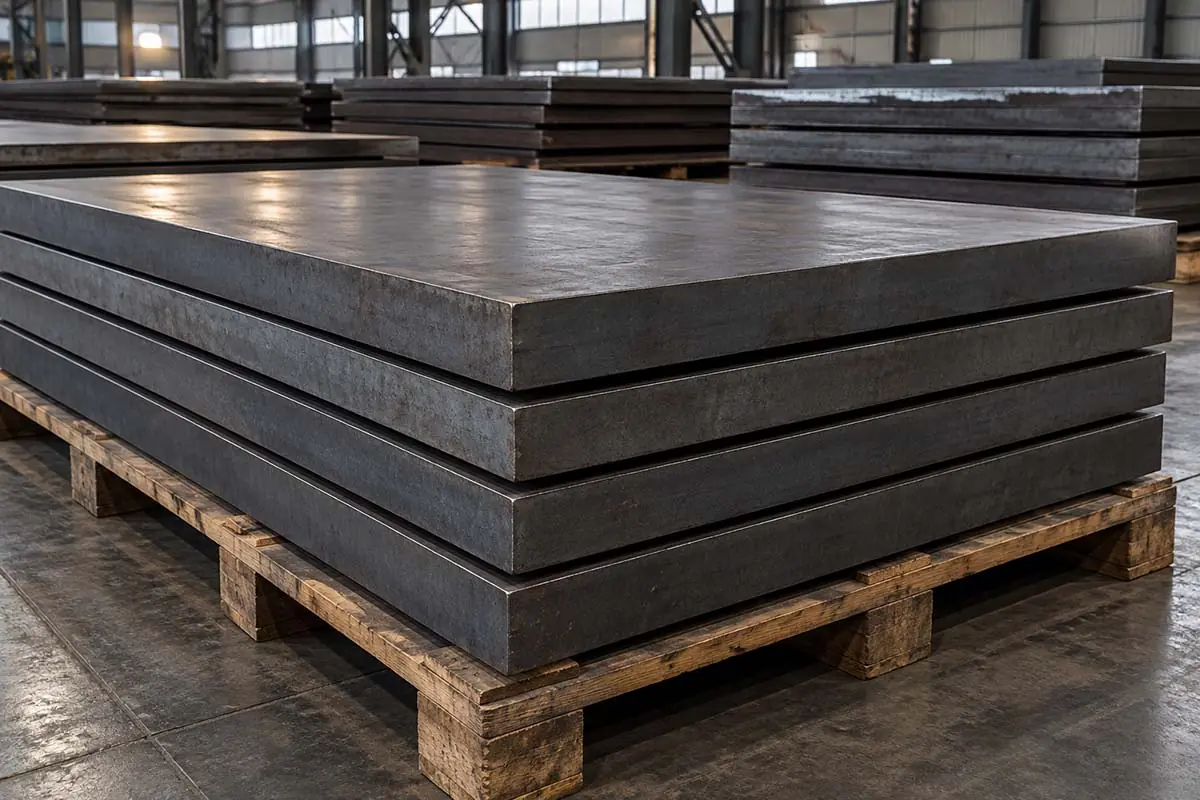
Giriraj Impex stocks, supplies and exports carbon steel plates for pressure vessels, boilers and structures – ASTM A516 Grades 60, 65 and 70, IS 2002 boiler quality plates, ASTM A36 and IS 2062 structural plates. We supply carbon steel plates from approved mills in as-rolled or normalised condition, with mill test certificates and supplementary tests such as impact and ultrasonic testing on request.
Carbon steel plate is the main material for pressure vessels, boilers, storage tanks, heat-exchanger shells and heavy fabrications in refineries, petrochemical and fertiliser plants, power stations and engineering works.
Specifications
| Standard | Grades | Use |
|---|---|---|
| ASTM A516 / ASME SA516 | Grade 55, 60, 65, 70 | Pressure vessels for moderate and lower temperature service |
| ASTM A515 / ASME SA515 | Grade 60, 65, 70 | Pressure vessels for intermediate and higher temperature service |
| IS 2002 | Grade 1, 2, 3 | Boilers and pressure vessels to Indian standards |
| ASTM A36 | – | Structural plate |
| IS 2062 | E250, E350 (A, BR, B0, C) | Structural plate; see also mild steel plates |
| Item | Details |
|---|---|
| Condition | As rolled or normalised, as the specification and order require |
| Supplementary tests | Charpy impact test, ultrasonic test (ASTM A435, A578), simulated post-weld heat treatment, through-thickness (Z) test |
| Sizes | Thickness, width and length to mill range; confirmed on enquiry |
| Documents | Mill test certificate (MTC); third-party inspection on request |
ASTM A516 mechanical properties
ASTM A516 grades differ mainly in strength; Grade 70 is the most widely used because its higher strength allows thinner vessel walls. See ASTM A516 Grade 70 plates for detail.
| Grade | Tensile strength, MPa (ksi) | Yield strength min, MPa (ksi) |
|---|---|---|
| Grade 60 | 415–550 (60–80) | 220 (32) |
| Grade 65 | 450–585 (65–85) | 240 (35) |
| Grade 70 | 485–620 (70–90) | 260 (38) |
Chemical composition limits (carbon and manganese vary with plate thickness) and elongation requirements are as given in the standard.
A516 or A515?
Both specifications cover carbon steel plates for pressure vessels with similar strength grades. ASTM A516 is made with fine-grain practice and has better notch toughness, so it is the usual choice for vessels operating at ambient and lower temperatures, and it can be impact tested for low-temperature service. ASTM A515 is intended for intermediate and higher temperatures, where toughness is less critical. In practice A516 has become the default for most new vessels, and many fabricators stock only A516 Grade 70.
Normalising, impact and ultrasonic testing
Thicker A516 plates are normalised to refine the grain and improve toughness, and normalising can be ordered for thinner plates too. For low-temperature vessels, Charpy impact testing at the minimum design metal temperature is added as a supplementary requirement. Plates for nozzles, tube sheets and other critical parts are often ultrasonically tested to ASTM A435 or A578 to confirm they are free from laminations. Where vessels will be post-weld heat treated, test coupons can be given a simulated PWHT so the mill certificate shows properties after heat treatment.
Ordering carbon steel plates
Please give the specification and grade, thickness, width, length and quantity, the heat-treatment condition, and any supplementary tests – impact test temperature, ultrasonic test standard and level, simulated PWHT – together with the inspection required and the design code if it is a pressure vessel. Plates are marked by the mill with specification, grade, heat number and dimensions, and checked against the mill test certificate before dispatch.
Thickness and toughness
As plate thickness increases, it becomes harder to achieve uniform toughness through the section, which is why heavier A516 plates are normalised and why low-temperature vessels often need impact tests at the mid-thickness position. Through-thickness (Z-direction) testing is specified for plates welded with high stress across their thickness, such as nozzle reinforcement and structural nodes, to check resistance to lamellar tearing. These requirements are taken from the design code and added to the order as supplementary requirements.
Applications and related products
Carbon steel plates are used for pressure vessels, columns, separators and drums, boilers and boiler drums, storage tanks, heat-exchanger shells and channels, skirts and supports, and heavy structures. For complete equipment we also supply carbon steel seamless pipes, ERW pipes, flanges, pipe fittings, round bars and fasteners. For high-temperature vessels see alloy steel plates. All plate materials are on the plates page and grade guidance on the carbon steel page.
Frequently Asked Questions
ASTM A516 Grade 70 is carbon steel plate for pressure vessels operating at moderate and lower temperatures. It is widely used for boilers, pressure vessels, separators and storage tanks.
A516 is a pressure vessel plate with controlled chemistry, toughness and testing, certified for code vessels. A36 is a structural plate for buildings, bridges and frames and is not normally used for pressure-retaining parts.
IS 2002 is the Indian standard for steel plates for boilers and pressure vessels, in Grades 1, 2 and 3. It is used for boilers and vessels built to Indian regulations.
Normalising refines the grain structure and improves toughness and uniformity, especially in thicker plates. It is required for thicker A516 plate and can be ordered for thinner plate.
Yes. Charpy impact testing at a specified temperature can be added to A516 plates as a supplementary requirement for low-temperature vessels.
Yes. Plates can be supplied certified to ASME SA516 for pressure vessels built to the ASME Boiler and Pressure Vessel Code.
Request a Quote for Carbon Steel Plates
Tell us the product, grade, size, standard, quantity and delivery location, and our sales team will reply with a quotation.