
Stainless Steel Plates
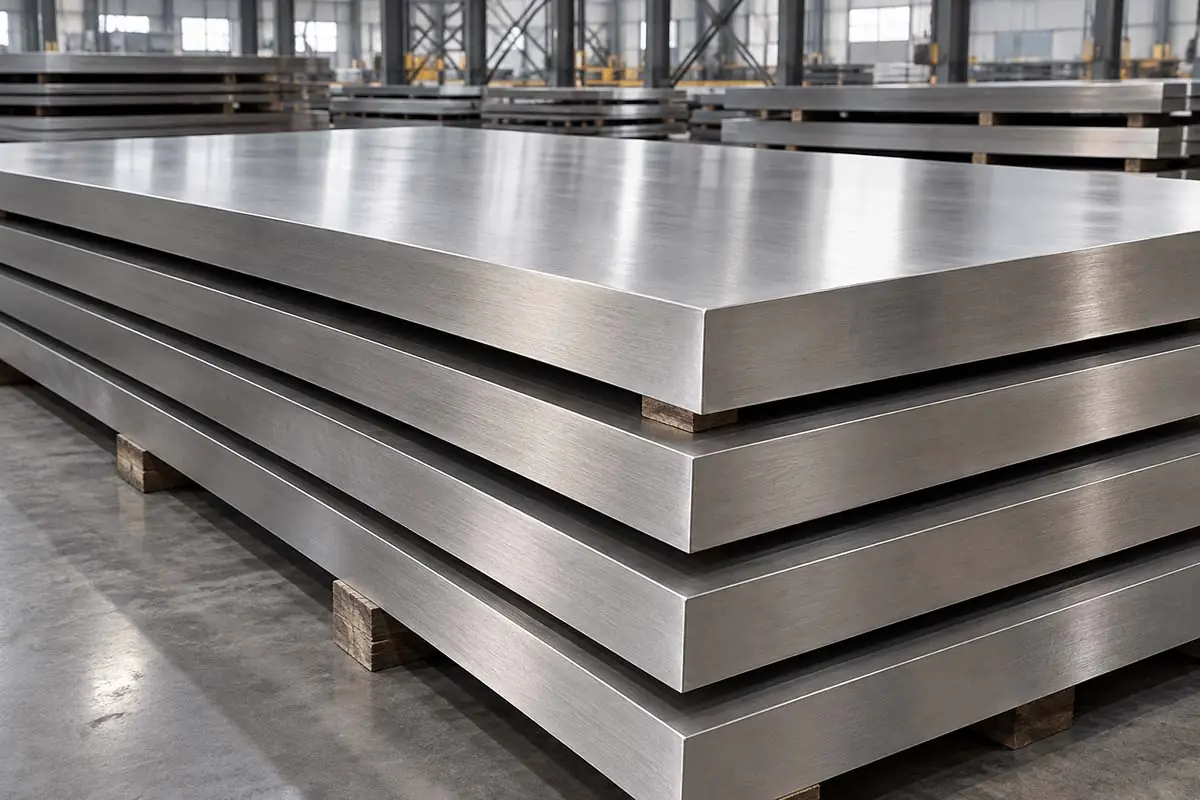
Giriraj Impex stocks, supplies and exports stainless steel plates to ASTM A240 / ASME SA240 in grades 304, 304L, 316, 316L, 321, 317L, 310S and 904L. We supply hot-rolled stainless steel plates from approved mills, solution annealed and pickled, in thicknesses commonly from about 3 mm to 100 mm depending on grade and mill, with mill test certificates.
Stainless plate is used where thickness and strength are needed together with corrosion resistance – pressure vessels, storage tanks, reactors, heat-exchanger tube sheets and shells, flanges and structural parts in chemical, pharmaceutical, food, water and marine applications.
Specifications
| Item | Details |
|---|---|
| Standard | ASTM A240 / ASME SA240; general requirements ASTM A480 |
| Grades | 304, 304L, 304H, 316, 316L, 316Ti, 317L, 321, 347, 310S, 904L |
| Thickness | Commonly about 3 mm to 100 mm, depending on grade and mill range |
| Production | Hot rolled, solution annealed and pickled (finish 1) |
| Edges | Mill edge or trimmed edge |
| Optional tests | Ultrasonic testing, intergranular corrosion test to ASTM A262 Practice E, impact test |
| Documents | Mill test certificate (MTC); third-party inspection on request |
Plate width and length depend on thickness and mill; please give the sizes you need and we will confirm availability.
Grades for plate applications
| Grade | UNS | Typical plate use |
|---|---|---|
| 304 / 304L | S30400 / S30403 | Tanks, vessels and structures in general corrosive service |
| 316 / 316L | S31600 / S31603 | Chloride, seawater and chemical service |
| 317L | S31703 | Flue gas desulphurisation and more aggressive chemical duties |
| 321 / 347 | S32100 / S34700 | Stabilised grades for elevated-temperature equipment |
| 310S | S31008 | Furnace parts, kilns and heat-treatment fixtures |
| 904L | N08904 | Sulphuric and phosphoric acid equipment |
Duplex plates are on the duplex sheets and plates page, and grade details on the stainless steel page.
Composition and mechanical properties
ASTM A240 requirements for the 304 and 316 families are shown below. Plate certified as 316/316L meets the low carbon limit of 316L and the strength of 316.
| Grade | UNS | C | Mn | P | S | Si | Cr | Ni | Mo | N |
|---|---|---|---|---|---|---|---|---|---|---|
| 304 | S30400 | 0.07 | 2.00 | 0.045 | 0.030 | 0.75 | 17.5–19.5 | 8.0–10.5 | – | 0.10 |
| 304L | S30403 | 0.030 | 2.00 | 0.045 | 0.030 | 0.75 | 17.5–19.5 | 8.0–12.0 | – | 0.10 |
| 316 | S31600 | 0.08 | 2.00 | 0.045 | 0.030 | 0.75 | 16.0–18.0 | 10.0–14.0 | 2.00–3.00 | 0.10 |
| 316L | S31603 | 0.030 | 2.00 | 0.045 | 0.030 | 0.75 | 16.0–18.0 | 10.0–14.0 | 2.00–3.00 | 0.10 |
Other elements and footnotes as given in the standard.
| Grade | Tensile strength min, MPa (ksi) | Yield strength min, MPa (ksi) | Elongation in 50 mm min, % | Hardness max, HBW / HRB |
|---|---|---|---|---|
| 304 | 515 (75) | 205 (30) | 40 | 201 / 92 |
| 304L | 485 (70) | 170 (25) | 40 | 201 / 92 |
| 316 | 515 (75) | 205 (30) | 40 | 217 / 95 |
| 316L | 485 (70) | 170 (25) | 40 | 217 / 95 |
Values for annealed material.
Plates for pressure equipment
For pressure vessels built to the ASME Boiler and Pressure Vessel Code, plates are ordered as ASME SA240 so that the mill certification meets the code. Thick plates for tube sheets and flanges are often ordered with ultrasonic testing to confirm they are free of laminations, and plates for low-temperature service with impact tests. Where plates are rolled into shells, the rolling direction and the forming method should be considered, and heads formed from plate may need re-annealing to restore corrosion resistance. Tell us the design code and the intended fabrication so the right certification and tests can be arranged.
Storage, cutting and fabrication
Stainless plates should be stored on timber or non-metallic supports, away from carbon steel, and lifted with clean slings or vacuum lifters to avoid iron contamination. They are cut by plasma, laser or water jet; thermal cutting leaves a heat-affected edge that is usually ground before welding. After fabrication, welds and heat-tinted areas are pickled and passivated. Circles and rings cut from plate are covered on our stainless steel circles and stainless steel rings pages.
Heat treatment and corrosion testing
Stainless plates are supplied solution annealed, which dissolves chromium carbides and gives full corrosion resistance. If plates are hot formed or stress relieved in fabrication, a further solution anneal may be needed to restore that condition. For equipment in aggressive service, an intergranular corrosion test to ASTM A262 Practice E confirms the plate is not sensitised, and for chloride service a ferric chloride pitting test can be specified for higher-alloy grades. These tests are agreed with the order and reported with the mill test certificate.
Applications and related products
Stainless steel plates are used for pressure vessels, columns and reactors, storage and process tanks, heat-exchanger shells and tube sheets, flanges and blinds, pulp and paper digesters, desalination units, food and pharmaceutical vessels, marine and offshore structures and architectural work. For thinner material see stainless steel sheets and coils. To complete a project we also supply stainless seamless pipes, welded pipes, tubes, flanges, pipe fittings, round bars, wires, fasteners, angles, channels and flats. All plate materials are on the plates page.
Frequently Asked Questions
ASTM A240 (ASME SA240 for code work) covers stainless steel plate, sheet and strip for pressure vessels and general use. Tolerances, finishes and general requirements are in ASTM A480.
Stainless plates are commonly supplied from about 3 mm to 100 mm thick, depending on the grade and mill range. Please give the thickness, width and length you need and we will confirm availability.
Hot-rolled stainless plates are normally supplied solution annealed and pickled, which is ASTM A480 finish 1 – a dull, slightly rough, clean surface suitable for fabrication.
Yes. Ultrasonic testing to a stated standard and acceptance level can be specified, which is common for thick plates used for tube sheets and flanges.
304H has a controlled higher carbon range, which gives better strength at elevated temperatures. It is used for high-temperature pressure equipment, while 304L is preferred for welded construction at normal temperatures.
Yes. Plates can be supplied certified to ASME SA240 for pressure vessels built to the ASME code, along with any supplementary tests required by the design.
Request a Quote for Stainless Steel Plates
Tell us the product, grade, size, standard, quantity and delivery location, and our sales team will reply with a quotation.