
Stainless Steel Flats
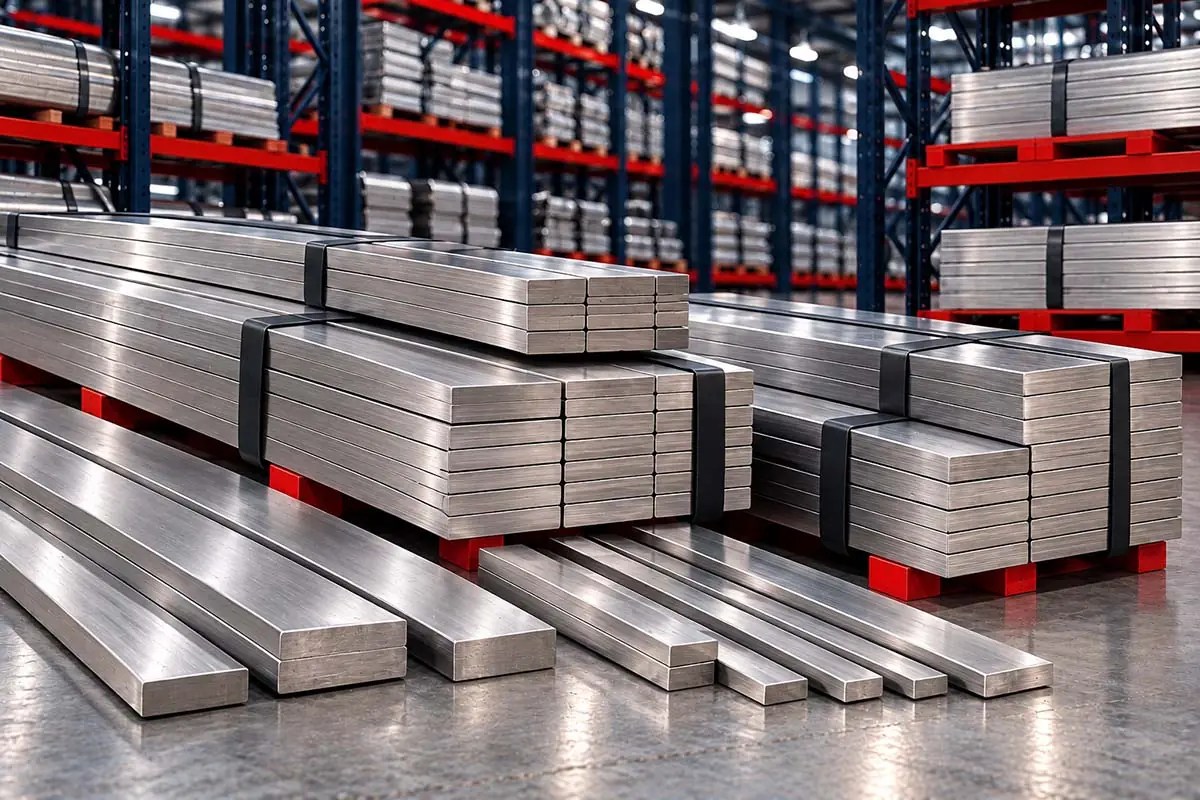
Giriraj Impex stocks, supplies and exports stainless steel flats – flat bars – to ASTM A276 and ASTM A484 in grades 304, 304L, 316 and 316L, with 321, 310S and duplex 2205 on request. We supply stainless steel flats from approved mills hot rolled and annealed, laser fused to ASTM A1069, or bent from sheet and plate, in standard mill sizes and lengths or cut to length, with mill test certificates.
Stainless steel flat bars are used for base plates, brackets, gussets, frames, railings, earthing strips and trims in food, pharmaceutical, chemical, marine and architectural work.
Specifications
| Item | Details |
|---|---|
| Standards | ASTM A276 and A479 (hot rolled); ASTM A484 (tolerances); ASTM A1069 (laser fused); ASTM A240 (bent from plate) |
| Grades | 304, 304L, 316, 316L; 321, 310S, duplex 2205 on request |
| Types | Hot-rolled, cold-drawn and cut-from-plate flats |
| Sizes | Standard mill sizes; other sizes on enquiry |
| Length | Standard mill lengths, typically 6 m, or cut to length |
| Finish | Annealed and pickled; brushed or polished on request |
| Documents | Mill test certificate (MTC); third-party inspection on request |
Chemical composition and mechanical properties
The ASTM A240 limits below are typical of 304/304L and 316/316L; bar standards A276 and A479 give similar limits.
| Grade | UNS | C | Mn | P | S | Si | Cr | Ni | Mo | N |
|---|---|---|---|---|---|---|---|---|---|---|
| 304 | S30400 | 0.07 | 2.00 | 0.045 | 0.030 | 0.75 | 17.5–19.5 | 8.0–10.5 | – | 0.10 |
| 304L | S30403 | 0.030 | 2.00 | 0.045 | 0.030 | 0.75 | 17.5–19.5 | 8.0–12.0 | – | 0.10 |
| 316 | S31600 | 0.08 | 2.00 | 0.045 | 0.030 | 0.75 | 16.0–18.0 | 10.0–14.0 | 2.00–3.00 | 0.10 |
| 316L | S31603 | 0.030 | 2.00 | 0.045 | 0.030 | 0.75 | 16.0–18.0 | 10.0–14.0 | 2.00–3.00 | 0.10 |
Other elements and footnotes as given in the standard.
| Grade | Tensile strength, MPa (ksi) | Yield strength, MPa (ksi) | Elongation in 50 mm, % | Reduction of area, % |
|---|---|---|---|---|
| 304 | 515 (75) | 205 (30) | 30 | 40 |
| 304L | 485 (70) | 170 (25) | 30 | 40 |
| 316 | 515 (75) | 205 (30) | 30 | 40 |
| 316L | 485 (70) | 170 (25) | 30 | 40 |
Chemical composition as given in ASTM A479 / A276 for each grade.
Choosing the grade
304 / 304L is the general-purpose grade for indoor structures, food and dairy plants and architecture away from the coast. 316 / 316L is chosen for coastal and marine sites, chemical and pharmaceutical plants, water treatment and wherever chlorides are present. 321 and 310S are used for high-temperature supports and furnace structures, and duplex 2205 where higher strength and chloride resistance are needed. The low-carbon L grades are preferred for welded structures.
Hot rolled, laser fused or bent
Hot-rolled stainless flats are rolled from billet and annealed; they have slightly rounded corners and are the standard choice for structural use. Laser-fused sections are made by fusing strips together with a laser beam, giving sharp corners, close tolerances and sizes not available from rolling mills. Bent sections are press-brake formed from sheet or plate, with an inside radius at the corners; they are economical for lighter sections and special profiles.
Surface finish
Hot-rolled sections are supplied annealed and pickled, with a matt surface. Laser-fused sections have a pickled or brushed finish. For architectural and visible work, sections can be supplied polished – for example No. 4 or 320 grit brushed – with protective film on request. Surface finish should be stated in the order, because it affects appearance, cleanability and corrosion behaviour.
Hot rolled, cold drawn and cut flats
Hot-rolled stainless flats are rolled to width and thickness and annealed, with slightly rounded edges. Cold-drawn or cold-finished flats have sharp edges, close tolerances and a smooth surface, ideal for machined parts and visible trims. Flats wider or thicker than the mill range are cut from plate by shearing, plasma or laser cutting. Flats are described by width and thickness, for example 40 × 5 mm.
Fabrication and care
Stainless flats are cut by saw or abrasive disc, drilled and welded with matching filler – 308L for 304, 316L for 316. Welds are pickled and passivated to restore corrosion resistance. Use dedicated tools and keep stainless separate from carbon steel to avoid iron contamination, and use stainless or insulated fasteners to prevent galvanic corrosion at connections.
Weight, packing and storage
Stainless flats are sold by weight or by length. Theoretical weight is calculated from the cross-section and a density of about 7.9–8.0 g/cm³ – slightly heavier than mild steel – and can be checked with our weight calculator. Sections are bundled and tagged with grade, size and heat number, wrapped to protect polished surfaces, and packed in wooden crates or on pallets for export. Store stainless sections indoors or under cover, off the ground on timber, and away from carbon steel to prevent contamination and rust spotting.
Flats for gratings and earthing
Stainless steel flats are used as bearing bars in floor gratings for food, chemical and offshore plants, where open mesh flooring must resist corrosion without coating. They are also used for earthing conductors and lightning protection in corrosive soils, coastal sites and chemical plants, where galvanised steel strips corrode. Size is chosen for the fault current or load, and grade 316 is usual for buried or coastal use.
Applications and related products
Stainless steel flats are used for base plates, cleats and gussets, brackets and hangers, frames and supports, railings and balusters, earthing strips, grating bars, machine parts and decorative trims. All materials are on the flats page. In stainless steel we also supply seamless pipes, welded pipes, tubes, flanges, pipe fittings, sheets, plates, round bars, fasteners, coils, circles, wires, angles, channels, rings. Grade information is on the stainless steel page.
Frequently Asked Questions
ASTM A276 and A479 cover stainless flat bars, with tolerances in ASTM A484.
Hot-rolled flats have slightly rounded edges and wider tolerances; cold-drawn flats have sharper edges, a smoother surface and closer tolerances.
Yes. Wider and thicker flats are cut from plate by shearing, plasma or laser.
Yes. Stainless flats are used for earthing in corrosive soils and coastal sites, where they last longer than galvanised steel.
Annealed 304 flats are non-magnetic; cold-drawn flats may be slightly magnetic.
Yes. Flats can be supplied brushed or polished for visible work.
Request a Quote for Stainless Steel Flats
Tell us the product, grade, size, standard, quantity and delivery location, and our sales team will reply with a quotation.