
SS 310S Plates
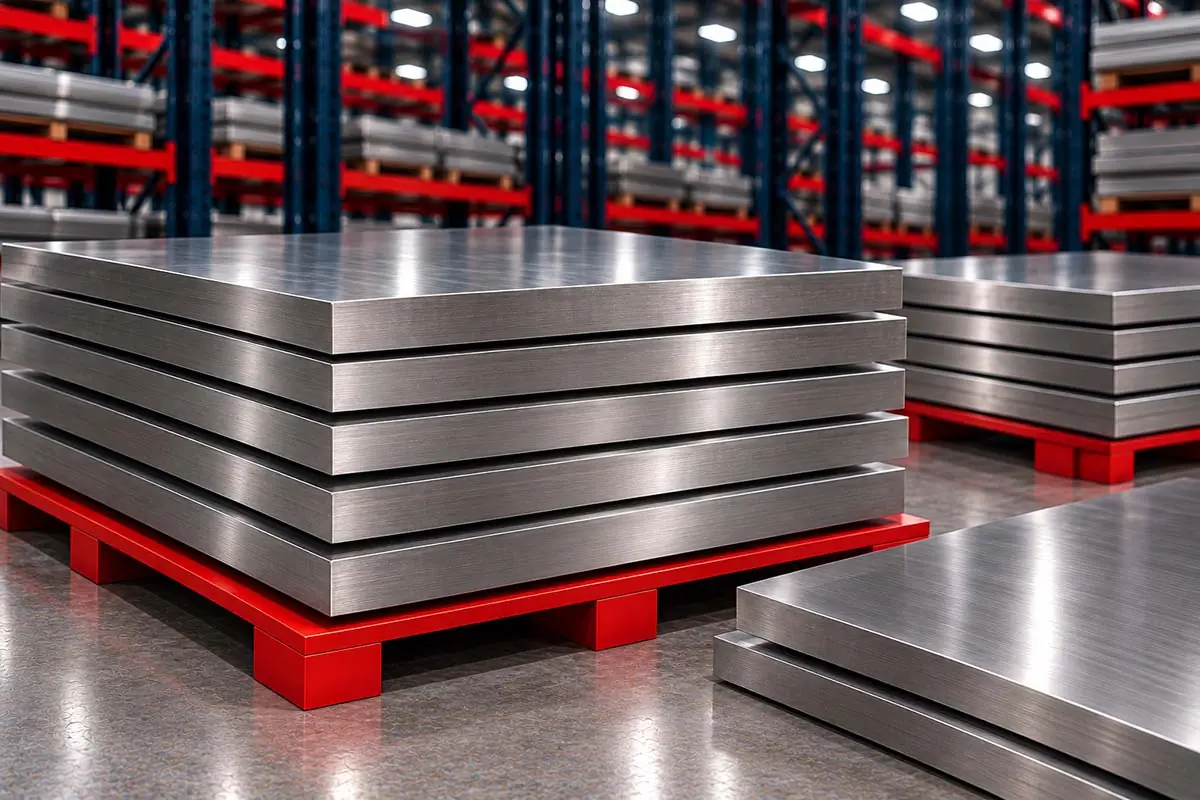
Giriraj Impex stocks, supplies and exports SS 310S plate and sheet to ASTM A240 / ASME SA240, UNS S31008, with 310 and 310H on request. We supply SS 310S plates hot rolled, annealed and pickled, and 310S sheets cold rolled in 2B finish, from approved mills, in full sizes or cut to size, with mill test certificates.
SS 310S plate is the standard heat-resistant stainless plate for furnace parts, heat-treatment fixtures, kilns, burners and heat shields, resisting oxidation in air up to about 1100 °C.
Specifications
| Item | Details |
|---|---|
| Standard | ASTM A240 / ASME SA240; ASTM A480 general requirements |
| Grades | 310S (S31008); 310 (S31000) and 310H (S31009) on request |
| Production | Plate hot rolled; sheet cold rolled |
| Finish | Plate: annealed and pickled. Sheet: 2B |
| Thickness and size | As the mill range allows; cut to size on request |
| Documents | Mill test certificate (MTC); third-party inspection on request |
Chemical composition and mechanical properties
| Grade | UNS | C | Mn | Si | P | S | Cr | Ni | Mo | Other elements |
|---|---|---|---|---|---|---|---|---|---|---|
| 310S | S31008 | 0.08 | 2.00 | 1.50 | 0.045 | 0.030 | 24.0–26.0 | 19.0–22.0 | 0.75 | – |
| 321 | S32100 | 0.08 | 2.00 | 0.75 | 0.045 | 0.030 | 17.0–19.0 | 9.0–12.0 | – | N 0.10; Ti 5 × (C + N) min, 0.70 max |
| 904L | N08904 | 0.020 | 2.00 | 1.00 | 0.045 | 0.035 | 19.0–23.0 | 23.0–28.0 | 4.0–5.0 | Cu 1.0–2.0; N 0.10 |
Limits for plate, sheet and strip to ASTM A240. Pipe (A312), bar (A276/A479) and forging (A182) limits are similar; check the standard for the product form.
| Grade | Tensile strength, MPa (ksi) | Yield strength 0.2%, MPa (ksi) | Elongation, % | Hardness max |
|---|---|---|---|---|
| 310S | 515 (75) | 205 (30) | 40 | 217 HB |
| 321 | 515 (75) | 205 (30) | 40 | 217 HB |
| 904L | 490 (71) | 220 (31) | 35 | 90 HRB |
Values for plate, sheet and strip to ASTM A240.
Background and equivalents are on the SS 310 / 310S page.
Furnace and heat-treatment uses
SS 310S plate is used for furnace muffles, retorts and hearths, radiant tubes and burner parts, heat-treatment baskets, trays and fixtures, kiln and calciner linings, annealing covers, heat exchangers and recuperators, flue and exhaust ducting, and heat shields. Its 25% chromium and 20% nickel form a protective oxide that resists scaling in continuous service up to about 1100 °C, and somewhat lower in cyclic service, where repeated heating and cooling cracks the scale. It also resists carburising atmospheres better than 304 and 321.
Design considerations
At high temperatures, strength falls and creep governs design; 310H, with controlled carbon, is specified where creep strength must be guaranteed for pressure parts. Austenitic stainless steel expands about 50% more than carbon steel, so furnace parts are designed with room for expansion. Long service between about 650 °C and 900 °C can form sigma phase, which reduces room-temperature toughness; parts that cycle to ambient should be designed with this in mind. In strongly reducing sulphur-bearing atmospheres, lower-nickel alloys may perform better.
Weight chart
| Thickness, mm | kg/m² | Sheet 1250 × 2500 mm, kg |
|---|---|---|
| 1 | 7.9 | 24.7 |
| 2 | 15.8 | 49.4 |
| 3 | 23.7 | 74.1 |
| 5 | 39.5 | 123.4 |
| 6 | 47.4 | 148.1 |
| 8 | 63.2 | 197.5 |
| 10 | 79.0 | 246.9 |
| 12 | 94.8 | 296.3 |
| 16 | 126.4 | 395.0 |
| 20 | 158.0 | 493.8 |
| 25 | 197.5 | 617.2 |
Use our weight calculator for other sizes.
Fabrication
310S plate is cut by plasma or water-jet and sheet by shearing or laser. It forms well cold, though it work-hardens. It is welded with matching 310 filler using low heat input, because fully austenitic welds can be prone to hot cracking. Post-weld heat treatment is not normally needed.
Ordering SS 310S plates
Please give the grade, thickness, plate or sheet size or cut sizes, finish, quantity and any testing or inspection requirement. Sheets are packed flat on pallets and plates on wooden skids; each piece is marked with grade, specification, heat number and size.
310S compared with other heat-resistant plates
For lower temperatures, SS 304H, 321 and 309S plates are less costly alternatives: 321 is used up to about 900 °C where intergranular corrosion after high-temperature exposure is a concern, and 309S, with 23% chromium and 13% nickel, sits between 304 and 310S. For higher creep strength or more aggressive atmospheres, nickel alloys such as Incoloy 800H and Inconel 600 or 601 plates are used. 310S is the usual choice where oxidation resistance up to about 1100 °C is needed at moderate cost.
Cut parts and circles
Furnace components are often made from cut plate – circles for retort ends, rings for flanges, strips for baskets and supports. Plates can be supplied cut to size or as circles and rings from the parent plate, each marked with the heat number for traceability to the mill test certificate.
Applications and related products
SS 310S plates are used in furnaces, kilns, heat-treatment equipment, burners, boilers and petrochemical heaters. Other stainless plates are on the stainless steel plates page and all materials on the plates page.
Frequently Asked Questions
ASTM A240 (ASME SA240) applies to 310S (UNS S31008) plate, sheet and strip.
SS 310S resists oxidation in continuous service up to about 1100 °C in air, somewhat lower in cyclic service.
310S has a maximum carbon of 0.08% against 0.25% for 310, reducing sensitisation and embrittlement.
For furnace muffles and retorts, heat-treatment fixtures, kilns, burners, recuperators and heat shields.
Matching 310 filler metal, with low heat input.
About 79 kg per square metre, using a density of 7.9 g/cm³.
Request a Quote for SS 310S Plates
Tell us the product, grade, size, standard, quantity and delivery location, and our sales team will reply with a quotation.
Inconel® and Incoloy® are trademarks of Special Metals Corporation.