
SS 310 / 310S – Chemical Composition, Equivalents & Products
SS 310 is a high-chromium, high-nickel austenitic stainless steel – about 25% chromium and 20% nickel – designed for high-temperature service. It resists oxidation in air up to around 1100 °C, as well as scaling, carburisation and sulphidation in many furnace atmospheres. SS 310S (UNS S31008) is the low-carbon version, with a 0.08% carbon maximum against 0.25% for 310 (UNS S31000); it is the form normally supplied as plate, sheet and pipe because it is less prone to sensitisation and embrittlement during welding and service.
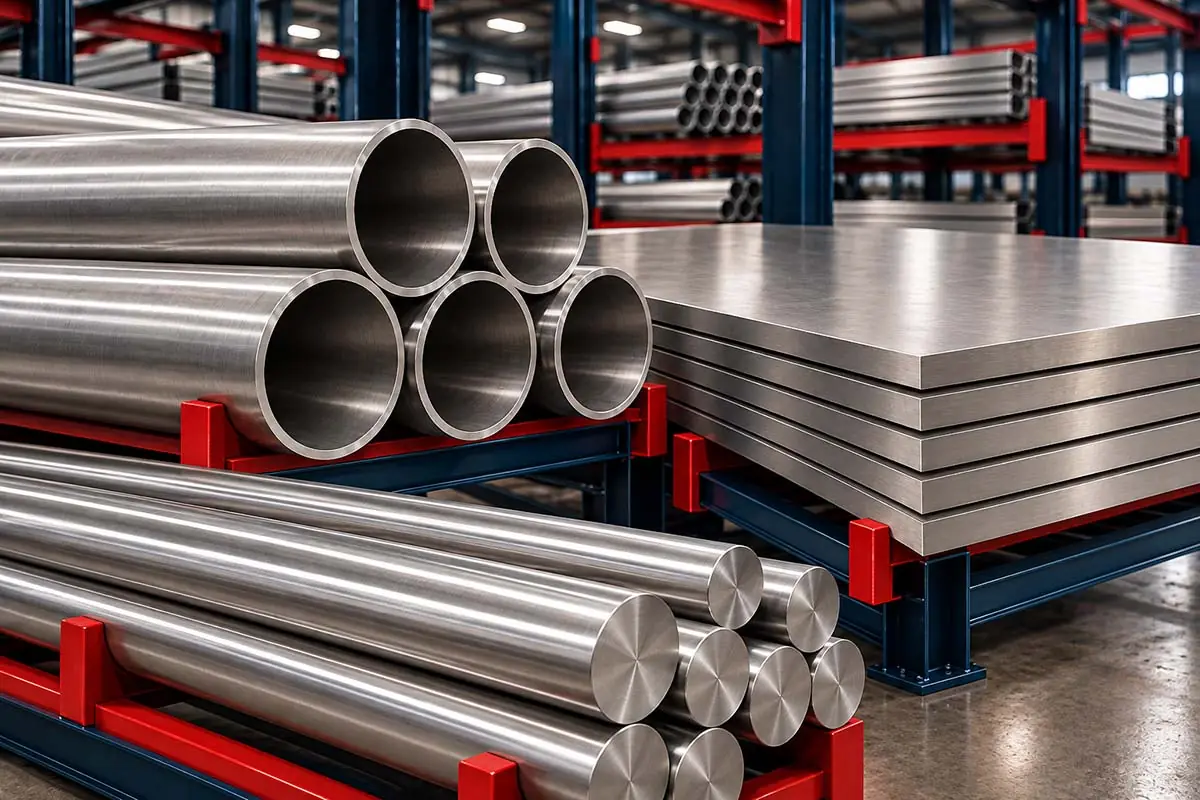
Giriraj Impex supplies SS 310 and 310S in every product form – we manufacture flanges, fittings, bars and fasteners, and stock and supply pipes, tubes, plates and sheets.
Chemical composition
| Grade | UNS | C | Mn | Si | P | S | Cr | Ni | Mo | Other elements |
|---|---|---|---|---|---|---|---|---|---|---|
| 310S | S31008 | 0.08 | 2.00 | 1.50 | 0.045 | 0.030 | 24.0–26.0 | 19.0–22.0 | 0.75 | – |
| 321 | S32100 | 0.08 | 2.00 | 0.75 | 0.045 | 0.030 | 17.0–19.0 | 9.0–12.0 | – | N 0.10; Ti 5 × (C + N) min, 0.70 max |
| 904L | N08904 | 0.020 | 2.00 | 1.00 | 0.045 | 0.035 | 19.0–23.0 | 23.0–28.0 | 4.0–5.0 | Cu 1.0–2.0; N 0.10 |
Limits for plate, sheet and strip to ASTM A240. Pipe (A312), bar (A276/A479) and forging (A182) limits are similar; check the standard for the product form.
Grade 310 (S31000), with carbon up to 0.25%, is mainly supplied as bar and forgings for high-temperature strength. 310H (S31009), with carbon between 0.04% and 0.10%, is specified where creep strength must be guaranteed. The mill test certificate shows the standard and actual analysis.
Mechanical properties
| Grade | Tensile strength, MPa (ksi) | Yield strength 0.2%, MPa (ksi) | Elongation, % | Hardness max |
|---|---|---|---|---|
| 310S | 515 (75) | 205 (30) | 40 | 217 HB |
| 321 | 515 (75) | 205 (30) | 40 | 217 HB |
| 904L | 490 (71) | 220 (31) | 35 | 90 HRB |
Values for plate, sheet and strip to ASTM A240.
Room-temperature strength is similar to 304, but 310S keeps useful strength and creep resistance at temperatures where 304 has become weak, and its high chromium forms a protective oxide that resists scaling.
Equivalent grades
| Grade | UNS | EN number | EN name | JIS | BS |
|---|---|---|---|---|---|
| 310S | S31008 | 1.4845 | X8CrNi25-21 | SUS310S | 310S16 |
| 321 | S32100 | 1.4541 | X6CrNiTi18-10 | SUS321 | 321S31 |
| 904L | N08904 | 1.4539 | X1NiCrMoCu25-20-5 | SUS890L | 904S13 |
Equivalent grades are similar but not identical; composition and property limits differ between standards. Order to the standard you need.
See the full grade equivalent chart for other grades and systems.
Physical properties
| Property | 310S | 321 | 904L |
|---|---|---|---|
| Density, g/cm³ | 7.9 | 7.9 | 8.0 |
| Melting range, °C | approx. 1400–1450 | approx. 1400–1425 | approx. 1300–1390 |
| Thermal conductivity at 100 °C, W/m·K | approx. 14 | approx. 16 | approx. 13 |
| Modulus of elasticity, GPa | approx. 200 | approx. 193 | approx. 195 |
| Magnetic (annealed) | No | No | No |
Typical values from recognised industry references, for guidance only; they are not specification limits.
Heat and corrosion resistance
The 25% chromium and 20% nickel give 310S excellent resistance to oxidation in continuous service up to about 1100 °C, and in intermittent service to somewhat lower temperatures, because repeated heating and cooling cracks the protective scale. It resists carburising atmospheres better than 304 and 321, and its high nickel helps in nitriding atmospheres. In strongly reducing sulphur-bearing gases, high nickel can be a disadvantage, and lower-nickel heat-resistant alloys may be preferred.
Between about 650 °C and 900 °C, 310S can form sigma phase over long periods, which reduces toughness at room temperature. Designers allow for this in equipment that cycles to ambient. In aqueous corrosion, 310S performs at least as well as 304, but it is not chosen for wet corrosion alone because 316L or higher alloys are more economical.
SS 310S products we supply
- SS 310S plates and sheets – ASTM A240, for furnace parts, heat shields and kilns.
- Seamless and welded pipes and tubes – ASTM A312 TP310S, A213 / A249 TP310S for furnace and heat-exchanger tubes.
- Flanges and forged fittings – ASTM A182 F310.
- Butt-weld fittings – ASTM A403 WP310S.
- Round bars and wire – ASTM A276 / A479 310 and 310S, for fasteners, furnace hangers and heating-element supports.
All stainless steel grades and forms are on the stainless steel page.
Comparable grades
SS 304 is used for general corrosion resistance and for heat resistance up to about 870 °C in continuous service. SS 321, stabilised with titanium, is used for welded parts in the 425–900 °C range where intergranular corrosion after high-temperature exposure is a concern. SS 309S, with 23% chromium and 13% nickel, sits between 304 and 310S and is used for intermediate temperatures and as a filler for dissimilar welds. Above the limits of 310S, nickel alloys such as Inconel 600 and 601 and Incoloy 800H are used.
Typical applications of SS 310S
310S is used for furnace parts – muffles, retorts, radiant tubes, conveyor belts, rollers and burner components – heat-treatment baskets and fixtures, kiln liners and cement kiln parts, heat exchangers and recuperators, thermowells, oil-burner parts, boiler baffles and supports, fluidised-bed combustor components, and equipment in petrochemical heaters and cryogenic service, where its stable austenite also gives good low-temperature toughness.
Fabrication
310S forms well cold, though it work-hardens. It is welded by all common processes using 310 filler metal; because fully austenitic welds can be sensitive to hot cracking, low heat input and clean joints are used. Post-weld heat treatment is not normally needed. For components that will run hot, designers allow for the high thermal expansion of austenitic stainless steel, which is about 50% greater than that of carbon steel.
Frequently Asked Questions
310S has a maximum carbon of 0.08% against 0.25% for 310. The lower carbon reduces sensitisation and embrittlement during welding and service, so 310S is the usual form for plate, sheet and pipe.
SS 310S resists oxidation in continuous service up to about 1100 °C in air, and to somewhat lower temperatures in intermittent service, depending on the atmosphere.
SS 310S is UNS S31008, and SS 310 is UNS S31000. The EN equivalent of 310S is 1.4845 (X8CrNi25-21).
No. 310S is fully austenitic and non-magnetic in the annealed condition, and stays essentially non-magnetic even after cold work.
SS 310S is used for furnace parts, heat-treatment fixtures, kiln liners, heat exchangers, radiant tubes, burner parts and boiler supports.
310S is welded with matching 310 filler metal, using low heat input to limit the risk of hot cracking.
Request a Quote
Tell us the product, grade, size, standard, quantity and delivery location, and our sales team will reply with a quotation.
Inconel® and Incoloy® are trademarks of Special Metals Corporation.