
SS 321 – Chemical Composition, Equivalents & Products
SS 321 is an austenitic 18% chromium, 10% nickel stainless steel stabilised with titanium. The titanium combines with carbon to form titanium carbides, so chromium carbides do not form at the grain boundaries when the steel is held between about 425 °C and 850 °C. This makes 321 resistant to intergranular corrosion after welding or after long service at elevated temperature, and gives it better creep strength than 304L. SS 321H (UNS S32109), with controlled higher carbon, is used where elevated-temperature strength must be guaranteed.
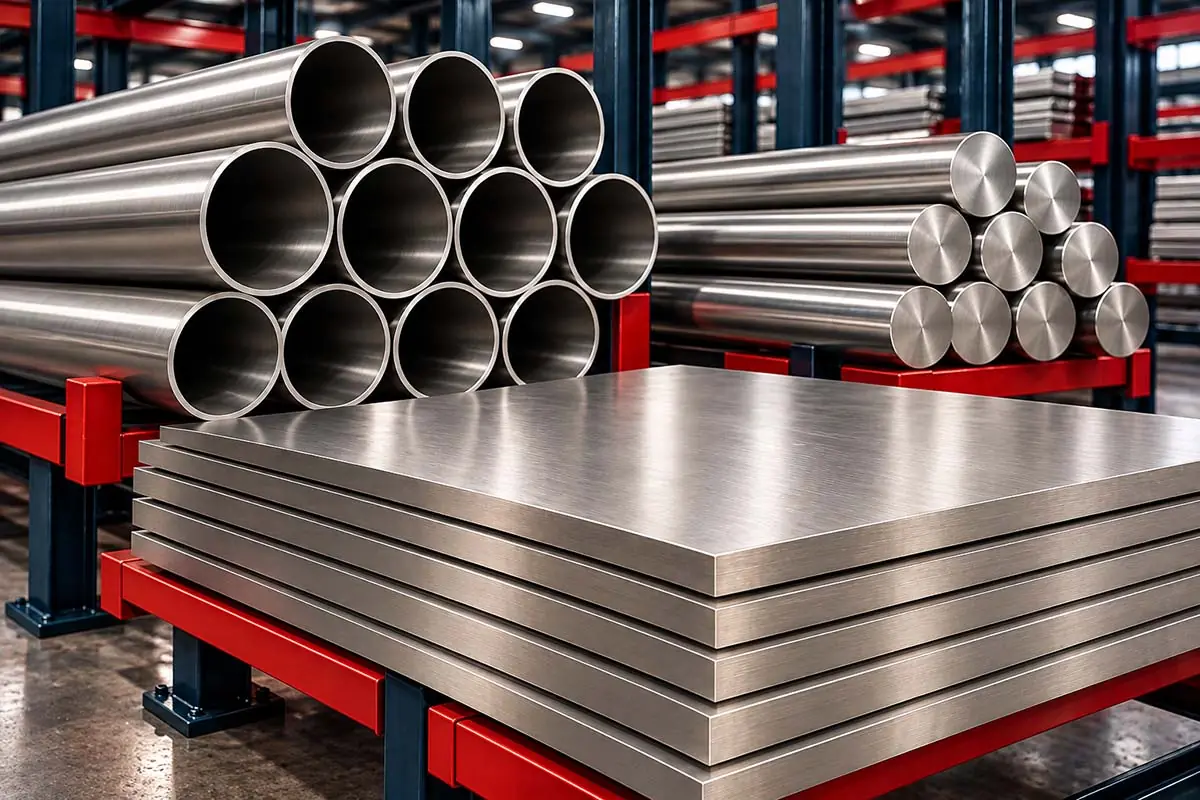
Giriraj Impex supplies SS 321 in every product form – we manufacture flanges, fittings, bars and fasteners, and stock and supply pipes, tubes, plates and sheets.
Chemical composition
| Grade | UNS | C | Mn | Si | P | S | Cr | Ni | Mo | Other elements |
|---|---|---|---|---|---|---|---|---|---|---|
| 310S | S31008 | 0.08 | 2.00 | 1.50 | 0.045 | 0.030 | 24.0–26.0 | 19.0–22.0 | 0.75 | – |
| 321 | S32100 | 0.08 | 2.00 | 0.75 | 0.045 | 0.030 | 17.0–19.0 | 9.0–12.0 | – | N 0.10; Ti 5 × (C + N) min, 0.70 max |
| 904L | N08904 | 0.020 | 2.00 | 1.00 | 0.045 | 0.035 | 19.0–23.0 | 23.0–28.0 | 4.0–5.0 | Cu 1.0–2.0; N 0.10 |
Limits for plate, sheet and strip to ASTM A240. Pipe (A312), bar (A276/A479) and forging (A182) limits are similar; check the standard for the product form.
The titanium content must be at least five times the combined carbon and nitrogen, so that enough titanium is present to tie up the carbon. 321H has carbon between 0.04% and 0.10% and a titanium minimum based on carbon content, as given in the standard.
Mechanical properties
| Grade | Tensile strength, MPa (ksi) | Yield strength 0.2%, MPa (ksi) | Elongation, % | Hardness max |
|---|---|---|---|---|
| 310S | 515 (75) | 205 (30) | 40 | 217 HB |
| 321 | 515 (75) | 205 (30) | 40 | 217 HB |
| 904L | 490 (71) | 220 (31) | 35 | 90 HRB |
Values for plate, sheet and strip to ASTM A240.
At room temperature 321 has properties similar to 304. Its advantage appears at elevated temperatures, where it keeps higher creep and rupture strength than 304L and 316L.
Equivalent grades
| Grade | UNS | EN number | EN name | JIS | BS |
|---|---|---|---|---|---|
| 310S | S31008 | 1.4845 | X8CrNi25-21 | SUS310S | 310S16 |
| 321 | S32100 | 1.4541 | X6CrNiTi18-10 | SUS321 | 321S31 |
| 904L | N08904 | 1.4539 | X1NiCrMoCu25-20-5 | SUS890L | 904S13 |
Equivalent grades are similar but not identical; composition and property limits differ between standards. Order to the standard you need.
See the full grade equivalent chart for other grades and systems.
Physical properties
| Property | 310S | 321 | 904L |
|---|---|---|---|
| Density, g/cm³ | 7.9 | 7.9 | 8.0 |
| Melting range, °C | approx. 1400–1450 | approx. 1400–1425 | approx. 1300–1390 |
| Thermal conductivity at 100 °C, W/m·K | approx. 14 | approx. 16 | approx. 13 |
| Modulus of elasticity, GPa | approx. 200 | approx. 193 | approx. 195 |
| Magnetic (annealed) | No | No | No |
Typical values from recognised industry references, for guidance only; they are not specification limits.
Why stabilisation matters
In unstabilised grades such as 304, holding the steel between about 425 °C and 850 °C – during welding or in service – lets chromium carbides form along the grain boundaries. The metal next to the boundaries loses chromium and can corrode rapidly in some environments, a problem called sensitisation or intergranular corrosion. Low-carbon grades such as 304L reduce this risk for the short times involved in welding, but not for long service at temperature. In 321, titanium takes the carbon first, so the steel stays resistant even after long exposure. For maximum resistance, 321 can be given a stabilising heat treatment at around 900 °C.
In aqueous corrosion at room temperature, 321 performs much like 304. It is not as good as 316 in chlorides, as it contains no molybdenum.
SS 321 products we supply
- Seamless pipes and welded pipes – ASTM A312 TP321 / TP321H.
- Tubes – ASTM A213 and A269 TP321 for heat exchangers, superheaters and instrumentation.
- Flanges and forged fittings – ASTM A182 F321 / F321H.
- Butt-weld fittings – ASTM A403 WP321.
- Sheets and plates – ASTM A240 321, for expansion bellows, exhaust and heat shields.
- Round bars – ASTM A276 / A479 321.
All stainless steel grades and forms are on the stainless steel page.
Comparable grades
SS 304 / 304L is the general-purpose grade for ambient service and for welded equipment that does not run in the sensitising range for long. SS 347, stabilised with niobium instead of titanium, is used in similar conditions and is often preferred for welding consumables and for the highest temperatures because niobium carbides are more stable. SS 310S is used above the range of 321, for oxidation resistance up to about 1100 °C. For chloride service, 316L or higher alloys are chosen.
Typical applications of SS 321
321 is used for aircraft and automotive exhaust systems and manifolds, expansion bellows and joints, jet engine parts, furnace components, refinery and petrochemical heater tubes, high-temperature process piping, superheaters and reheaters in boilers, heat exchangers, thermal oxidisers, and chemical equipment that operates in the 425–900 °C range or is welded and later exposed to corrosive media.
Fabrication
321 forms well and is welded by all common processes. Because titanium does not transfer well across the welding arc, 321 is normally welded with 347 filler metal, which is stabilised with niobium. Post-weld heat treatment is not needed for corrosion resistance. Titanium-rich particles can make 321 slightly less suitable for high polish than 304; for decorative polished surfaces, 304 is preferred.
Frequently Asked Questions
SS 321 is an austenitic 18Cr-10Ni stainless steel stabilised with titanium, which prevents intergranular corrosion after exposure to 425–850 °C and gives good creep strength.
321 contains titanium, which stops chromium carbides forming at elevated temperature. It is used for welded parts and equipment running at 425–900 °C, where 304 could become sensitised.
SS 321 is UNS S32100 and 321H is UNS S32109. The EN equivalent is 1.4541 (X6CrNiTi18-10).
321 is normally welded with 347 filler metal, stabilised with niobium, because titanium does not transfer well across the arc.
Both are stabilised austenitic stainless steels; 321 uses titanium and 347 uses niobium. 347 is often preferred for welding consumables and the highest temperatures.
SS 321 is used for exhaust systems, expansion bellows, furnace parts, heater tubes, superheaters, heat exchangers and high-temperature process piping.
Request a Quote
Tell us the product, grade, size, standard, quantity and delivery location, and our sales team will reply with a quotation.