
SS 304 / 304L – Chemical Composition, Equivalents & Products
SS 304 is the most widely used stainless steel – an austenitic 18% chromium, 8% nickel alloy (often called 18-8) with good corrosion resistance, excellent formability and weldability, and toughness down to cryogenic temperatures. SS 304L is the low-carbon version, with a carbon limit low enough to avoid sensitisation in the heat-affected zone of welds, so it is the usual choice for welded equipment. Most material today is dual certified as 304/304L.
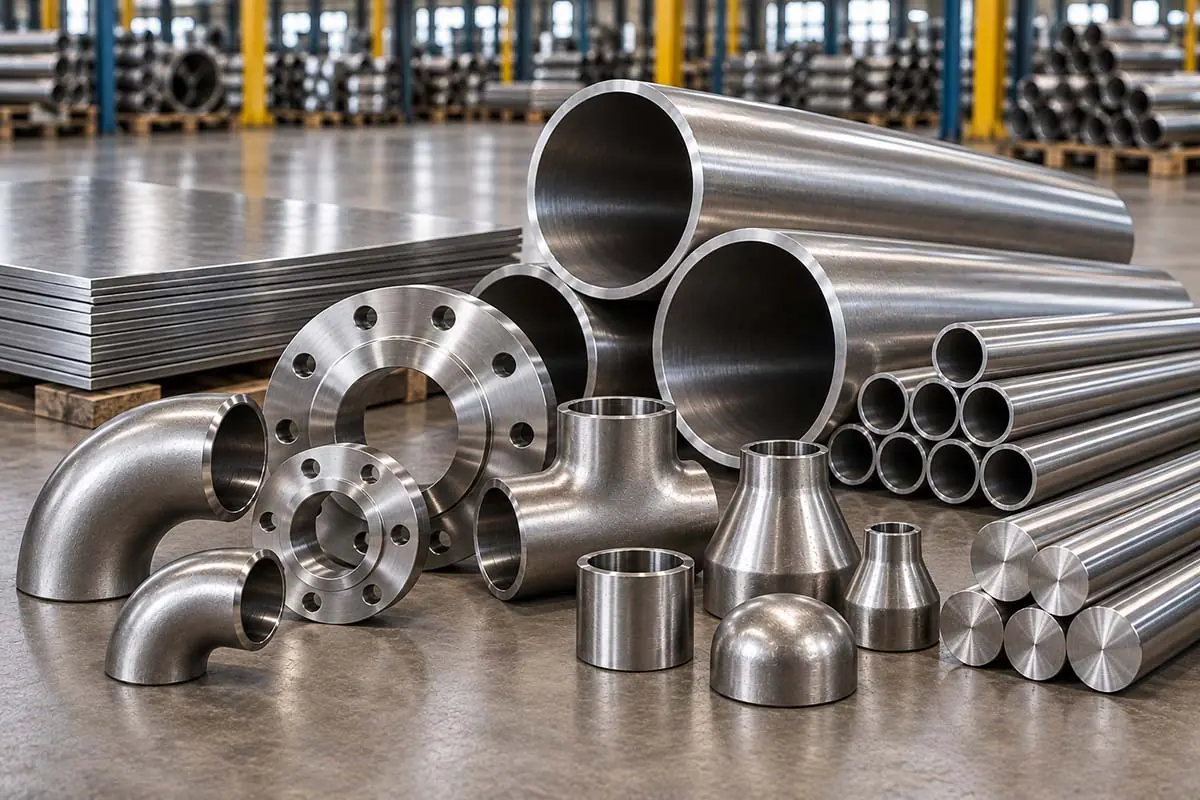
Giriraj Impex supplies SS 304 and 304L in every product form – we manufacture flanges, fittings, bars and fasteners, and stock and supply pipes, tubes, plates and sheets. This page gives the composition, properties and equivalent designations of the grade.
Chemical composition
Composition limits differ slightly between product standards. The tables below give the limits for plate and sheet to ASTM A240 and for pipe to ASTM A312; the mill test certificate shows the standard and the actual analysis.
| Grade | UNS | C | Mn | P | S | Si | Cr | Ni | Mo | N |
|---|---|---|---|---|---|---|---|---|---|---|
| 304 | S30400 | 0.07 | 2.00 | 0.045 | 0.030 | 0.75 | 17.5–19.5 | 8.0–10.5 | – | 0.10 |
| 304L | S30403 | 0.030 | 2.00 | 0.045 | 0.030 | 0.75 | 17.5–19.5 | 8.0–12.0 | – | 0.10 |
| 316 | S31600 | 0.08 | 2.00 | 0.045 | 0.030 | 0.75 | 16.0–18.0 | 10.0–14.0 | 2.00–3.00 | 0.10 |
| 316L | S31603 | 0.030 | 2.00 | 0.045 | 0.030 | 0.75 | 16.0–18.0 | 10.0–14.0 | 2.00–3.00 | 0.10 |
Other elements and footnotes as given in the standard.
| Grade | UNS | C | Mn | P | S | Si | Cr | Ni | Mo |
|---|---|---|---|---|---|---|---|---|---|
| TP304 | S30400 | 0.08 | 2.00 | 0.045 | 0.030 | 1.00 | 18.0–20.0 | 8.0–11.0 | – |
| TP304L | S30403 | 0.035 | 2.00 | 0.045 | 0.030 | 1.00 | 18.0–20.0 | 8.0–13.0 | – |
| TP316 | S31600 | 0.08 | 2.00 | 0.045 | 0.030 | 1.00 | 16.0–18.0 | 10.0–14.0 | 2.00–3.00 |
| TP316L | S31603 | 0.035 | 2.00 | 0.045 | 0.030 | 1.00 | 16.0–18.0 | 10.0–14.0 | 2.00–3.00 |
Other elements and footnotes as given in the standard. Dual-certified material meets both grades.
Mechanical properties
| Grade | Tensile strength min, MPa (ksi) | Yield strength min, MPa (ksi) | Elongation in 50 mm min, % | Hardness max, HBW / HRB |
|---|---|---|---|---|
| 304 | 515 (75) | 205 (30) | 40 | 201 / 92 |
| 304L | 485 (70) | 170 (25) | 40 | 201 / 92 |
| 316 | 515 (75) | 205 (30) | 40 | 217 / 95 |
| 316L | 485 (70) | 170 (25) | 40 | 217 / 95 |
Values for annealed material.
304L has slightly lower minimum strength than 304 because of its lower carbon. Dual-certified 304/304L meets the low carbon of 304L and the strength of 304.
Equivalent grades
| Grade | UNS | EN number | EN name | JIS | BS |
|---|---|---|---|---|---|
| 304 | S30400 | 1.4301 | X5CrNi18-10 | SUS304 | 304S31 |
| 304L | S30403 | 1.4307 | X2CrNi18-9 | SUS304L | 304S11 |
| 316 | S31600 | 1.4401 | X5CrNiMo17-12-2 | SUS316 | 316S31 |
| 316L | S31603 | 1.4404 | X2CrNiMo17-12-2 | SUS316L | 316S11 |
Equivalent grades are similar but not identical; composition and property limits differ between standards. Order to the standard you need.
See the full grade equivalent chart for other grades and systems.
Physical properties
| Property | 304 / 304L | 316 / 316L |
|---|---|---|
| Density, g/cm³ | 7.9 | 8.0 |
| Melting range, °C | approx. 1400–1450 | approx. 1375–1400 |
| Thermal conductivity at 100 °C, W/m·K | approx. 16 | approx. 16 |
| Modulus of elasticity, GPa | approx. 193 | approx. 193 |
| Magnetic (annealed) | No | No |
Typical values from recognised industry references, for guidance only; they are not specification limits.
Corrosion and heat resistance
304 resists atmospheric corrosion, fresh water, most foods and beverages, many organic chemicals and dilute or cold mineral acids. It is not suitable for chloride-rich environments such as seawater, brine or warm coastal splash, where pitting and crevice corrosion occur and stress corrosion cracking can follow above about 60 °C – 316L or duplex is used there. 304 has good oxidation resistance in intermittent service up to roughly 870 °C, but prolonged exposure between about 425 °C and 860 °C can sensitise standard-carbon 304; 304L avoids this during welding, and 304H or stabilised 321 is chosen for sustained high-temperature service. Annealed 304 is non-magnetic but can become slightly magnetic after cold work.
SS 304 products we supply
- SS 304 pipes – seamless and welded, ASTM A312 TP304/304L.
- SS 304 sheets and plates – ASTM A240 304/304L.
- SS 304 round bars – ASTM A276/A479.
- Flanges (A182 F304/304L), butt-weld fittings (A403 WP304/304L) and fasteners (A193 B8 / A194 Grade 8) – see the stainless steel page for every form.
Comparable grades
SS 316 adds 2–3% molybdenum for better resistance to chlorides and many acids; it costs more but is the standard step up where 304 pits. SS 202 replaces part of the nickel with manganese and nitrogen; it is cheaper and suits indoor, light-duty uses, but has lower corrosion resistance than 304 and is not used for process equipment. Ferritic 430 is cheaper again and magnetic, for appliances and trim.
Typical applications of SS 304
Because it combines corrosion resistance, hygiene, formability and moderate cost, 304 is found in more products than any other stainless steel: kitchen sinks and cookware, food and dairy processing equipment, brewery and beverage tanks, pharmaceutical utilities, hospital and laboratory furniture, architectural trim and handrails, water pipes and fittings, heat exchangers in clean service, chemical containers for mild chemicals, and cryogenic vessels for liquefied gases, where its toughness at very low temperature is valuable. Its limit is chloride exposure, where 316 or duplex takes over.
Fabrication
304 and 304L are easy to bend, roll, deep draw and spin, though they work-harden and need more force than mild steel. They weld readily by all common processes with 308L filler; 304L is preferred for heavy sections and multi-pass welds. After welding, heat tint is removed and the surface pickled and passivated. 304 machines less freely than mild steel; free-machining 303 is used for parts with heavy machining.
Frequently Asked Questions
SS 304 is an austenitic stainless steel with about 18% chromium and 8% nickel. To ASTM A240, chromium is 17.5–19.5%, nickel 8.0–10.5% and carbon 0.07% maximum.
304L has a lower maximum carbon content (0.030% in ASTM A240 against 0.07% for 304), which prevents sensitisation during welding. Its minimum strength is slightly lower. Material is often dual certified 304/304L.
SS 304 corresponds to EN 1.4301 (X5CrNi18-10) and 304L to EN 1.4307 (X2CrNi18-9). The Japanese equivalents are SUS304 and SUS304L.
No. 304 pits and suffers crevice corrosion in seawater and other chloride-rich environments. SS 316L, duplex or higher alloys are used for seawater service.
Annealed 304 is essentially non-magnetic. Cold working, such as bending or forming, can make it slightly magnetic, which does not affect its corrosion resistance.
The typical density of SS 304 is about 7.9 g/cm³ (7,900 kg/m³), which is used for weight calculations of pipes, plates and bars.
Request a Quote
Tell us the product, grade, size, standard, quantity and delivery location, and our sales team will reply with a quotation.