
SS 202 – Chemical Composition, Equivalents & Products
SS 202 is an austenitic stainless steel in the 200 series, in which part of the nickel of 304 is replaced by manganese and nitrogen. It contains about 17–19% chromium, 4–6% nickel and 7.5–10% manganese. This makes SS 202 lower in cost than 304, with higher strength, good formability and an attractive surface, but with lower corrosion resistance. In India it is widely used for kitchenware, furniture, railings, decorative tubes and other products for indoor and mild environments.
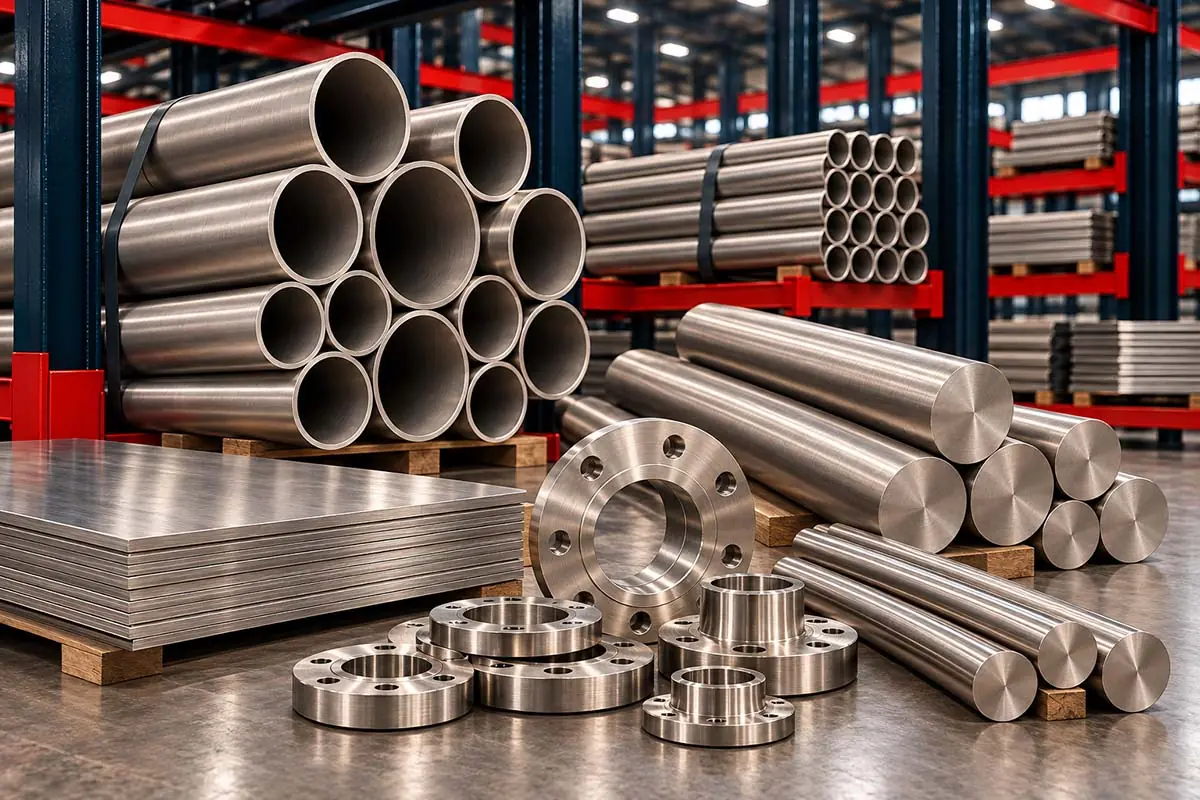
Giriraj Impex supplies SS 202 in common product forms – we manufacture flanges, fittings and bars, and stock and supply pipes, tubes and sheets.
Chemical composition
| Grade | C | Mn | Si | P | S | Cr | Ni | N |
|---|---|---|---|---|---|---|---|---|
| 202 (S20200) | 0.15 | 7.5–10.0 | 1.00 | 0.060 | 0.030 | 17.0–19.0 | 4.0–6.0 | 0.25 |
Limits for plate, sheet and strip to ASTM A240. Pipe and bar standards give similar limits.
Manganese and nitrogen keep the steel austenitic while using less nickel. The lower chromium-plus-molybdenum content compared with 316, and the higher sulphur tolerance of some commercial products, are the main reasons 202 has lower corrosion resistance than 304.
Mechanical properties
| Grade | Tensile strength, MPa (ksi) | Yield strength 0.2%, MPa (ksi) | Elongation, % | Hardness max |
|---|---|---|---|---|
| 202 | 620 (90) | 260 (38) | 40 | 241 HB |
Values for plate, sheet and strip to ASTM A240.
Nitrogen strengthens the austenite, so 202 has higher minimum strength than 304 (515 MPa tensile, 205 MPa yield in ASTM A240). It also work-hardens faster during forming.
Equivalent grades
| Grade | UNS | EN number | EN name | JIS | BS |
|---|---|---|---|---|---|
| 202 | S20200 | 1.4373 | X12CrMnNiN18-9-5 | SUS202 | 284S16 |
Equivalent grades are similar but not identical; composition and property limits differ between standards. Order to the standard you need.
See the full grade equivalent chart for other grades and systems.
Physical properties
| Property | 202 |
|---|---|
| Density, g/cm³ | 7.8 |
| Melting range, °C | approx. 1400–1450 |
| Thermal conductivity at 100 °C, W/m·K | approx. 16 |
| Modulus of elasticity, GPa | approx. 200 |
| Magnetic (annealed) | No; slightly magnetic after cold work |
Typical values from recognised industry references, for guidance only; they are not specification limits.
Corrosion resistance
SS 202 resists corrosion well indoors, in dry and clean atmospheres, and in contact with many foods for short periods. Outdoors, especially in coastal, humid or polluted environments, it is more likely than 304 to show surface rust staining and pitting, because of its lower nickel and the effect of manganese on the passive film. It is not recommended for chloride-bearing water, chemical process equipment or pressure piping in corrosive service. For these, SS 304 or SS 316 should be used.
SS 202 and Indian market grades
Much of the lower-nickel stainless steel sold in India for utensils, tubes and decorative products is made to commercial grades whose composition differs from the ASTM 202 limits – often with lower nickel and different manganese and copper levels. These are not the same as ASTM A240 202. Where performance matters, buyers should order to ASTM 202 (UNS S20200) or another recognised standard, and check the composition on the mill test certificate.
SS 202 products we supply
- Welded pipes and tubes – decorative, furniture, railing and structural tubes.
- Seamless pipes – on enquiry.
- Sheets and coils – 2B, BA and No. 4 finishes for kitchenware and panels.
- Flanges and pipe fittings – for low-pressure, non-corrosive service on request.
- Round bars and wire – for fasteners and general engineering.
All stainless steel grades and forms are on the stainless steel page.
SS 202 vs SS 304
SS 202 costs less than 304 because it contains less nickel, and it is slightly stronger. SS 304 has better corrosion resistance, better weldability for demanding applications and wider acceptance in food, pharmaceutical and process equipment. Both are non-magnetic when annealed, though 202 becomes slightly magnetic after cold work. A simple rule: 202 for indoor decorative and household products where cost matters, 304 where the product will be exposed to moisture, outdoor weather, food processing or chemicals.
Typical applications of SS 202
SS 202 is used for kitchen utensils and cookware, sinks, household appliances, furniture and fittings, railings and balustrades indoors, decorative and architectural tubes, automotive trim, hose clamps, and general fabrication in dry and mild environments.
Care and maintenance
To keep SS 202 products looking good, clean them regularly with mild detergent and water, rinse and dry, and avoid bleach, chloride-based cleaners and steel wool, which can leave iron particles that rust on the surface. Products used near the sea or in kitchens with salty steam need more frequent cleaning than 304 products in the same location.
Fabrication
202 forms well and is used for drawing and spinning, though it needs more force than 304 because it is stronger and work-hardens faster. It is welded by the common processes with 308L or other suitable austenitic filler metal; heat tint should be removed and welds pickled and passivated to restore corrosion resistance. Polished finishes should be protected during handling, and products for outdoor use should be cleaned regularly to prevent staining.
Frequently Asked Questions
SS 202 is a 200-series austenitic stainless steel in which part of the nickel is replaced by manganese and nitrogen. It costs less than 304 and is used for indoor and decorative products.
SS 202 contains less nickel and more manganese, so it is cheaper and slightly stronger, but less resistant to corrosion than 304.
Not in coastal, humid or polluted environments, where it can stain and pit. SS 304 or 316 is recommended for outdoor and wet service.
SS 202 is non-magnetic in the annealed condition but can become slightly magnetic after cold work.
SS 202 is UNS S20200. The EN equivalent is 1.4373 (X12CrMnNiN18-9-5).
SS 202 is used for many household utensils, but for food processing equipment SS 304 or 316 is the usual requirement because of their better corrosion resistance.
Request a Quote
Tell us the product, grade, size, standard, quantity and delivery location, and our sales team will reply with a quotation.