
Hastelloy C276 – Chemical Composition, Equivalents & Products
Hastelloy C276 (UNS N10276, WNR 2.4819) is a nickel-molybdenum-chromium alloy with tungsten, containing about 16% molybdenum, 16% chromium and 4% tungsten. It is one of the most corrosion-resistant alloys in general use, resisting reducing and oxidising acids, wet chlorine, hypochlorite and chlorine dioxide, and pitting, crevice corrosion and stress corrosion cracking in chlorides. Its very low carbon and silicon keep welds and heat-affected zones resistant to intergranular attack in the as-welded condition.
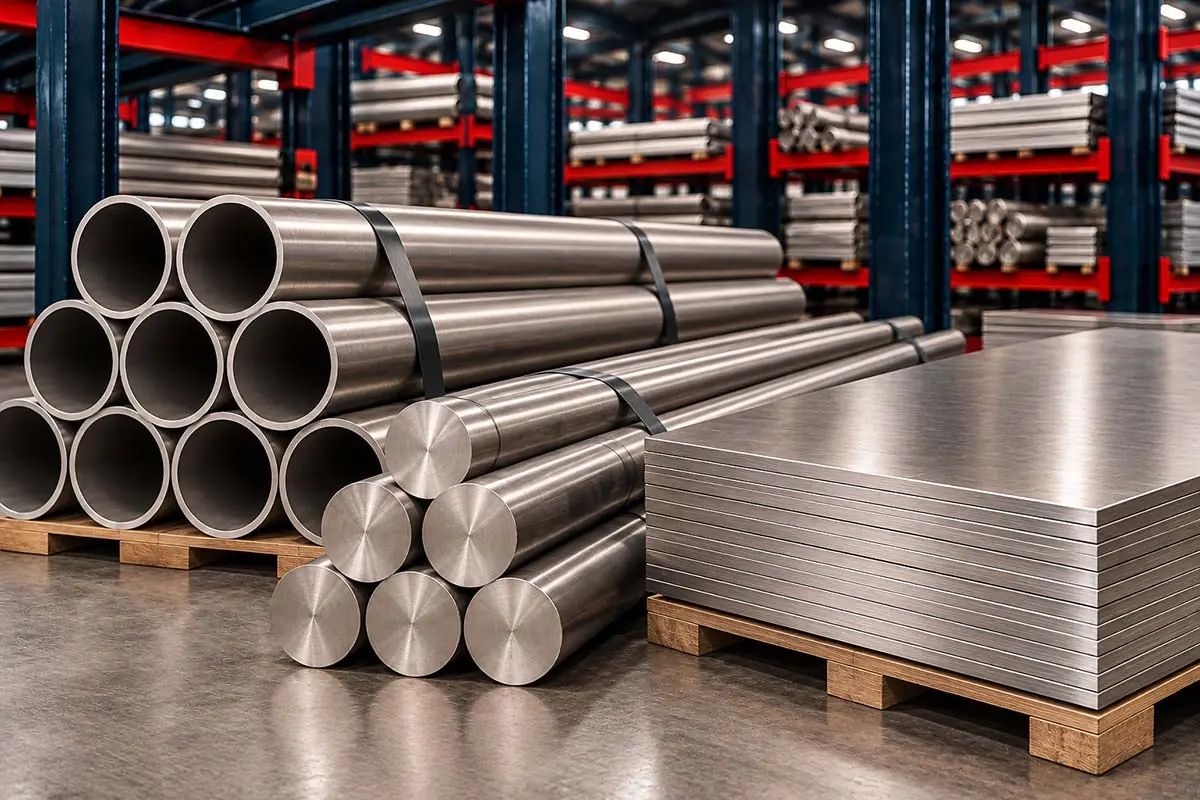
Giriraj Impex supplies Hastelloy C276 in every product form – we manufacture flanges, fittings, bars and fasteners, and stock and supply pipes, tubes, plates and sheets, to the ASTM B specifications for each form.
Chemical composition
| Alloy | Ni | Cr | Mo | Fe | W | Co | C | Si | Mn | V |
|---|---|---|---|---|---|---|---|---|---|---|
| C276 (N10276) | Balance | 14.5–16.5 | 15.0–17.0 | 4.0–7.0 | 3.0–4.5 | 2.5 | 0.010 | 0.08 | 1.00 | 0.35 |
| C22 (N06022) | Balance | 20.0–22.5 | 12.5–14.5 | 2.0–6.0 | 2.5–3.5 | 2.5 | 0.015 | 0.08 | 0.50 | 0.35 |
Phosphorus and sulphur limits as given in the standards.
The table includes Hastelloy C22 for comparison. In C276, molybdenum and tungsten give resistance to reducing acids and localised corrosion; chromium gives resistance to oxidising media.
Mechanical properties
| Alloy | Tensile strength, MPa (ksi) | Yield strength 0.2%, MPa (ksi) | Elongation, % |
|---|---|---|---|
| C276 (N10276) | 690 (100) | 283 (41) | 40 |
| C22 (N06022) | 690 (100) | 310 (45) | 45 |
Values for solution-annealed material as given in ASTM B575.
C276 is supplied solution annealed and rapidly cooled. It keeps good strength and ductility over a wide temperature range, and is used for pressure parts up to about 675 °C under ASME design rules, although it is chosen mainly for corrosion resistance rather than heat resistance.
Equivalent grades and physical properties
| Alloy | UNS | WNR (EN / DIN number) | DIN name |
|---|---|---|---|
| Inconel 600 | N06600 | 2.4816 | NiCr15Fe |
| Inconel 625 | N06625 | 2.4856 | NiCr22Mo9Nb |
| Incoloy 825 | N08825 | 2.4858 | NiCr21Mo |
| Monel 400 | N04400 | 2.4360 | NiCu30Fe |
| Hastelloy C276 | N10276 | 2.4819 | NiMo16Cr15W |
Equivalent designations are similar but not identical; order to the standard you need.
| Property | Inconel 600 | Inconel 625 | Incoloy 825 | Monel 400 | Hastelloy C276 |
|---|---|---|---|---|---|
| Density, g/cm³ | 8.47 | 8.44 | 8.14 | 8.80 | 8.89 |
| Melting range, °C | approx. 1354–1413 | approx. 1290–1350 | approx. 1370–1400 | approx. 1300–1350 | approx. 1323–1371 |
| Thermal conductivity, W/m·K | approx. 15 | approx. 10 | approx. 11 | approx. 22 | approx. 10 |
| Modulus of elasticity, GPa | approx. 207 | approx. 205 | approx. 196 | approx. 179 | approx. 205 |
Typical values from recognised industry references, for guidance only; they are not specification limits.
See the full grade equivalent chart for other grades.
Corrosion resistance
Hastelloy C276 resists a remarkably wide range of chemical environments: hydrochloric and sulphuric acids, hot contaminated mineral acids, organic acids, wet chlorine gas, hypochlorite and chlorine dioxide solutions, ferric and cupric chlorides, seawater and brines, and sour gas. With a pitting resistance equivalent number of about 65–70, it resists pitting and crevice corrosion in hot chloride solutions where stainless steels and lower nickel alloys fail, and its high nickel and molybdenum make it resistant to chloride stress corrosion cracking.
Its limits are hot, strongly oxidising acids such as concentrated nitric acid, where higher-chromium alloys perform better, and long exposure between about 650 °C and 1040 °C, which can form precipitates that reduce corrosion resistance and toughness.
Hastelloy C276 products we supply
- Pipes and tubes – seamless to ASTM B622, welded to B619 and B626.
- Plates and sheets – ASTM B575; see Hastelloy C276 sheets and plates.
- Round bars – ASTM B574.
- Flanges and forged fittings – ASTM B564.
- Butt-weld fittings – ASTM B366 WPHC276.
- Fasteners – from B574 bar; welding wire ERNiCrMo-4.
All Hastelloy alloys are on the Hastelloy page.
Comparable alloys
Hastelloy C22 has more chromium and less molybdenum, giving better resistance to oxidising media and to processes that alternate between oxidising and reducing conditions. Inconel 625 is stronger and suits oxidising and seawater service, but is less resistant to strongly reducing acids. Hastelloy B-2 and B-3 resist hydrochloric acid even better than C276 but fail in the presence of oxidising contaminants. Incoloy 825 and SS 904L are lower-cost options for milder conditions.
Typical applications of Hastelloy C276
Hastelloy C276 is used for flue-gas desulphurisation scrubbers, ducts, dampers and stack liners, pulp and paper bleach plants, chemical and pharmaceutical reactors, heat exchangers, evaporators and transfer piping, chlorination systems, sulphuric acid plants, pickling equipment, waste incineration and treatment, sour gas production equipment and downhole components, and seawater and brine service where other alloys would pit.
Fabrication
Hastelloy C276 is welded by TIG, MIG and manual arc processes using matching ERNiCrMo-4 filler or matching electrodes, with low heat input and interpass temperatures kept low to limit the time in the precipitation range. Joints must be clean and free of contaminants. Because of its low carbon and silicon, C276 can be used as welded for most corrosive service, without post-weld heat treatment. It work-hardens quickly in forming and machining; rigid tooling and sharp carbide tools are needed.
Frequently Asked Questions
Hastelloy C276 (UNS N10276) is a nickel-molybdenum-chromium-tungsten alloy that resists a very wide range of acids, chlorides, wet chlorine and other severe chemical environments.
The Werkstoff number of Hastelloy C276 is 2.4819, with the DIN name NiMo16Cr15W.
C22 has more chromium and less molybdenum, giving better resistance to oxidising media. C276 is preferred in strongly reducing acids such as hydrochloric acid.
ERNiCrMo-4 is the matching filler metal for Hastelloy C276.
Yes. Its very low carbon and silicon keep welds resistant to intergranular corrosion, so post-weld heat treatment is not normally needed.
It is used for flue-gas scrubbers, bleach plants, chemical reactors and heat exchangers, chlorination systems, sulphuric acid plants and sour gas equipment.
Request a Quote
Tell us the product, grade, size, standard, quantity and delivery location, and our sales team will reply with a quotation.
Inconel® and Incoloy® are trademarks of Special Metals Corporation; Hastelloy® of Haynes International.