
Alloy 20 Flanges
Giriraj Impex is a manufacturer, stockist, supplier and exporter of Alloy 20 flanges from ASTM B462 / ASME SB462 forgings in UNS N08020. We manufacture Alloy 20 flanges to ASME B16.5 from ½" to 24" NB in Class 150 to 2500, to ASME B16.47 for larger sizes and to EN 1092-1, in weld neck, slip-on, blind, socket weld, threaded and lap joint types, with mill test certificates.
Alloy 20 flanges connect Alloy 20 pipe, valves and equipment in sulphuric acid, pickling and chemical service.
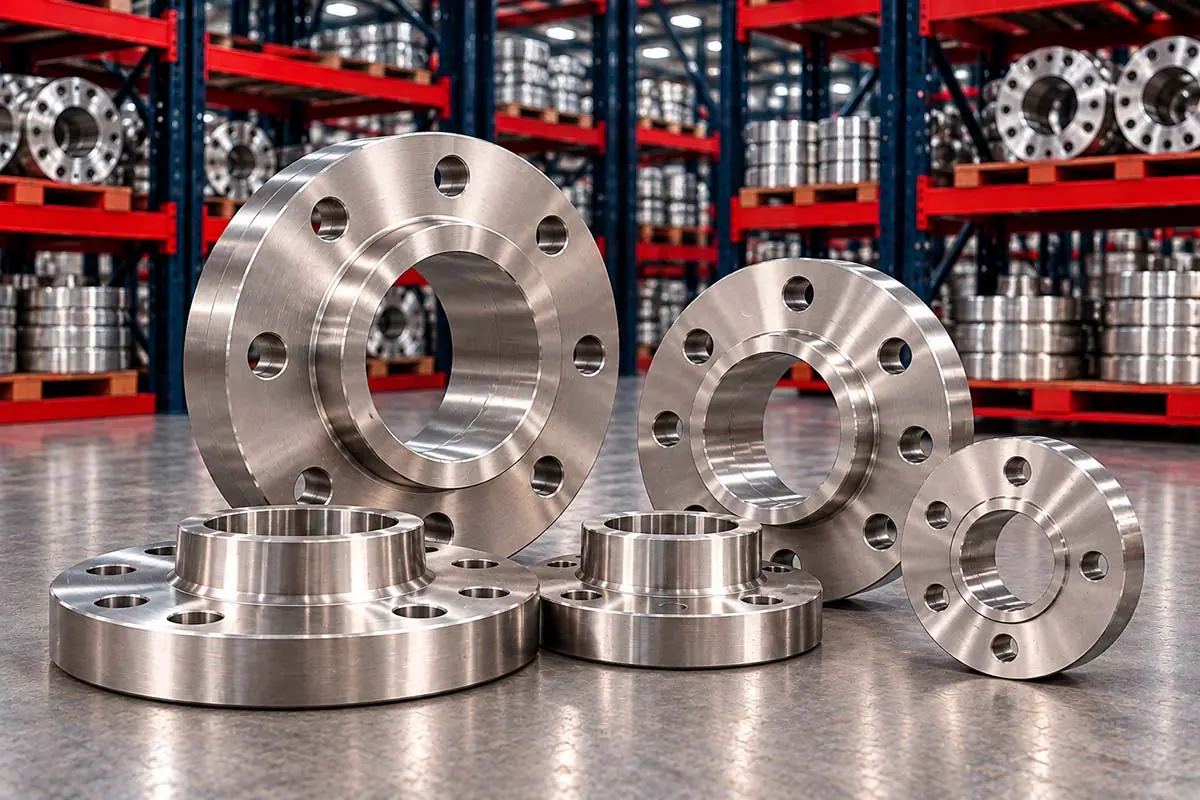
Specifications
| Item | Details |
|---|---|
| Material | ASTM B462 / ASME SB462 forgings, UNS N08020 |
| Dimensional standards | ASME B16.5, B16.47, B16.48; EN 1092-1 |
| Sizes | ½" to 24" NB (B16.5); larger to B16.47 |
| Classes | 150, 300, 600, 900, 1500, 2500 |
| Types | Weld neck, slip-on, blind, socket weld, threaded, lap joint, spectacle blind |
| Facings | RF, FF, RTJ |
| Condition | Annealed |
| Documents | Mill test certificate (MTC); third-party inspection on request |
Chemical composition and mechanical properties
| C | Mn | Si | P | S | Cr | Ni | Mo | Cu | Nb + Ta |
|---|---|---|---|---|---|---|---|---|---|
| 0.07 | 2.00 | 1.00 | 0.045 | 0.035 | 19.0–21.0 | 32.0–38.0 | 2.00–3.00 | 3.0–4.0 | 8 × C min, 1.00 max |
Limits as given in the ASTM B specifications for N08020.
| Product | Tensile strength, MPa (ksi) | Yield strength 0.2%, MPa (ksi) | Elongation, % |
|---|---|---|---|
| Plate, sheet and strip – ASTM B463 | 551 (80) | 241 (35) | 30 |
Pipe, bar and forging requirements are given in ASTM B464, B729, B473 and B462.
Actual values for each heat are reported on the mill test certificate.
Why Alloy 20
Alloy 20 is a niobium-stabilised nickel-iron-chromium alloy with molybdenum and copper, designed for sulphuric acid. It is chosen for sulphuric acid across a wide range of concentrations, phosphoric and nitric acids, pickling liquors and chloride-bearing water. Compared with 316L, Alloy 20 resists sulphuric acid and chloride stress corrosion cracking far better; compared with 904L it has higher nickel; for hot concentrated or heavily contaminated acids, Hastelloy C276 is used instead.
How we manufacture Alloy 20 flanges
Alloy 20 flanges are machined from forged blanks or rings of certified B462 material, forged to shape and annealed. Machining covers the bore, facing, hub, thickness and bolt holes to ASME B16.5 or the specified standard. Every flange is marked with grade, size, class, facing and heat number and inspected before dispatch.
Joint design in acid service
In sulphuric acid lines, flanged joints should be kept to the minimum, located away from where people pass, and fitted with spray shields. PTFE-based gaskets are the usual choice for acid service. Lap joint flanges with Alloy 20 stub ends and coated carbon steel backing flanges are an economical alternative to solid Alloy 20 flanges, since only the stub end is wetted. Bolting should be protected from acid drips, which attack carbon steel studs.
Welding and fabrication
Alloy 20 is welded by TIG, MIG and manual arc processes with matching ER320LR filler or suitable nickel-based fillers, on clean joints free of oil, paint, marking crayon, sulphur and lead, using low heat input and controlled interpass temperatures. Heat tint is removed and welds are pickled where corrosion resistance at the weld matters. Fabrication areas should be kept separate from carbon steel, and dedicated tools used to avoid iron contamination.
Testing and ordering
Common supplementary requirements are an intergranular corrosion test to ASTM A262, positive material identification and third-party inspection by the buyer's nominated agency. Please give the grade and specification, product type, size, schedule or class, quantity and any testing or inspection requirement with your enquiry. Each piece is marked with grade, specification, size and heat number, packed in wooden boxes or on pallets, and traceable to its mill test certificate.
Sizes, supply and packing
Flanges are bored to match the pipe schedule for weld neck and socket weld types, with a raised face serrated to ASME B16.5 or a smooth finish for special gaskets, and RTJ grooves for high-pressure classes. Faces are protected with covers or plywood discs, and flanges are packed in wooden boxes so that faces and bevels are not damaged in transit. Non-standard flanges – long weld necks, orifice flanges, reducing flanges and flanges to customer drawings – are made on request.
Certification and traceability
Alloy 20 is often confused with 300-series stainless steels and with other nickel alloys of similar appearance. Every piece carries its grade and heat number, and the mill test certificate reports the full chemistry – including nickel, copper, molybdenum and niobium – and mechanical properties. Positive material identification can be carried out before dispatch on request, and intergranular corrosion testing can be added where the end user specifies it.
Applications and related products
Alloy 20 flanges are used in sulphuric acid plants, pickling lines, phosphoric acid and fertiliser plants, and chemical and pharmaceutical processing. Matching products include Alloy 20 pipes and tubes, Alloy 20 sheets and plates, Alloy 20 round bars and Alloy 20 pipe fittings. Background on the alloy is on the Alloy 20 page. Flanges in other materials are on the flanges page.
Frequently Asked Questions
Alloy 20 flanges are made from forgings to ASTM B462 (ASME SB462), with dimensions to ASME B16.5, B16.47 or EN 1092-1.
PTFE-based gaskets are the usual choice for sulphuric acid service.
Yes. Alloy 20 stub ends can be supplied with coated carbon steel backing flanges.
Class 150 to 2500 to ASME B16.5 and B16.47.
UNS N08020 is the designation for Alloy 20, a nickel-iron-chromium alloy for sulphuric acid service.
Yes, along with weld neck, slip-on, socket weld, threaded and lap joint flanges.
Request a Quote for Alloy 20 Flanges
Tell us the product, grade, size, standard, quantity and delivery location, and our sales team will reply with a quotation.
Hastelloy® is a trademark of Haynes International.