
Blind Flanges
Giriraj Impex is a manufacturer, stockist, supplier and exporter of blind flanges to ASME B16.5 from ½" to 24" NB and ASME B16.47 Series A and B from 26" to 60" NB, in Class 150, 300, 400, 600, 900, 1500 and 2500, and to EN 1092-1 Type 05. We manufacture blind flanges in stainless steel, carbon steel, alloy steel, duplex and super duplex steel and nickel alloys, with raised face, flat face and ring type joint facings, with mill test certificates.
A blind flange is a solid disc that closes the end of a pipe, valve or vessel nozzle. It is used at line ends, for future connections, test points and inspection openings, and wherever a line must be isolated or opened for access.
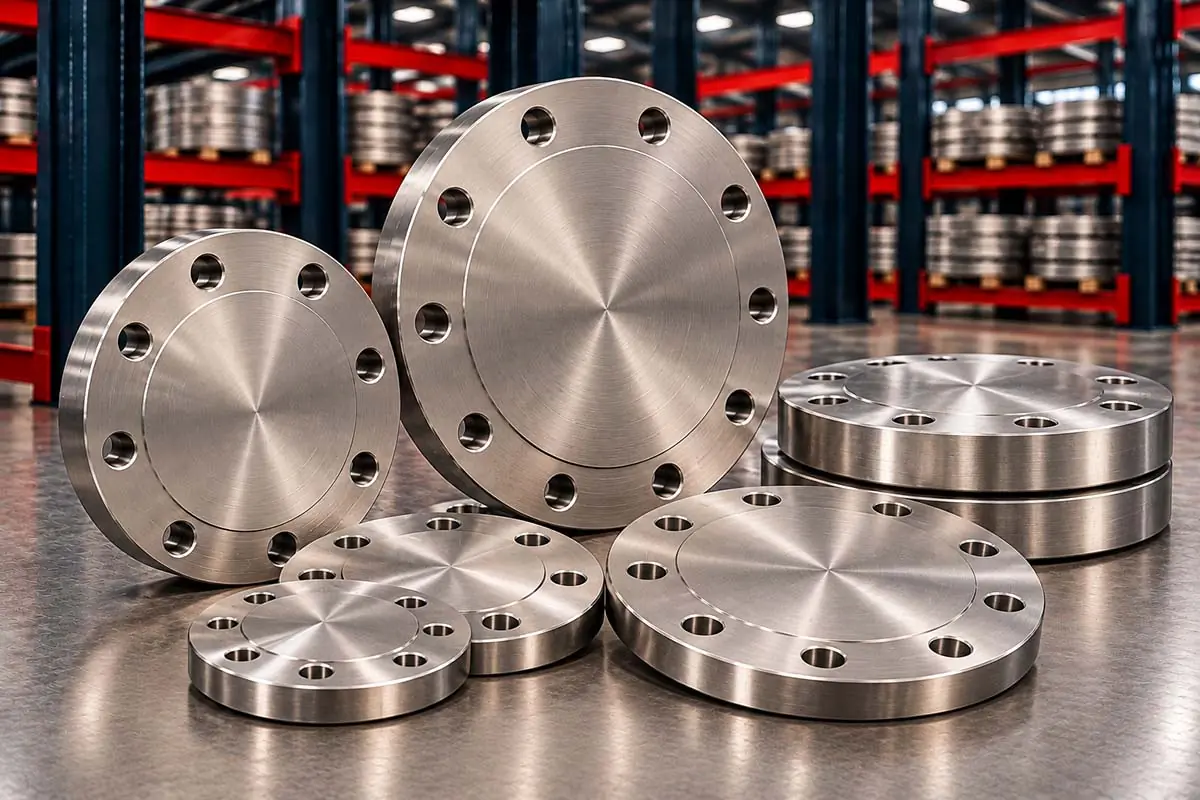
What is a blind flange?
A blind flange has the same outside diameter, bolt circle and facing as other flanges of its size and class, but no bore. Bolted to a mating flange with a gasket, it seals the opening completely. Because it carries the full pressure load across its face, a blind flange is subject to higher bending stress than other flange types, especially in large sizes – which is why its thickness is set by class in ASME B16.5. Blind flanges can also be supplied with a tapped hole for a vent, drain or instrument connection.
Specifications
| Item | Details |
|---|---|
| Dimensional standards | ASME B16.5, B16.47 Series A and B; EN 1092-1 Type 05; MSS SP-44 |
| Sizes | ½" to 24" NB (B16.5); 26" to 60" NB (B16.47) |
| Classes | 150, 300, 400, 600, 900, 1500, 2500; PN ratings to EN 1092-1 |
| Facings | Raised face (RF), flat face (FF), ring type joint (RTJ), tongue and groove |
| Options | Tapped centre hole, lining or overlay on the wetted face |
| Documents | Mill test certificate (MTC); third-party inspection on request |
Blind flange materials
- Stainless steel flanges – ASTM A182 F304/304L, F316/316L, F321, F347.
- Carbon steel flanges – ASTM A105, A350 LF2, A694 F42–F70.
- Alloy steel flanges – ASTM A182 F5, F9, F11, F22, F91.
- Duplex steel flanges – ASTM A182 F51, F60.
- Super duplex flanges – ASTM A182 F53, F55.
- Inconel flanges – ASTM B564 alloys 600 and 625, and other nickel alloys.
All flange materials are on the flanges page.
Blind flange thickness by class
| NPS | Class 150 | Class 300 | Class 600 |
|---|---|---|---|
| ½ | 9.6 | 12.7 | 14.3 |
| ¾ | 11.2 | 14.3 | 15.9 |
| 1 | 12.7 | 15.9 | 17.5 |
| 1¼ | 14.3 | 17.5 | 20.7 |
| 1½ | 15.9 | 19.1 | 22.3 |
| 2 | 17.5 | 20.7 | 25.4 |
| 2½ | 20.7 | 23.9 | 28.6 |
| 3 | 22.3 | 27.0 | 31.8 |
| 4 | 22.3 | 30.2 | 38.1 |
| 5 | 22.3 | 33.4 | 44.5 |
| 6 | 23.9 | 35.0 | 47.7 |
| 8 | 27.0 | 39.7 | 55.6 |
| 10 | 28.6 | 46.1 | 63.5 |
| 12 | 30.2 | 49.3 | 66.7 |
| 14 | 33.4 | 52.4 | 69.9 |
| 16 | 35.0 | 55.6 | 76.2 |
| 18 | 38.1 | 58.8 | 82.6 |
| 20 | 41.3 | 62.0 | 88.9 |
| 24 | 46.1 | 68.3 | 101.6 |
Dimensions are from ASME B16.5 (2013 and later editions) and are given for guidance. Minimum thickness excludes the raised face for Class 400 and above. Always check the current edition of the standard and the project specification. More classes and dimensions are in the flange dimensions chart.
Outside diameter, bolt circle and bolting for each class are the same as for other flanges of that class.
How we manufacture blind flanges
We manufacture blind flanges from forged discs or, where the specification allows, from plate of certified material. Machining covers the facing and face finish, the outside diameter, thickness and bolt holes. For large blind flanges in expensive alloys, a carbon steel blind with a corrosion-resistant overlay or lining on the wetted face can be supplied to reduce cost. Every flange is marked with material, size, class, facing and heat number and inspected before dispatch.
Blind flanges and spectacle blinds
Where a line must be isolated often, a spectacle blind, spade or spacer to ASME B16.48 placed between two flanges may be used instead of removing a blind flange. Blind flanges are used where the closure is permanent or opened only rarely, and at line ends and nozzles. See spectacle blinds for line blanks.
Ordering blind flanges
Please give the material, size, class, facing and face finish, any tapped hole, quantity and any testing such as ultrasonic testing, NACE MR0175 / ISO 15156 or third-party inspection. Flanges are packed in wooden boxes with faces protected.
Frequently Asked Questions
A blind flange is a solid flange without a bore, used to close the end of a pipe, valve or nozzle.
Thickness depends on size and class and is set in ASME B16.5. For example, a 4" Class 150 blind flange has a minimum thickness of 22.3 mm.
A blind flange carries the full pressure across its face, so higher pressure classes need thicker flanges to limit bending stress.
Yes. Blind flanges can be supplied with a tapped centre hole for a vent, drain or instrument connection.
A blind flange closes a line end; a spectacle blind is inserted between two flanges to isolate a line and can be swung open or closed.
ASME B16.5 covers NPS ½ to 24, ASME B16.47 covers NPS 26 to 60, and EN 1092-1 Type 05 covers metric blind flanges.
Request a Quote for Blind Flanges
Tell us the product, grade, size, standard, quantity and delivery location, and our sales team will reply with a quotation.
Inconel® is a trademark of Special Metals Corporation.