
Titanium Grade 2 – Chemical Composition, Equivalents & Products
Titanium Grade 2 (UNS R50400, WNR 3.7035) is commercially pure titanium, and the most widely used titanium grade for industrial equipment. It offers a good balance of moderate strength, excellent formability and weldability, and outstanding corrosion resistance in seawater, chlorides, wet chlorine and many oxidising chemicals, with a density only about 57% that of steel.
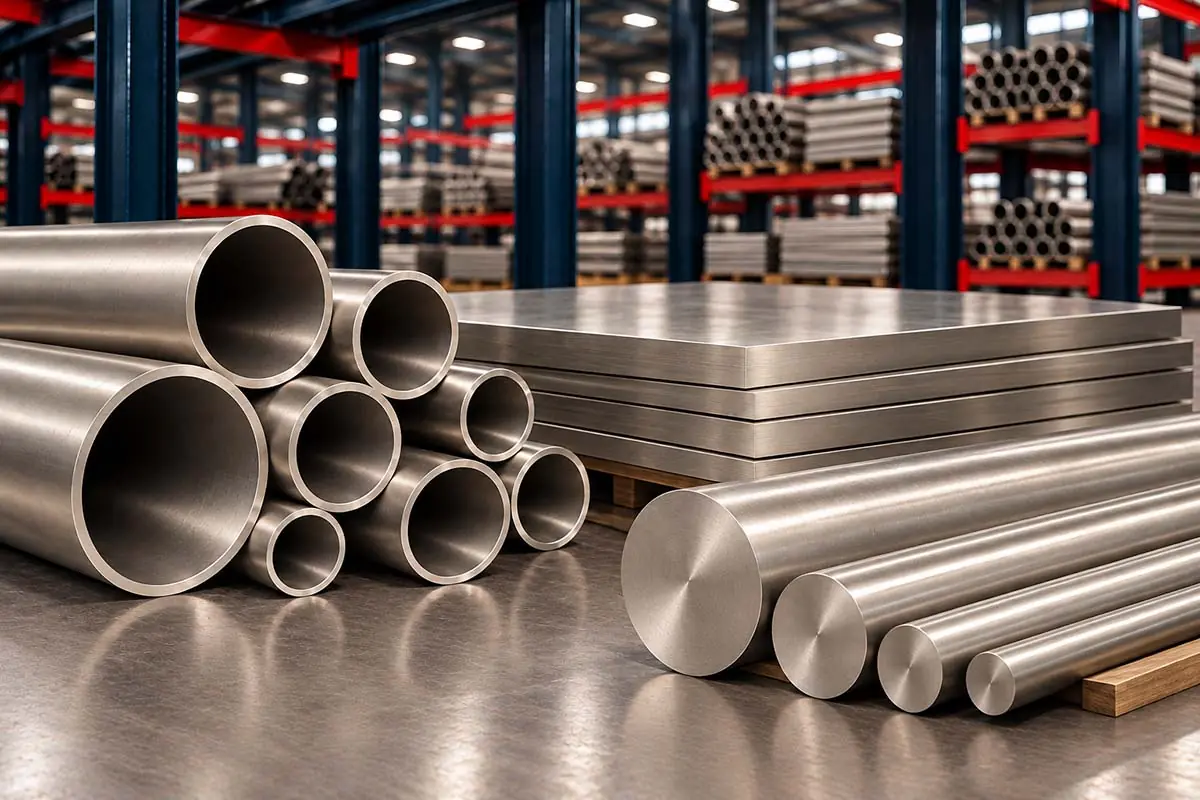
Giriraj Impex supplies titanium Grade 2 in every product form – we manufacture flanges, fittings, bars and fasteners, and stock and supply pipes, tubes, plates and sheets, to the ASTM B specifications for each form.
Chemical composition
| Grade | UNS | N | C | H | Fe | O | Al | V | Other |
|---|---|---|---|---|---|---|---|---|---|
| Grade 1 | R50250 | 0.03 | 0.08 | 0.015 | 0.20 | 0.18 | – | – | – |
| Grade 2 | R50400 | 0.03 | 0.08 | 0.015 | 0.30 | 0.25 | – | – | – |
| Grade 5 | R56400 | 0.05 | 0.08 | 0.015 | 0.40 | 0.20 | 5.5–6.75 | 3.5–4.5 | – |
| Grade 7 | R52400 | 0.03 | 0.08 | 0.015 | 0.30 | 0.25 | – | – | Pd 0.12–0.25 |
| Grade 12 | R53400 | 0.03 | 0.08 | 0.015 | 0.30 | 0.25 | – | – | Mo 0.2–0.4, Ni 0.6–0.9 |
Hydrogen limits differ slightly between product forms; residual element limits as given in each ASTM specification.
Grade 2 is unalloyed titanium; its strength is controlled by small amounts of oxygen and iron. Grade 1 has lower oxygen and iron and is softer; Grades 3 and 4 have more and are stronger.
Mechanical properties
| Grade | Tensile strength, MPa (ksi) | Yield strength 0.2%, MPa (ksi) | Elongation, % |
|---|---|---|---|
| Grade 1 | 240 (35) | 138 (20) | 24 |
| Grade 2 | 345 (50) | 275 (40) | 20 |
| Grade 5 | 895 (130) | 828 (120) | 10 |
| Grade 7 | 345 (50) | 275 (40) | 20 |
| Grade 12 | 483 (70) | 345 (50) | 18 |
Grades 1, 2 and 7 also have maximum yield strength limits. Values are typical of ASTM B265 and B348; check the specification for the product form.
Grade 2 has a minimum tensile strength of 345 MPa and a yield strength between 275 and 450 MPa. Its strength-to-weight ratio is similar to that of many structural steels, and it keeps good toughness at low temperatures.
Equivalent grades and physical properties
| ASTM grade | UNS | WNR (EN / DIN number) | Common name |
|---|---|---|---|
| Grade 1 | R50250 | 3.7025 | CP titanium, soft |
| Grade 2 | R50400 | 3.7035 | CP titanium |
| Grade 5 | R56400 | 3.7165 | Ti-6Al-4V |
| Grade 7 | R52400 | 3.7235 | Ti-0.15Pd |
| Grade 12 | R53400 | 3.7105 | Ti-0.3Mo-0.8Ni |
Equivalent designations are similar but not identical; order to the standard you need.
| Property | Grade 2 | Grade 5 |
|---|---|---|
| Density, g/cm³ | 4.51 | 4.43 |
| Melting point / range, °C | approx. 1665 | approx. 1604–1660 |
| Thermal conductivity, W/m·K | approx. 16 | approx. 7 |
| Modulus of elasticity, GPa | approx. 105 | approx. 114 |
| Magnetic | No | No |
Typical values from recognised industry references, for guidance only; they are not specification limits.
See the full grade equivalent chart for other grades.
Corrosion resistance
Titanium Grade 2 forms a thin, tightly adherent oxide film that heals itself instantly in air or water. As a result, it is practically immune to corrosion in seawater and most chloride solutions at normal temperatures, including pitting, crevice corrosion, erosion at high velocities and microbiologically influenced corrosion. It resists wet chlorine, hypochlorite and chlorine dioxide, nitric acid, many organic acids and oxidising salts.
Its limits are hydrofluoric acid and fluorides, hot concentrated reducing acids such as hydrochloric and sulphuric acid, dry chlorine, and crevice corrosion in hot chloride solutions above about 70 °C – where Grade 7 or Grade 12 is used. Hydrogen absorption can embrittle titanium in some conditions, which is considered in design.
Titanium Grade 2 products we supply
- Titanium pipes and tubes – seamless pipe to ASTM B861, welded pipe to B862, tubes to B338.
- Titanium sheets and plates – ASTM B265.
- Titanium round bars – ASTM B348.
- Titanium flanges – ASTM B381 F-2.
- Titanium pipe fittings – ASTM B363 WPT2.
- Titanium fasteners – from B348 bar.
All titanium grades are on the titanium page.
Comparable grades
Titanium Grade 5 (Ti-6Al-4V) is about two and a half times as strong and is used for high-strength parts, but is less formable and costs more. Grade 7 and Grade 12 add palladium or molybdenum and nickel for better crevice corrosion resistance in hot chlorides. Grade 1 is softer for deep forming. Among other alloys, Monel 400 is an alternative in flowing seawater and hydrofluoric acid, where titanium is unsuitable, and super duplex stainless steel is a lower-cost alternative for seawater at moderate temperatures.
Typical applications of titanium Grade 2
Titanium Grade 2 is used for condenser and heat-exchanger tubes in power stations and refineries, plate heat exchangers, desalination evaporators, offshore seawater cooling and firewater piping, chlor-alkali and chlorate plants, pulp and paper bleach plants, anodes and electroplating equipment, chemical reactors and storage tanks, marine hardware and architectural cladding.
Titanium Grade 2 in heat exchangers
Because titanium Grade 2 does not need a corrosion allowance in seawater, condenser tubes are typically made with thin walls, which gives good heat transfer and offsets much of the higher material cost. Its resistance to erosion allows higher water velocities than copper alloys, and its resistance to sulphide-polluted water makes it a common choice for coastal power stations.
Fabrication
Grade 2 forms well cold, with allowance for spring-back, and is welded by TIG or plasma with full inert-gas shielding of the weld pool, the cooling weld and the root side, because hot titanium absorbs oxygen and nitrogen and becomes brittle. Weld colour – bright silver to light straw – shows acceptable shielding. Machining uses sharp tools, low speeds, heavy feeds and plenty of coolant. Fabrication areas must be kept separate from carbon steel.
Frequently Asked Questions
Titanium Grade 2 (UNS R50400) is commercially pure titanium with moderate strength, excellent formability and weldability, and outstanding corrosion resistance.
The Werkstoff number of titanium Grade 2 is 3.7035.
Titanium Grade 2 has a density of about 4.51 g/cm³, about 57% that of steel.
Grade 1 has lower oxygen and iron, making it softer and more formable. Grade 2 is stronger and is the standard grade for most industrial equipment.
Yes. Titanium Grade 2 is practically immune to seawater corrosion at normal temperatures and is widely used for condensers, heat exchangers and seawater piping.
No. Titanium is non-magnetic.
Request a Quote
Tell us the product, grade, size, standard, quantity and delivery location, and our sales team will reply with a quotation.
Monel® is a trademark of Special Metals Corporation.