
Inconel 600 – Chemical Composition, Equivalents & Products
Inconel 600 (UNS N06600, WNR 2.4816) is a nickel-chromium-iron alloy with at least 72% nickel and about 15% chromium. It resists oxidation and carburisation at high temperatures, is practically immune to chloride stress corrosion cracking, and resists caustic soda, many organic compounds and dry chlorine. It keeps good strength and toughness from cryogenic temperatures up to about 1100 °C in oxidising atmospheres.
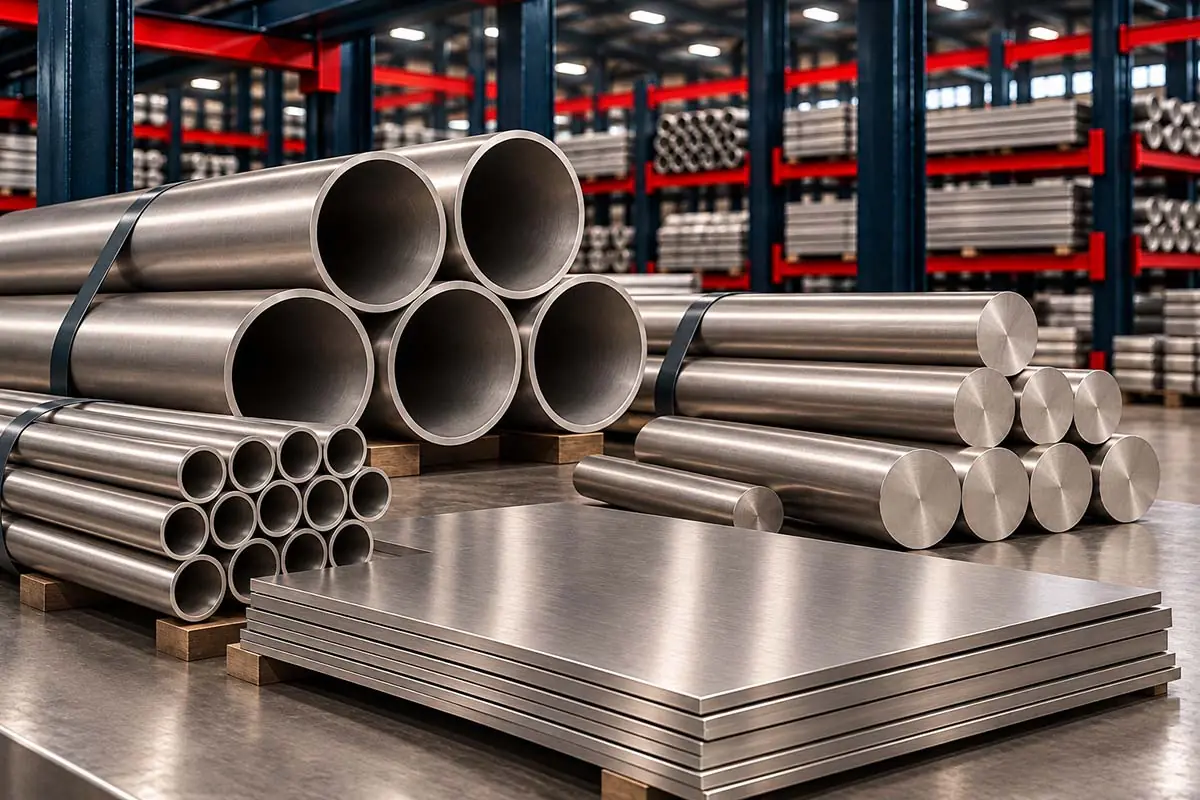
Giriraj Impex supplies Inconel 600 in every product form – we manufacture flanges, fittings, bars and fasteners, and stock and supply pipes, tubes, plates and sheets, to the ASTM B specifications for each form.
Chemical composition
| Alloy | Ni | Cr | Fe | Mo | Nb + Ta | C | Mn | Si | S | Other elements |
|---|---|---|---|---|---|---|---|---|---|---|
| 600 (N06600) | 72.0 min | 14.0–17.0 | 6.0–10.0 | – | – | 0.15 | 1.00 | 0.50 | 0.015 | Cu 0.50 |
| 625 (N06625) | 58.0 min | 20.0–23.0 | 5.0 | 8.0–10.0 | 3.15–4.15 | 0.10 | 0.50 | 0.50 | 0.015 | P 0.015, Al 0.40, Ti 0.40, Co 1.0 |
Nickel includes cobalt where stated in the standard. Footnotes as given in each ASTM specification.
The high nickel content gives Inconel 600 its resistance to chloride stress corrosion cracking and to alkaline solutions, while chromium provides resistance to oxidation and sulphur compounds at high temperature.
Mechanical properties
| Product | Tensile strength, MPa (ksi) | Yield strength 0.2%, MPa (ksi) | Elongation, % |
|---|---|---|---|
| Plate and sheet – ASTM B168 | 552 (80) | 241 (35) | 30 |
| Pipe and tube, cold worked and annealed – ASTM B167 | 552 (80) | 241 (35) | 30 |
| Rod and bar – ASTM B166 | 552 (80) | 241 (35) | 30 |
Annealed condition. Hot-finished and other conditions, and size limits, are as given in each standard.
Inconel 600 cannot be hardened by heat treatment; its strength can be raised only by cold work. It is used in the annealed condition for most applications, and in the solution-treated condition where creep strength above about 650 °C is needed.
Equivalent grades and physical properties
| Alloy | UNS | WNR (EN / DIN number) | DIN name |
|---|---|---|---|
| Inconel 600 | N06600 | 2.4816 | NiCr15Fe |
| Inconel 625 | N06625 | 2.4856 | NiCr22Mo9Nb |
| Incoloy 825 | N08825 | 2.4858 | NiCr21Mo |
| Monel 400 | N04400 | 2.4360 | NiCu30Fe |
| Hastelloy C276 | N10276 | 2.4819 | NiMo16Cr15W |
Equivalent designations are similar but not identical; order to the standard you need.
| Property | Inconel 600 | Inconel 625 | Incoloy 825 | Monel 400 | Hastelloy C276 |
|---|---|---|---|---|---|
| Density, g/cm³ | 8.47 | 8.44 | 8.14 | 8.80 | 8.89 |
| Melting range, °C | approx. 1354–1413 | approx. 1290–1350 | approx. 1370–1400 | approx. 1300–1350 | approx. 1323–1371 |
| Thermal conductivity, W/m·K | approx. 15 | approx. 10 | approx. 11 | approx. 22 | approx. 10 |
| Modulus of elasticity, GPa | approx. 207 | approx. 205 | approx. 196 | approx. 179 | approx. 205 |
Typical values from recognised industry references, for guidance only; they are not specification limits.
See the full grade equivalent chart for other grades.
Corrosion and heat resistance
At high temperatures, Inconel 600 forms a protective chromium oxide that resists oxidation up to about 1100 °C, and it resists carburising and nitriding atmospheres well, which makes it a standard material for furnace components and heat-treatment equipment. In aqueous service, its high nickel gives excellent resistance to caustic soda and other alkalis, to chloride stress corrosion cracking, and to high-purity water. It resists dry chlorine and hydrogen chloride at elevated temperatures. It is less resistant than molybdenum-bearing alloys to pitting in chlorides and to reducing acids, and in sulphur-bearing atmospheres at very high temperatures, alloys with more chromium may be preferred.
Inconel 600 products we supply
- Inconel pipes and tubes – seamless to ASTM B167, welded to B517; heat-exchanger tubes to B163.
- Inconel sheets and plates – ASTM B168.
- Inconel round bars – ASTM B166.
- Inconel flanges – from ASTM B564 forgings.
- Inconel pipe fittings – ASTM B366 WPNCI and forged fittings.
- Inconel fasteners – from B166 bar.
All Inconel alloys are on the Inconel page.
Comparable alloys
Inconel 625 adds molybdenum and niobium for much higher strength and resistance to pitting and acids, and is chosen for seawater and chemical service. Inconel 601 adds aluminium for better oxidation resistance at the highest temperatures. Incoloy 800H, with less nickel and more iron, offers high creep strength at lower cost and is widely used for reformer and furnace piping. Nickel 200 and 201 are used where even better caustic resistance is needed at moderate temperatures.
Typical applications of Inconel 600
Inconel 600 is used for furnace muffles, retorts, radiant tubes and trays, heat-treatment baskets and fixtures, thermocouple sheaths, heating-element sheathing, caustic soda evaporators and concentrators, chlorination equipment and titanium dioxide production, food-processing equipment, nuclear steam-generator components and reactor control-rod parts, jet engine and gas turbine components, and electronic parts.
Inconel 600 in nuclear and caustic service
In nuclear steam generators, Inconel 600 was historically used for tubing because of its resistance to chloride stress corrosion cracking; later designs moved to alloy 690 with higher chromium for better resistance to primary water stress corrosion cracking. In caustic soda plants, alloy 600 is used for evaporator tubes and concentrator equipment at temperatures and concentrations where stainless steels would crack.
Fabrication
Inconel 600 forms readily cold and hot, and is welded by TIG, MIG and manual arc using ERNiCr-3 filler metal or matching covered electrodes. Joints must be clean and free of sulphur, lead and other low-melting contaminants. Hot working is done in a sulphur-free atmosphere. Machining requires rigid set-ups and sharp tools because the alloy work-hardens. Post-weld heat treatment is not normally needed.
Frequently Asked Questions
Inconel 600 (UNS N06600) is a nickel-chromium-iron alloy with at least 72% nickel, used for high-temperature oxidation resistance and for caustic and chloride service.
The Werkstoff number of Inconel 600 is 2.4816, with the DIN name NiCr15Fe.
Inconel 600 resists oxidation up to about 1100 °C in air, and is used for furnace and heat-treatment components at high temperatures.
Inconel 625 contains molybdenum and niobium, giving much higher strength and better resistance to pitting and acids. Inconel 600 is used mainly for heat and caustic service.
No. Inconel 600 is not age hardenable; its strength can be increased only by cold work.
ERNiCr-3 filler metal, or matching covered electrodes, is used to weld Inconel 600.
Request a Quote
Tell us the product, grade, size, standard, quantity and delivery location, and our sales team will reply with a quotation.
Inconel® and Incoloy® are trademarks of Special Metals Corporation.